





.png?width=1230&height=692&name=Vector%20(13).png)
What Does It Mean to Lease Equipment?
Leasing IT equipment means renting laptops, servers, monitors, smartphones, and even furniture instead of purchasing them. The primary benefit of leasing is that it allows you to access hardware without making a huge upfront investment.
You can lease equipment, usually for a term of 12, 24, or 36 months in exchange for a fixed monthly or annual fee. This lease amount often includes bundled services such as setup, maintenance, warranty, and end-of-life handling (e.g., asset retrievals, disposals, and recycling).
And when the lease ends, you can renew it, buy the equipment, or return it, depending on the type of lease you’ve signed. Common types of leases include:
- Finance Lease (Capital Lease): Functions like a loan; you effectively own the equipment over time.
- $1 Buyout Lease: Ownership is guaranteed at the end for a nominal fee and the highest monthly payments.
- Operating Lease (True Lease): Rental model; return the equipment at the end with no ownership.
- FMV Lease (Fair Market Value): Lower payments with the option to return, upgrade, or buy at market value.
- Purchase Option Lease (e.g., 10%): Fixed buyout price at the end; balances cost and ownership flexibility.
- Leasing generally makes sense when you: Have distributed workforces or roles with high churn.
Note. Leasing is different from renting. It’s a long-term financing arrangement (12, 24, or 36 months, or even longer) that includes maintenance and support, with flexible end-of-life options.
Renting, on the other hand, is a short-term arrangement with no ownership or financial commitment beyond usage.
What Does It Mean to Buy Equipment?
Buying IT equipment simply means owning the assets you deploy within your company or to your remote employees. This involves paying the full value of the device upfront or through monthly payments (as a loan).
You own the devices from day 1 and control everything, from procurement and configuration to maintenance, retrievals, and disposal.
While leasing reduces your capital expenditure (CapEx), buying gives you more control over the devices and saves you operational expenditure (OpEx)
Buying IT equipment generally makes sense when:
- The roles you’re buying the devices for are stable
- Your industry demands more control.
- You have the internal capacity to manage the device lifecycle
Key Differences: Lease vs. Buy (Comparison Table)
Buying vs leasing IT equipment serves different business needs.
Leasing IT assets optimizes your cash flow and offers more flexibility and speed. Buying, on the other hand, offers ownership and control.
Here are the key differences between IT equipment leasing vs buying to help you make the right decision for your company:
|
Factor |
Buying |
Leasing |
|
Upfront cost |
High initial spend |
Low or no upfront cost |
|
Total cost (3–5 yrs) |
Lower overall cost (pay once, reuse, resell) |
Higher overall cost due to financing + margins |
|
Cash flow |
Capital tied up upfront |
Predictable monthly expense |
|
Asset ownership |
Full ownership + resale/redeployment value |
No ownership (unless buyout) |
|
Residual value |
Recover ~30–50% after 3 years |
No recovery (value retained by lessor) |
|
Tax treatment |
Potential upfront deduction (Section 179 + bonus depreciation) |
Deductions spread over the lease term (operating leases) |
|
Flexibility (lifecycle) |
Can extend usage to 4–5+ years |
Fixed term (2–3 years), early exit penalties |
|
Scalability |
Slower, requires procurement planning |
Faster, bundled sourcing and deployment |
|
Higher (procurement, tracking, recovery) |
Lower (outsourced lifecycle management) |
|
|
Maintenance & support |
Managed internally or via warranties |
Often bundled into a lease |
|
Device standardization |
Depends on internal processes |
Easier to enforce a standardized fleet |
|
Flexible (use as long as viable) |
Forced refresh cycles |
|
|
End-of-life handling |
Requires recovery, resale, and disposal processes |
Typically handled by the provider |
|
Risk (damage, loss) |
Internal responsibility |
Sometimes covered in the lease |
|
Best fit |
Stable teams, long usage, cost optimization |
High-growth teams, short cycles, cash flow focus |
Pros of Leasing Equipment
Here’s why leasing equipment makes sense:
1. Lower upfront costs, predictable monthly spend
While it may sound obvious, leasing equipment comes with lower upfront costs.
100 laptops at $2,500 each (warranties, add-ons) would cost you $250,000 upfront (for a 3-year term, assuming you turnover assets every 3 years). In contrast, you’d be spending $80,000–$100,000 a year if you leased.
On paper, this clearly looks like you’re paying way more by leasing IT equipment.
However, if you look at it from this IT director’s perspective on Reddit, selling the idea of $80,000-$100,000 annually (or ~$8,000 monthly) is easier than spending $240,000 to $300,000 every 3 years:

Source: Reddit
Plus, leasing gives you a stable budget year over year, which matters more to enterprises.
In a nutshell, leasing makes sense if you turn over devices regularly and need a stable budget.
2. Faster scaling across borders
If you’re managing workforces distributed across LATAM, EMEA, and APAC, it’s challenging to manually procure, configure, deploy, and retrieve assets.
Handling customs, local compliance, taxes, and multiple shipping vendors on your own is both time-consuming and expensive.
But when you lease IT assets, the provider handles all that for you.
Workwize, for instance, helps you procure, deploy, maintain, retrieve, and dispose of IT assets across 100+ countries. It takes care of international customs, import/export regulations, and duties, so you're not stuck navigating the logistics yourself. And with a vast network of local warehouses and vendors, on-time deliveries are rarely a concern.
3. Built-in maintenance and support
According to this IT director, having replacements and repairs covered under the lease terms is one of the main benefits of leasing equipment:

Source: Reddit
Now think about a real-world scenario. You’re headquartered in Kentucky, and a device breaks in Manila. In a traditional setup, your IT team would have to track warranty coverage and find a local vendor to repair the device. And in the meantime, you might also have to send in a replacement device.
That is a lot of moving parts for a single issue.
But the situation flips if you’re leasing the device. The provider will handle the repairs and replace the device with a loaner without your team stepping in. Work continues without disruption, and your IT team stays focused on higher-impact tasks instead of chasing operational issues.

4. Automatic refresh cycles
If you don’t have a fixed refresh cycle and devices older than 4-5 years old are still in use or sitting in your warehouses unattended, leasing can help.
Say you lease 10 MacBook Pros with the M5 chip in 2026 for 3 years. After three years, your MacBooks would become obsolete, since the newer ones would come equipped with M7 or M8 chips.
When your lease ends, the lessor will replace the older assets with newer ones. Or you can start a new lease with a different provider, based on your lease agreement.
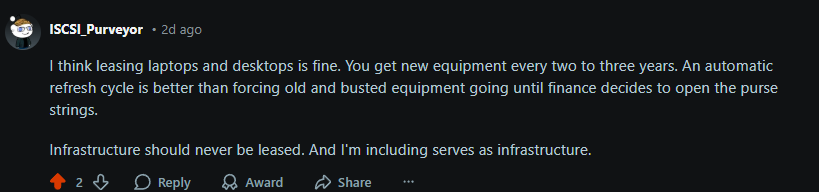
This Reddit user highlights how leasing automates and enforces refresh cycles:
Source: Reddit
Your organization will always have access to the latest technology, and the system will automatically handle older devices. This improves productivity, reduces the chances of non-compliance, and lowers the burden on internal IT.
5. Simplified offboarding
Manual IT offboarding involves:
- Retrieving the assets from employees
- Wiping them clean using certified tools
- Making the necessary repairs
- Reassigning, reselling, recycling, or disposing of assets
When you handle all these in-house, devices get lost, data security weakens, and resources are tied up.
Leasing changes that dynamic. Your lessor handles all of the above steps, ensuring a secure, compliant, stress-free, and automated offboarding.
Cons of Leasing IT Equipment
Here’s why leasing might not always be the right choice:
1. Higher total cost if your team is stable
Leasing makes sense for high-churn roles that require quick deployment, such as support staff and freelance contractors.
However, if you’re leasing equipment for stable or low-churn roles, you’re going to spend way more.
Let’s say an employee stays with your organization for 4-5 years. Leasing equipment for around $140 a month for 5 years would cost you $8,400. And buying that device would cost you around $3,500 (factoring in the add-ons, security tools, warranties, and repairs)
Even this assistant IT director on Reddit says the monthly cost of devices isn’t usually worth the money you saved by not spending upfront.

Source: Reddit
2. No ownership and thus no resale value
Based on the terms in the lease agreement, you can either return the equipment, renew the lease, or buy the equipment.
Finance leases (like $1 buyouts) allow you to own and resell the asset, but typically at a significantly higher total cost. True leases, on the other hand, offer lower monthly payments but no ownership or resale value.
However, if you pay $2,500 upfront for a laptop, you can resell the device and recover up to 45% of its value, bringing your total ownership cost to around $1,300. Now that’s way lower than the amount you’d pay over a 3-year lease.
3. Limited customization
When you’re leasing equipment, you have to choose from the catalog of equipment available with your lessor.
This arrangement can work for support, sales, HR, or operations because they don’t require any custom configuration or high-spec devices.
But for developers who need Linux workstations or AI or ML engineers who need powerful GPUs, leasing can be limiting. Because you have to adjust to whatever the provider offers.
In these scenarios, buying makes the most sense. You can customize the assets you own, however you like.

4. Vendor dependency
Say you sign a 3-year agreement with your lessor for 100 MacBook Pros. If their delivery or retrieval is slow, or their support is poor, you’re doomed for 3 years. And breaching the lease would also cost you a lot, depending on the terms.
Therefore, it’s important to choose the right vendor when leasing.
Pros of Buying IT Equipment
Based on the research and discussions on a Reddit post I created about Leasing vs Buying IT equipment, many experts lean toward buying over leasing for one simple reason. It gives you more control and often costs less in the long run.
Let’s break down why buying makes more sense:
1. Full ownership and control
Buying IT equipment gives you complete ownership and control. You don’t have to limit yourself to the vendor’s catalog.
You can choose exactly what your team needs and customize devices based on specific roles. That flexibility matters. Your developers might need Linux-based machines, while your design or video team needs high-performance rigs. Buying lets you make those decisions without compromise.
2. Lower total cost of ownership (TCO) for stable teams
Yes, leasing reduces upfront spend, but over time it’s significantly more expensive.
For example, buying a laptop for $2,500 and using it for 5 years costs about $500/year.
The same device, at $140/month, costs ~$1,680/year in lease payments. Over five years, that’s ~$5,900 more per device.
3. Tax benefits: Section 179 deduction
When you buy equipment, you can instantly unlock tax relief through the Section 179 deduction (US tax code). It allows businesses to deduct up to $1.2 million, reducing the taxable income and improving the cash flow.
However, when you lease, the deductions are spread over the lease term, which means the tax relief isn’t immediate.
Pro Tip: If your purchases exceed the set limit of Section 179, you can deduct the remaining under bonus depreciation.
4. Resale potential
You can always resell your assets as you please. For instance, global IT hardware management platforms like Workwize help you resell your assets and recover up to 45% of the residual value. This reduces your total cost of ownership and makes buying a smart decision.
5. No vendor lock-in or contract terms
Buying assets gives you the freedom to use them however you like. You can repair and refurbish, resell, donate, recycle, or dispose of as you please. No auto-renewals, no surprise fees, and no contract negotiations.
Cons of Buying IT Equipment
Buying IT assets up front has several disadvantages.
Let’s take a look at these drawbacks.
1. High upfront capital requirement
This is the biggest hurdle for most companies. Buying devices up front can be super expensive, especially for smaller companies struggling to manage their budgets.
Let’s say you’re buying MacBooks for 100 employees. You’re looking at around a $250,000 investment every 3-4 years.
And if you’re an enterprise that needs devices for 400-5000 employees, you’re easily looking at over a million dollars. Getting approval for that kind of spend is not easy, especially when budgets are tight.
This Reddit user says it’s easier to lease equipment as opposed to getting approval for a million dollars.

Source: Reddit
This type of large purchase puts pressure on your cash flow and limits how much you can invest in other areas, such as hiring, training, skill development, marketing, and more.
2. Procurement and setup burden
With leasing, it’s the lessor’s responsibility to procure, ship, retrieve, and dispose of assets as and when required. Also, they handle repairs and maintain the devices in the best possible condition.
Buying puts all that responsibility on your IT team. IT has to find the right vendors, negotiate prices, configure devices, handle customs & shipping, and more. The process is time-consuming, error-prone, and difficult to scale, especially for global teams.
Pro Tip: Whether you buy or lease, partnering with platforms like Workwize ensures you don’t have to handle the nuances of procurement, deployment, repairs, retrievals, and disposals.
Workwize automates the entire asset lifecycle, reducing IT overhead and making procurement and setup more scalable for global teams.

3. IT support overhead
Devices will fail at some point. That is unavoidable.
But when you own the hardware, your IT team is responsible for fixing those issues. In a global setup, this means coordinating repairs across different countries, sourcing local vendors, and arranging temporary replacements.
Delays are common, and employees may have to wait longer for a working device. Multiply this across teams and locations, and the operational load becomes hard to manage.
4. Risk of obsolescence
One of the major disadvantages of buying IT equipment is the risk that devices will become obsolete.
If you invest heavily in devices today, you are committing to using them for several years to justify the cost. For example, buying 100 MacBooks in 2026 means those devices will likely stay in use until at least 2030.
Upgrading earlier would require another large investment, which is not always feasible.
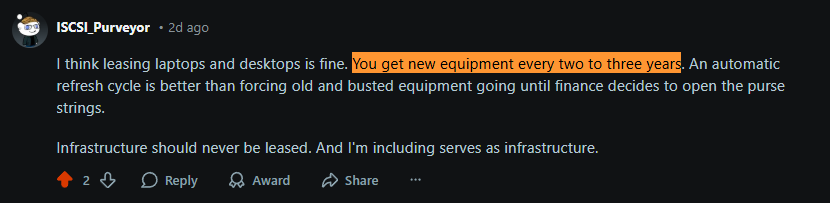
But with leasing, you can get new equipment every 2 or 3 years, just like this Reddit user says:
Source: Reddit
This model ensures the employees always have newer equipment at hand.
Cost Comparison: Buying vs. Leasing IT For 20 Employees
A real-world cost comparison between buying and leasing will make the decision-making a little easier.
Here’s what buying and leasing look like side-by-side when you equip 20 remote hires across 5 countries:
|
Cost Category |
Buying |
Leasing |
|
Upfront Cost |
$50,000 ($2,500 × 20 employees) |
$2,800 (first month) + possible deposit |
|
Procurement Time |
30–40 hours (sourcing, quotes, shipping) |
5–10 hours (catalog + approvals) |
|
Setup & Config |
Manual (internal IT, 2–3 days per batch) |
Preconfigured, ready-to-use |
|
Support Model |
Managed internally or through Workwize |
Provider handles repairs & replacements |
|
Year 1 Total |
~$55,000 (devices + shipping + setup) |
~$33,600 ($140/user/month × 20 × 12) |
|
Year 2 Total |
~$4,000 (maintenance, support, replacements) |
~$33,600 |
|
Year 3 Total |
~$4,000 |
~$33,600 |
|
3-Year Total |
~$63,000 |
~$100,800 |
|
5-Year Total |
~$75,000 |
~$168,000 |
|
Offboarding |
Manual retrieval, data wipe |
Pickup, secure wipe, tracked |
Note. These numbers don’t account for residual value. In practice, you can resell or redeploy the devices you own, recovering ~30–50% of value after 3 years. This further reduces the effective cost of buying, especially for stable teams.
Buying may look better on paper after 3-5 years, especially if your team is stable and devices are used for the full lifecycle. But that model also assumes you have internal resources to manage procurement, support, and recovery across countries.
Leasing prioritizes speed and simplicity. It reduces hidden overhead and lets you scale device operations without scaling your IT team.
Buying wins on total cost if your team stays intact for 3+ years. But that assumes:
- Zero turnover (unlikely)
- Internal IT can handle procurement, support, and retrieval at scale
- You have $50K in capital to deploy upfront
Leasing wins if:
- You're scaling quickly or have high turnover
- You need devices in multiple countries
- You lack internal IT resources
- Cash flow management is critical
Hybrid Model: When to Mix Buying and Leasing
If you operate globally and hire for both stable and high churn roles, you can mix buying and leasing to get the best of both worlds. Here’s what a hybrid model looks like in practice:
- Buy IT equipment for stable roles with low turnover, such as developers, senior engineers, and the exec team.
- And lease for high-turnover roles that require faster deployment, including contractors and support agents.
A SaaS company might buy MacBooks for its 30-person engineering team headquartered in Kentucky and lease laptops for a 50-person team distributed across India, the Philippines, Colombia, and Poland.
- You may also want to buy when you need specialized hardware, such as Linux-based workstations or GPU-heavy PCs for designers, or when you have strict data residency rules.
- Buy if you’re fine using the same hardware for 4-5 years and lease if your business demands fresh devices every 2-3 years.
Both leasing and buying have their pros and cons. But the goal is not to choose one and stick to it. It is to create a system that adapts to your business needs.

Making The Decision: Buying vs. Leasing Equipment
A Redditor sums up the buy vs. lease debate in a widely appreciated post:
“This has been an endless debate, and we have tried different models with our clients.
From a cost management perspective, OPEX (lease/rent) is best for small or very dynamic businesses as they struggle to plan financially. The cost of a laptop can be devastating to cash flow and budget.
For larger and financially mature organizations, CAPEX tends to be preferred. This allows financial controls for depreciation; it can be used to tie up year-end funds for taxes and more. The purchases become a tool.
As the service provider who sees the hardware costs, the liability, insurance, and team required to maintain such a program... the markup we have to put on rented/leased machines for it to make sense is extreme.
Add to this that we're seeing the lifespan of modern laptops go for 5-7 years, and my personal recommendation is to buy them. Rent/lease is more expensive and a huge hassle to manage.
Just make sure you are buying actual business-class machines. These typically run one generation behind, have significantly beefed-up cooling, and the components have been extensively tested with each other. On the Dell side, this means OptiPlex and Latitude. Perhaps others can pitch in with the equivalent for other brands. Do not use Vostro, Inspiron, XPS, etc.”
Here’s a powerful decision framework table that helps you instantly make the right choice for your situation.
|
Decision Factor |
Buy If… |
Lease If… |
|
Team Stability |
Headcount is stable, low turnover (<15%) |
Hiring fast or turnover is high (>20%) |
|
Geography |
1–2 countries, easy logistics |
3+ countries, cross-border complexity |
|
IT Bandwidth |
Dedicated IT team can handle lifecycle |
Lean IT, need outsourced operations |
|
Cash Flow Priority |
Optimizing for total cost (long-term savings) |
Optimizing for cash flow (low upfront, predictable spend) |
|
Device Type |
High-spec, customized, or security-sensitive setups |
Standardized laptops and peripherals |
|
Device Lifecycle |
Use devices 4–5+ years, redeploy internally |
Refresh every 2–3 years with minimal effort |
|
Asset Management Maturity |
Strong tracking, retrieval, and reuse processes |
Limited tracking, want built-in compliance |
|
Workforce Type |
Mostly long-term full-time employees (3+ years) |
Mix of contractors, temp, or short-term roles |
Use this framework as a starting point, not a rule. Most companies land somewhere in the middle, which is where hybrid models shine.
Our Take
After reviewing insights from IT professionals and real-world discussions, the pattern is clear.
- Buying is typically the more cost-efficient option, especially for stable teams that can use devices for 4–5 years and recover value through reuse or resale.
- Leasing is often positioned as the easier option because it offloads procurement, deployment, retrieval, repairs, and disposal. But platforms like Workwize now offer similar operational convenience even when you own the equipment.
- Leasing still makes sense for companies with limited capital, rapid hiring needs, or strict refresh cycles. But in most long-term scenarios, buying delivers better overall value.
In fact, this Reddit user says that the companies they have worked with have switched back to buying after trying to lease devices because of the higher costs:

Source: Reddit
How Workwize Simplifies IT Procurement (Buy, Lease, or Both)
Choosing between buying, leasing, or a hybrid model isn’t easy. Each option has trade-offs, and the right decision depends on your team size, growth pace, cash flow, and operational maturity.
But in practice, the bigger challenge isn’t the model. It's theexecution.
Managing procurement, deployment, tracking, and retrieval across 10 or more countries introduces layers of complexity. You are dealing with multiple vendors, customs regulations, compliance requirements, and logistics that most IT teams are not built to handle at scale. Small errors, such as delayed deliveries, directly impact the user onboarding experience and lead to employee turnover.
That’s why having the right partner matters more than the model itself.
Platforms like Workwize support buying, leasing, and hybrid strategies without forcing you into a single option. When you choose Workwize, you can
- Buy, lease, or rent IT equipment (laptops, servers, keyboards, furniture, and more)
- Have them deployed (pre-configured) in 100+ countries.
- Ensure fast deliveries because of the local vendor network and warehouses.
- Manage repairs and replacements without chasing multiple providers
- Enable zero-touch offboarding for smoother employee transitions
- Retrieve, refurbish, resell, recycle, or dispose of IT assets based on your preferences.
And throughout the entire lifecycle, you have visibility into all your assets in real-time. Want to see how Workwize works for teams that mix buying and leasing? Book a free demo now.

Establish a single source of truth for every IT asset across the globe.
.png?width=258&height=318&name=g10%20(5).png)

Get monthly insights into how other IT leaders are improving their ops.




.svg)
.svg)
.svg)
.svg)