




.png?width=1230&height=692&name=Vector%20(13).png)
Don’t want to spend $30K/year just to know who has what laptop?
That’s where open-source ITAM comes in.
These tools let you keep track of your IT assets without spending a fortune. Some of the good ones are as powerful as proprietary software.
In this article, we will cover four popular open-source IT asset management software.
TL;DR:
- In this article, we will learn about open-source ITAM, which involves tracking, managing, and optimizing assets using software with freely available source code.
- There are plenty of great options in this space. We picked Snipe-IT, OpenBoxes, Ralph, and GLPI.
- Open source comes with its perks; public code, low (if any at all) costs to run and maintain, and easier to run.

Why Choose Open Source for Asset Management?
Open source software has permeated the mainstream of corporate infrastructure.
82% of IT leaders say they will increase their use of enterprise open‑source software. That only means the model has won executive-level trust for critical workloads.
Asset management is no exception: when teams need control over hardware lifecycles but dislike being locked into vendor roadmaps, transparent code and permissive licenses become an advantage.
Here are some reasons why teams are gravitating towards open‑source:
- Total visibility: You can review the code for security, compliance, or data‑handling practices before deployment.
- Custom‑fit workflows: There’s the freedom to add lifecycle states or integrations without negotiating feature requests.
- Community momentum: You’re free to share best‑practice plugins, reports, and bug fixes with peers, which accelerates innovation for everyone.
Essentially, open source enables you to grow at the pace of your organization, rather than the pace set by your vendor.
Features You’ll Find in Open‑Source ITAM Software
Now, just because open-source software is open, are they all the same? Not exactly.
While each project has its own thing going on, the best‑in‑class open‑source tools share a foundation that lets them rival, or even surpass, expensive suites:
- Lifecycle checkpoints: Ordered - Received - Deployed - In Repair - Retired states (and any custom steps) for a verifiable audit trail.
- Relationship mapping: The ability to link assets to tickets, racks, or cloud instances so support teams see full context.
- API‑first design: REST or GraphQL endpoints that let you automate onboarding, bulk updates, and sync with CI/CD or ITSM stacks.
- Extensible plugin or module systems: Barcode generators, calculators, or multi-language packs are common examples.
As you read about our open-source picks below, you’ll see a lot of these features appear.
Our Picks: Open-Source ITAM Software
1. Snipe-IT
Via Snipe-IT
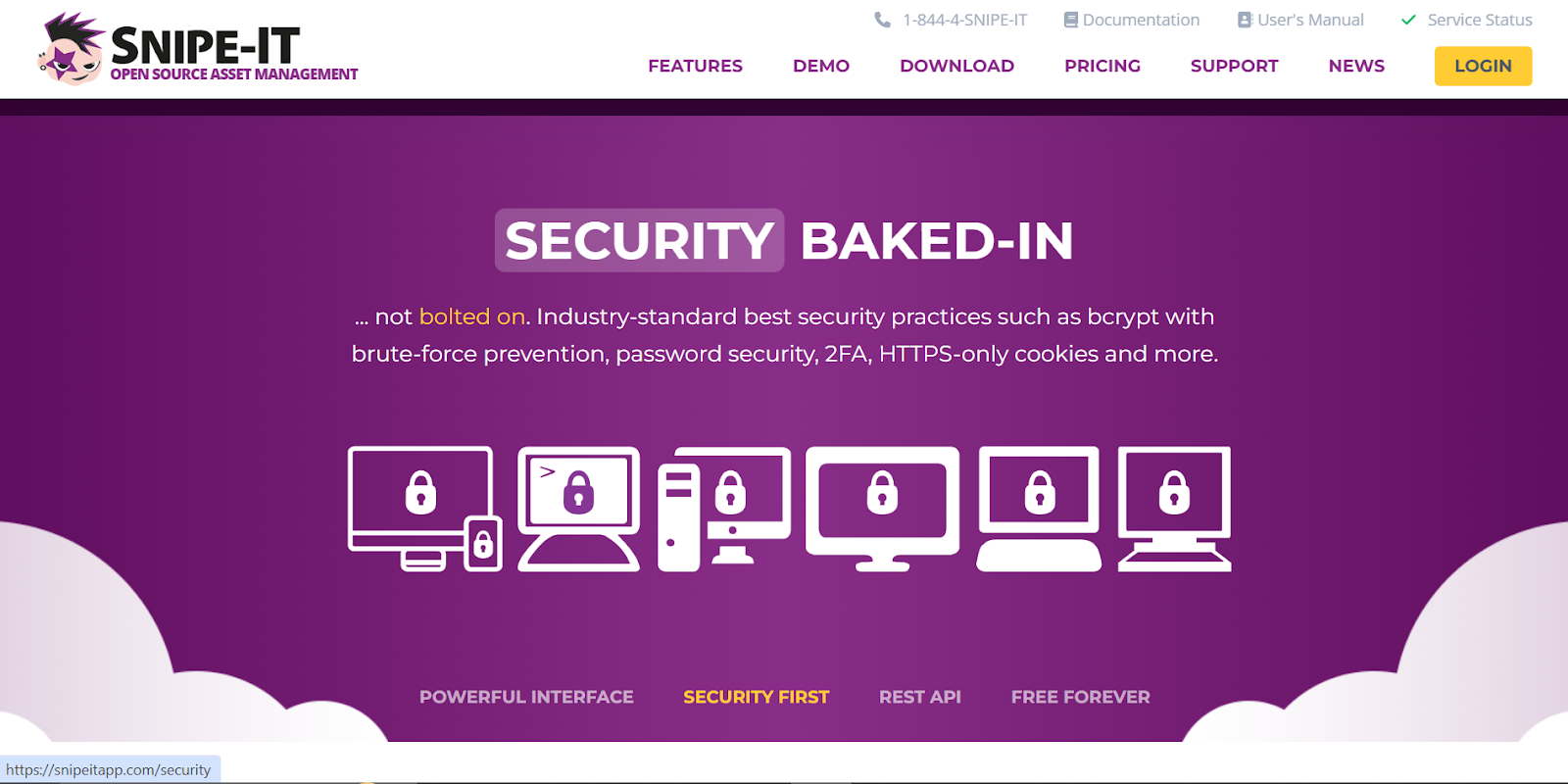
Snipe‑IT is a GPL‑licensed, web‑based platform that gives your IT team a clean control panel for every physical or virtual asset in care.
You host it on Linux, Windows, or macOS, point a browser at it, and start issuing hardware to people or locations immediately. Because the project has been under continuous development for more than a decade, the interface feels mature.
Snipe‑IT ships also with an automation-friendly REST API and email and Slack notifications for expiring warranties or overdue returns.
Snipe-IT best features
- Track every lifecycle event: Capture assignment, service, and retirement history in a single timeline.
- Automate with a REST API: Push or pull asset data from build pipelines, chatbots, or your ITSM tool.
- Generate barcode and QR labels: Print codes and scan them to update status in real-time.
Reviews and ratings
- G2: 4.6/5 (20+ reviews)
- Capterra: 4.4/5 (20+ reviews)
Pricing
- Self‑hosted Community: Free forever
- Small Business Hosting: $39.99/month (billed monthly, unlimited assets)
2. GLPI
Via GLPI
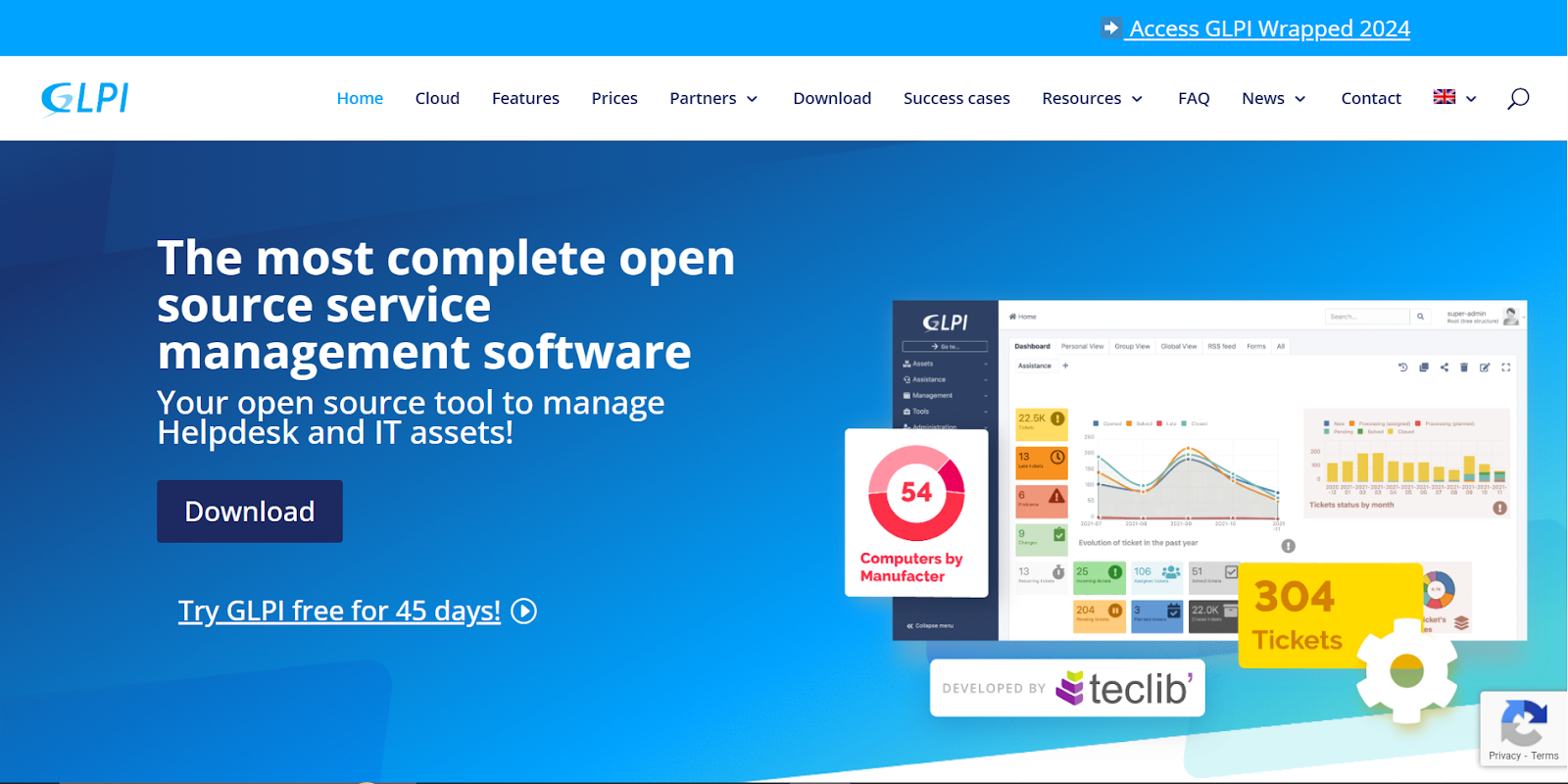
GLPI is a full IT service‑management suite. The community edition lets you install on‑premises and start cataloging laptops, servers, SIM cards, and even whole datacenter racks within a configurable CMDB.
We appreciate that the asset workflow is both opinionated and flexible. A relationship system links hardware to software, tickets, and projects, providing your support staff with instant context when incidents arise. Because GLPI is plugin‑driven, you can extend it with budget tracking, project management, or cloud‑resource sync.
GLPI best features
- Link assets to tickets: Jump from a failing laptop straight to its service history.
- Attach contracts and costs: Keep warranties, leases, and supplier data alongside hardware.
- Extend with plugins: Add inventory, finance, or reporting modules as needed.
Reviews and ratings
- G2: 4.5/5 (30+ reviews)
- Capterra: 4.5/5 (40+ reviews)
Pricing
- Community Edition: Free self‑hosted
- GLPI Network Cloud: €19 per IT agent per month (billed monthly)
- On‑prem Basic Subscription: €100 per month (12‑month commitment)
Read More: 15 Best IT Hardware Inventory Management Software in 2025
3. Ralph
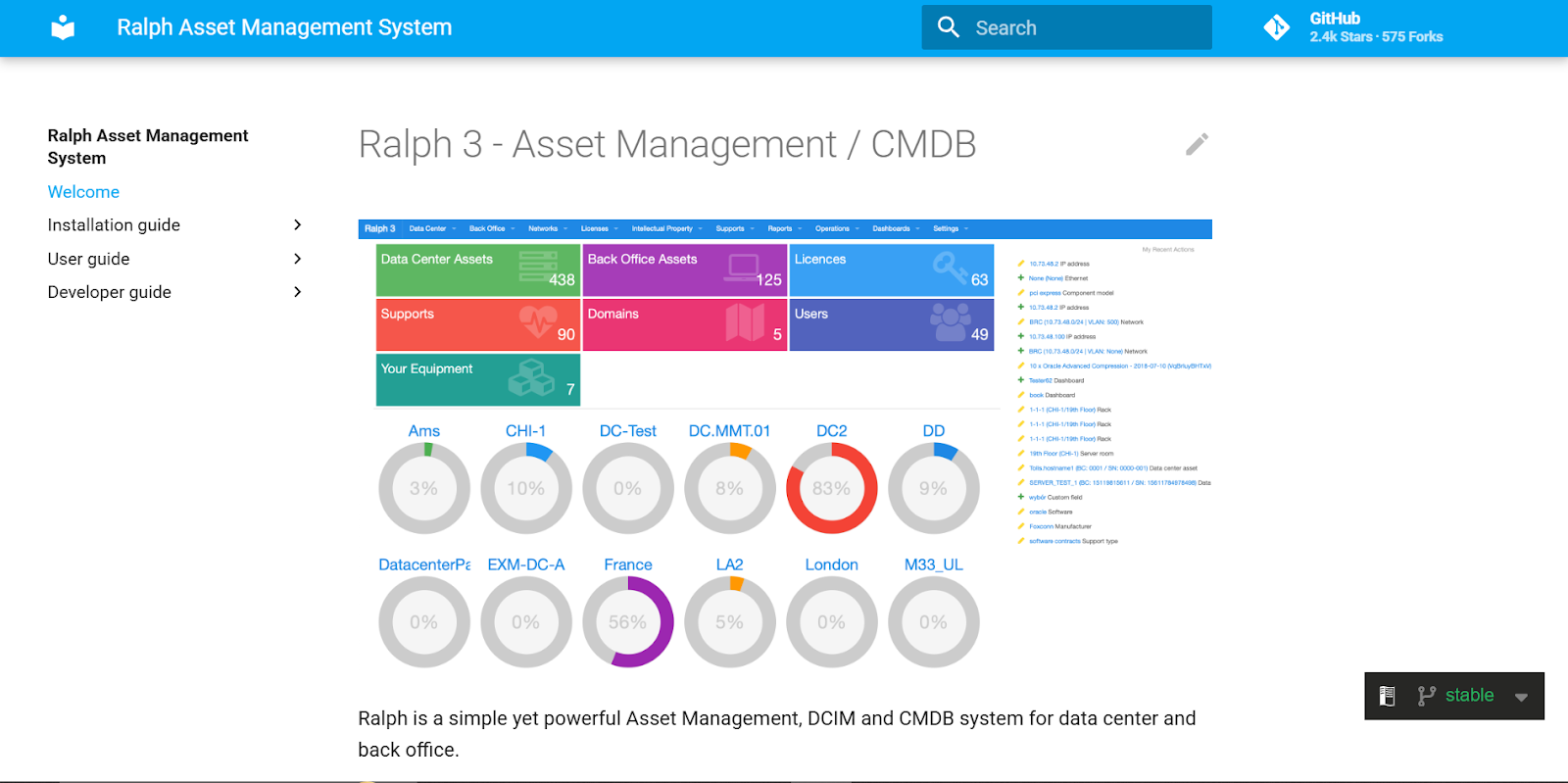
Via Ralph
Ralph is a Python and Django application built by e‑commerce giant Allegro and released under the Apache 2.0 license. It targets organizations that run both back‑office equipment and sizable data centers. We love Ralph because it combines asset management, DCIM, and CMDB capabilities in one package.
In Ralph, you decide the checkpoints, and Ralph enforces them and stores purchase details, barcodes, and cost centers along the way.
Ralph best features
- Define custom lifecycles: Model unique approval or staging steps with a visual flow builder
- Track non‑physical assets: Record licenses, domains, and vendor contracts alongside hardware
- Script everything: Use a CLI or REST API to seed data or trigger actions from CI/CD jobs
Reviews and ratings
- G2: N/A
- Capterra: N/A
Pricing
- Open‑source edition: Free to download and self‑host (Apache 2.0)
4. OpenBoxes
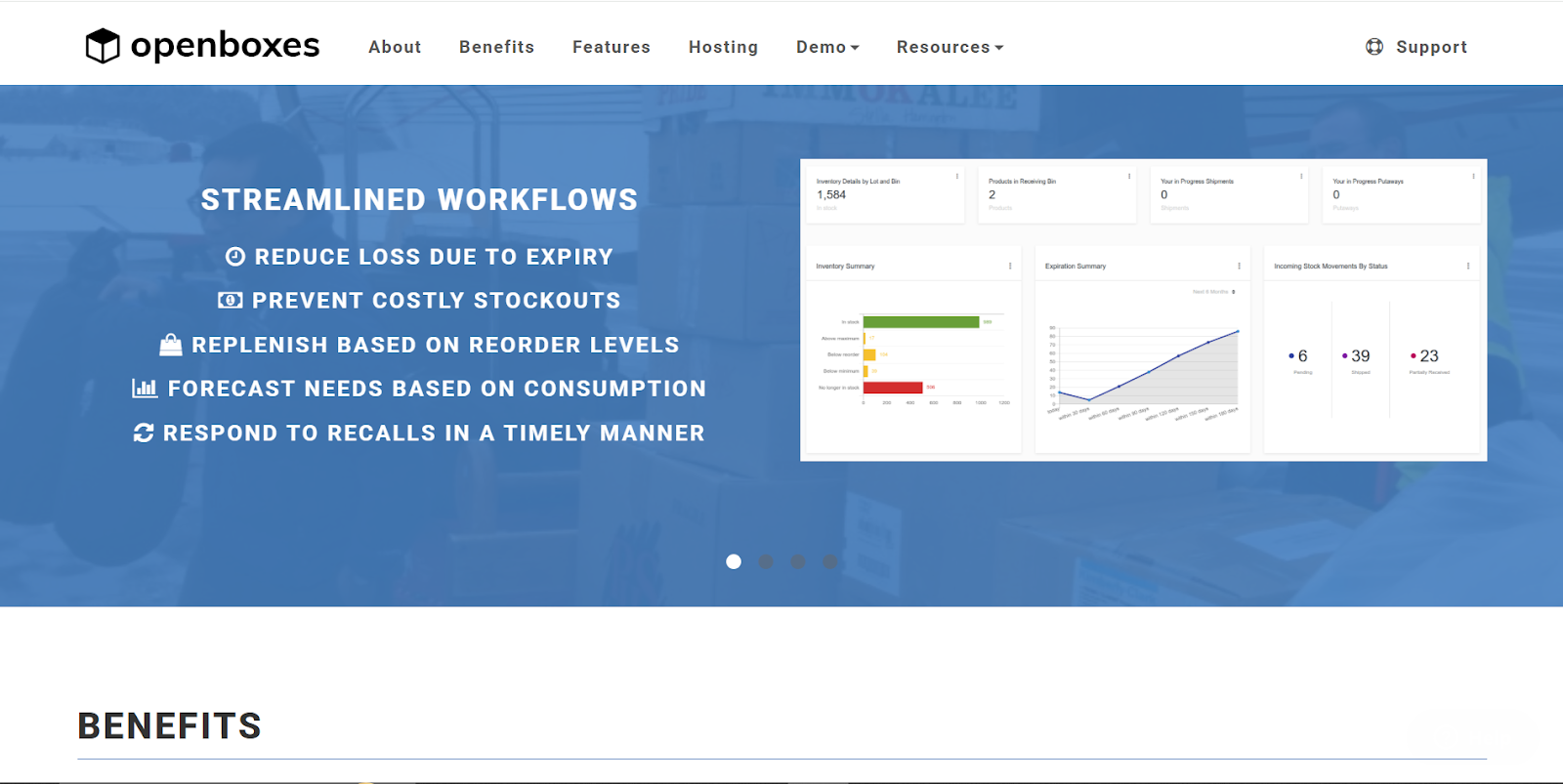
Via OpenBoxes
OpenBoxes is a Java-based, web-hosted platform used anywhere a team needs precise custody of physical items. Because it is licensed under the MPL 2.0 and ships with Docker images, you can use it on-premises or in the cloud and start cataloging everything from laptops to lab equipment without license limits.
You’ll find lifecycle control built around serial‑number and lot tracking.OpenBoxes ships with compliance‑grade traceability, and a REST API plus CSV import and export make bulk updates painless.
OpenBoxes best features
- Record serialized assets: Assign serial numbers and attach manuals, photos, and warranties to each item.
- Enforce FEFO rotations: Auto‑generate picklists that pull the soon‑to‑expire or oldest‑purchase stock first.
- Trace lots across sites: Locate every unit affected by a recall or maintenance bulletin in seconds.
Reviews and ratings
- G2: N/A
- Capterra: N/A
Pricing
- Open‑source self‑hosted: Free (bring‑your‑own infrastructure)
- Self-hosted via DigitalOcean: Starts at $100/month
Open Source IT Asset Management Software: At a Glance
Finally, here’s a roundup of the 4 ITAM software we just listed.
|
Best for |
Best feature |
|
|
Snipe‑IT |
Small, mid‑size IT teams that want a self‑hosted, straightforward hardware‑lifecycle tracker |
Built‑in barcode and QR label engine that works with off‑the‑shelf scanners |
|
GLPI |
Organizations that need asset CMDB data sent directly into a full help‑desk or ITSM suite |
Every asset record links to tickets, problems, and changes |
|
Ralph |
Data centers and hybrid environments |
Drag‑and‑drop rack visualization in the DCIM view |
|
OpenBoxes |
Multi‑site operations that require recall‑ready traceability |
FEFO‑driven picklists and lot tracing |
We love the simplicity of Snipe-IT and recommend it for organizations just transitioning from spreadsheets.
Moreover, OpenBoxes could be a preferred choice for healthcare and humanitarian organizations needing open-source inventory and supply chain management. The latter may be used to manage IT assets too, but might not be the best for it.
How to Deploy and Customize an Open‑Source ITAM Tool
Suppose you pick one of these tools to use in your organization. Where do you even start?
Step one: Decide where the system will reside — on-premises or in the cloud — and set up the basics. These include an OS that’s easy to patch (Ubuntu LTS or RHEL), the database engine your project prefers, and a reverse proxy with TLS.
Next, pull the official Docker images (or install from source), run the migrations, and verify that backups and notification emails function correctly before inviting users.
Once the core is healthy, shape it around your workflow. Add custom fields or lifecycle states that reflect approval gates, apply a company-branded theme or language pack, and connect the REST API or CLI to import purchase data from your ERP system. Finally, add plugins like barcode generators (if they’re not built).
Workwize: An Alternative To Open Source Asset Management Solutions
Open-source ITAM tools are powerful if you’ve got the time, tech skills, and internal alignment to self-host, customize, and maintain them.
But what if you don’t?
What if your team just needs to order, ship, track, retrieve, and retire assets across borders without becoming an asset management team?
That’s where you can consider Workwize.

Workwize is an IT hardware lifecycle management solution that lets you manage IT hardware from procurement to disposal. It’s one platform, not just to manage assets (know where they are in their lifecycle, locations, usage history, etc.) but to actually control them.
With Workwize, you can procure hardware when your current supply is running out, have it delivered to employees/offices anywhere in the world, enjoy one-click retrieval, and benefit from asset decommissioning services — all from one platform.
Contact us today to see if Workwize is the right fit for you. It’s remarkably easy to use and deploy, and trusted by names like DuckDuckGo, HighLevel, and more.
FAQs
Can open-source solutions integrate with our existing systems?
Most mature open-source asset management platforms offer extensive integration capabilities through APIs, webhooks, and standard protocols such as LDAP for user authentication. Since you have access to the source code, custom integrations are always possible if standard options don't meet your needs.
Can open-source software scale for enterprise use?
Absolutely. Many large enterprises successfully run open source asset management systems to manage tens of thousands of assets across multiple locations. Organizations such as universities, government agencies, and multinational corporations regularly use open-source solutions at scale.
How secure is open-source ITAM software?
Open source software can be extremely secure, often more so than proprietary alternatives. With thousands of developers worldwide able to examine the code, security vulnerabilities are typically discovered and patched faster than in closed-source systems.

Establish a single source of truth for every IT asset across the globe.
.png?width=258&height=318&name=g10%20(5).png)
More related resources to help you stop firefighting hardware operations.



Get monthly insights into how other IT leaders are improving their ops.



.svg)
.svg)
.svg)
.svg)