




.svg)
.svg)

.svg)


.svg)





.svg)
.png?width=500&height=424&name=Style-1---V1-(1).png)
.png?width=1230&height=692&name=Vector%20(13).png)
Modern enterprise IT environments are not underpowered. They are fragmented.
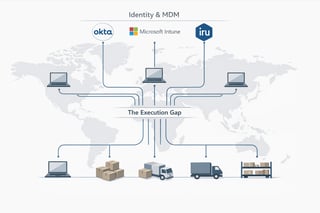
Okta governs identity and access. Microsoft Intune manages Windows endpoints. Kandji, now Iru, manages Apple devices. Each platform is mature and effective within its domain. But none of them manages the physical lifecycle of hardware.
That gap is where onboarding delays, lost devices, audit exposure, and compliance risk begin.
It is also why enterprises are increasingly evaluating an enterprise IT hardware logistics vendor that can sit between identity systems, endpoint management tools, and real-world device execution.
Workwize is the operating layer that automates IT hardware lifecycle management for enterprises distributed across 130+ countries.
The Blind Spot in the Enterprise IT Stack
Okta determines who should have access. Intune and Kandji determine whether a device is compliant.
Neither system tracks physical reality: where a device is, who last had it, whether it has been returned, or whether it was wiped correctly.
In global organizations, hardware is constantly in motion.
Employees join, relocate, and leave. Devices are repaired, replaced, shipped across borders, or reassigned.
Without a centralized hardware logistics platform, IT teams rely on a patchwork of resellers, warehouses, couriers, spreadsheets, and tickets just to maintain control.
That fragmentation is where execution breaks down.
What an Enterprise IT Hardware Logistics Vendor Actually Does
An enterprise IT hardware logistics vendor manages the full physical device lifecycle across global operations, from procurement through decommissioning.
More importantly, it connects each lifecycle stage into one operational system.
Instead of treating hardware as a procurement task, it becomes an execution layer aligned with identity and compliance.
Without this layer, IT teams must manually coordinate between Okta identity events, Intune or Kandji compliance state, procurement teams, regional vendors, couriers, ITAD partners, and finance.
As organizations scale globally, that coordination becomes fragile and error-prone.
Where Okta, Intune, and Kandji (Iru) Stop
Okta governs digital identity. It provisions users, enforces access policies, and deactivates accounts. It does not ship hardware, recover devices, verify wipes, or track physical custody.
Intune and Kandji govern device configuration and compliance. They determine whether a device meets security standards. They do not manage global sourcing, cross-border logistics, retrieval workflows, or certified destruction.
These platforms manage the digital state. Hardware exists in the physical world. That disconnect creates a gap in the enterprise device lifecycle.
The Enterprise Device Lifecycle Gap
Enterprise device lifecycle management spans procurement, deployment, active lifecycle management, offboarding and retrieval, and decommissioning or resale. In many organizations, these stages are handled by different vendors or internal teams with little operational continuity.
The results are predictable. New hires wait for devices because procurement and onboarding are misaligned. Devices ship before enrollment or compliance checks are confirmed. Asset records drift between MDM and finance systems. Offboarded devices are not always returned on time, and wipe documentation must be manually assembled during audits.
For IT managers, hardware becomes a coordination problem instead of a controlled system.
What Okta Intune Device Lifecycle Integration Really Means
Okta Intune device lifecycle integration is not just a technical connector. It is operational alignment.
When identity events occur in Okta, physical workflows should trigger automatically. When a device is not compliant in Intune or Kandji, it should not be shipped or redeployed. When an employee leaves, retrieval and wipe verification should begin without manual follow-up.
This only happens when an enterprise IT hardware logistics vendor sits in the middle, translating identity and compliance signals into real-world execution.

Device Lifecycle Management: With vs. Without Workwize
|
Area |
Without a Hardware Logistics Platform |
With Workwize |
|
Onboarding |
Devices ordered manually after identity provisioning; enrollment and shipping handled separately |
Okta joiner events trigger provisioning with zero-touch deployment |
|
Time-to-Productivity |
New hires often wait days or weeks |
Predictable, start-date-aligned delivery |
|
Inventory Visibility |
Asset data split across tools and spreadsheets |
Serialized inventory tracked end-to-end |
|
Compliance Enforcement |
Devices can ship or redeploy before checks are complete |
Compliance gates shipment and reuse |
|
Offboarding & Retrieval |
Device returns rely on follow-ups |
Retrieval triggered automatically on leaver events |
|
Wipe Verification |
Wipes issued but inconsistently documented |
Verified, documented wipe before reuse or disposal |
|
Audit Readiness |
Evidence assembled manually |
Audit-ready by default |
|
Global Operations |
Region-specific vendors and SLAs |
Centralized lifecycle across 130+ countries |
|
IT Team Workload |
High manual coordination |
System-driven execution |
How Workwize Operates as the Middle Layer
Workwize unifies procurement, deployment, maintenance, retrieval, and decommissioning into a single operational platform.
- Devices are sourced locally to reduce lead times and customs delays.
- Zero-touch deployment is handled through Apple Business Manager and Windows Autopilot before shipment.
- Repairs and replacements follow structured workflows.
- Offboarding triggers automated retrieval, standardized wipe verification, and documented outcomes.
- End-of-life devices move through certified ITAD workflows with audit-ready records.
The value is not visibility alone. It is operational execution.
Offboarding: Where Risk Concentrates
Offboarding is the highest-risk stage of the device lifecycle. Without structured retrieval and wipe verification, devices remain in employee possession, wipe completion cannot be proven, and the chain-of-custody records are fragmented.
With a hardware logistics platform in the middle, retrieval is automated, wipe processes are logged, certifications are generated, and devices are redeployed, resold, or destroyed in accordance with policy. Risk becomes a controlled process.
What to Look for in an Enterprise IT Hardware Logistics Vendor
When evaluating vendors, focus on lifecycle orchestration rather than shipping capability. The right platform integrates directly with Okta, uses Intune and Kandji/Iru compliance to gate logistics actions, supports the full lifecycle from procurement through ITAD, and operates globally with standardized wipe verification and audit-ready reporting.

What's next?
Okta, Intune, and Kandji (Iru) provide strong digital control over identity and compliance. They do not manage physical hardware.
An enterprise IT hardware logistics vendor that sits in the middle connects identity, compliance, and device movement into a single, controlled lifecycle.
For enterprise IT managers, that middle layer turns hardware from an operational burden into a predictable, auditable system. Workwize is built to be that layer.

Establish a single source of truth for every IT asset across the globe.
.png?width=258&height=318&name=g10%20(5).png)
More related resources to help you stop firefighting hardware operations.

.png?width=360&height=200&name=Device%20Lifecycle%20Management%20(1).png)

Get monthly insights into how other IT leaders are improving their ops.



.png?width=2880&height=1232&name=Group%202147262874%20(1).png)
Stop coordinating
hardware like it's 2012.
.svg)
.svg)
.svg)
.svg)
.svg)