




.svg)
.svg)

.svg)


.svg)





.svg)
.png?width=500&height=424&name=Style-1---V1-(1).png)

.png?width=1230&height=692&name=Vector%20(13).png)
TL;DR
-
Losing hardware is expensive, so we rounded up five tracking systems that show you where every asset is hiding.
-
Workwize is an excellent asset tracking system that enables you to track hardware throughout its lifecycle, from procurement to disposal.
-
ManageEngine and SolarWinds integrate asset data into ITSM, and Sortly shines on mobile.
-
Asset Panda bends to any workflow, but Link Labs is focused on tracking gear.
-
When choosing one for your organization, zero in on automated discovery, lifecycle workflows, real-time alerts, integrations, and role-based controls.

Best IT Asset Tracking Software (Quick List)
Workwize
Asset Panda
ManageEngine AssetExplorer
ServiceNow
Lansweeper
InvGate
Flexera One
Asset Tiger
Reftab
Snow License Manager
Snipe‑IT
Shelf
Best IT Asset Tracking Software at a Glance
Here are the best asset tracking software in 2026:
|
Tool |
Key Features |
Pricing |
Best For |
Ratings |
| Workwize | Global procurement, deployment, retrieval, lifecycle automation, HRIS & MDM integrations | Custom pricing | Global remote teams managing device logistics | G2: 4.4/5 (8) · Capterra: 4.4/5 (17) |
| Firstbase | Device procurement, onboarding/offboarding automation, warehouse network, asset tracking | Custom pricing | Distributed companies managing equipment globally | G2: 4.8/5 (50) · Capterra: 4.5/5 (10) |
| ManageEngine AssetExplorer | Network discovery, CMDB, hardware & software inventory, lifecycle workflows | From $955/year (on-prem) or $115/month | SMBs already using the ManageEngine ecosystem | G2: 4.3/5 (12) · Capterra: 4.6/5 (13) |
| ServiceNow ITAM | Enterprise asset lifecycle management, software license optimization, automation, CMDB | Custom pricing | Large enterprises with complex IT environments | G2: 4.4/5 (152) · Gartner: 4.2/5 (134) |
| Snipe-IT | Open-source asset tracking, license tracking, check-in/out workflows | Free (self-hosted) · Hosting from ~$399/year | Small teams replacing spreadsheets | G2: 4.6/5 (25) · Capterra: 4.4/5 (22) |
| Lansweeper | Agentless & agent discovery, network scanning, vulnerability insights | Free (100 assets) · Paid from €219 | Mid-sized IT teams needing strong discovery | G2: 4.4/5 (62) · Capterra: 4.5/5 (73) |
| InvGate Asset Management | Agent & network discovery, customizable dashboards, ITSM integration | From ~$0.21/node/month | Mid-sized teams using InvGate ITSM | G2: 4.7/5 (11) · Capterra: 4.4/5 (14) |
| Flexera One | Software license intelligence, SaaS management, cloud cost optimization | Custom pricing | Enterprises managing complex software licensing | G2: 4.3/5 (123) · Gartner: 4.4/5 (711) |
| AssetTiger | Simple asset tracking, barcode scanning, depreciation tracking | Free (250 assets) · Paid from ~$20/month | Schools, nonprofits, small teams | G2: 4.5/5 (15) · Capterra: 4.6/5 (270) |
| Reftab | Hardware & software tracking, MDM integrations, automated workflows | From ~$31/month (250 assets) | SMB IT teams and MSPs | G2: 4.3/5 (5) · Capterra: 4.7/5 (130) |
| EZO AssetSonar | Hardware, software & license management, discovery, automation workflows | Custom pricing | Mid-sized IT teams needing balanced ITAM | G2: 4.5/5 (73) · Capterra: 4.6/5 (38) |
| Shelf.nu | Open-source hardware asset tracking, reservations, customizable categories | Free plan · Paid from $34/month | Small teams needing simple hardware tracking | G2: 5/5 (10) · Capterra: 4.8/5 (106) |
1. Workwize
Source: Workwize
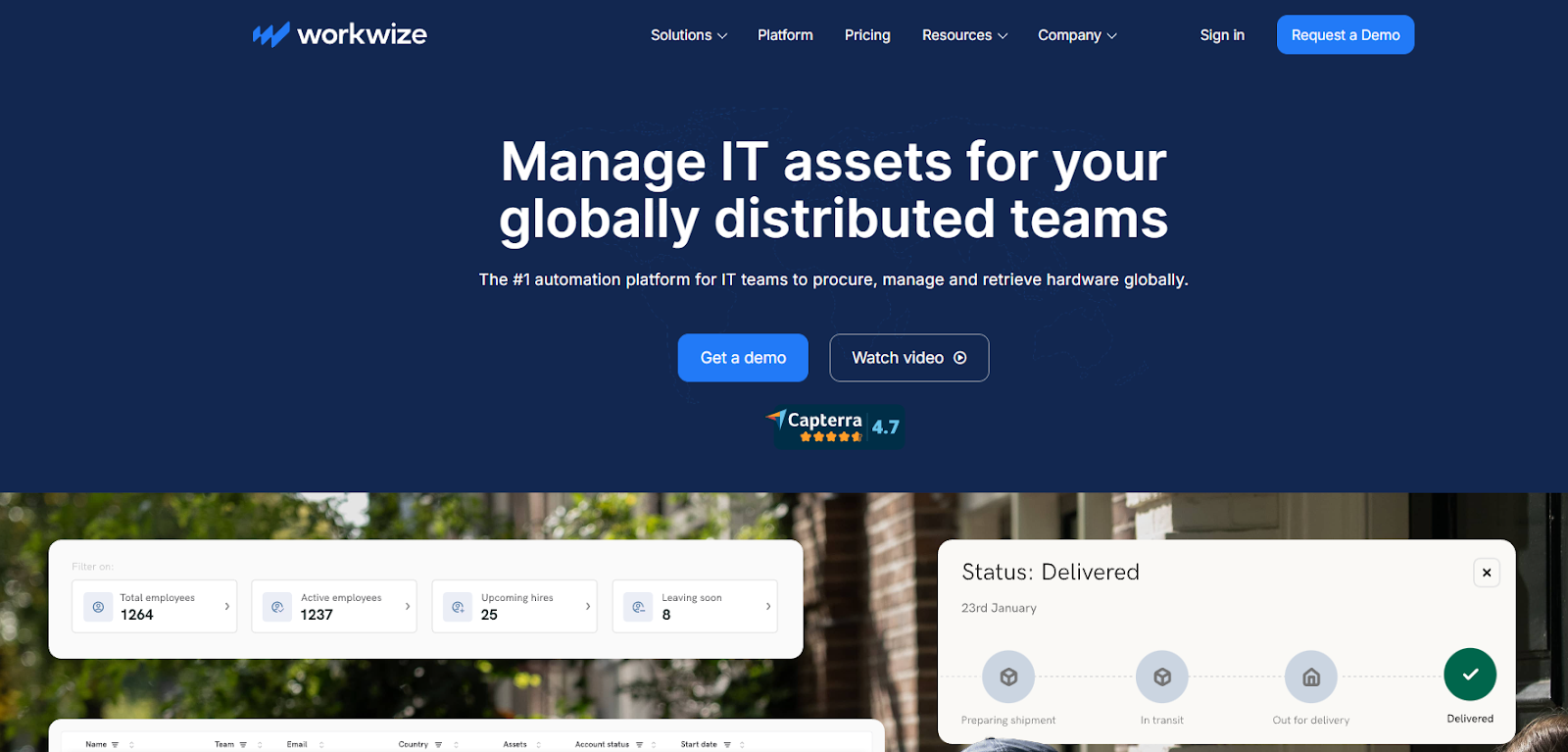
Workwize is a global IT hardware management platform that automates procurement, deployment, repairs, retrievals and disposals, i.e. the complete lifecycle, across 130+ countries.
This platform is designed specifically for global hybrid or remote teams that need a single platform for handling the digital and operational aspects (logistics) of asset management.
Because of its massive network of resellers and local warehouses, Workwize ensures timely, affordable and sustainable deployments and retrievals in over 130 countries.
However, some users mention that Workwize should expand to more regions. And we’re headed in the right direction, since Workwize expanded it’s warehouses in Japan and the UAE just a few weeks ago.
Coming to the platform’s UI and functionality, this is how Workwize’s asset management dashboard looks:
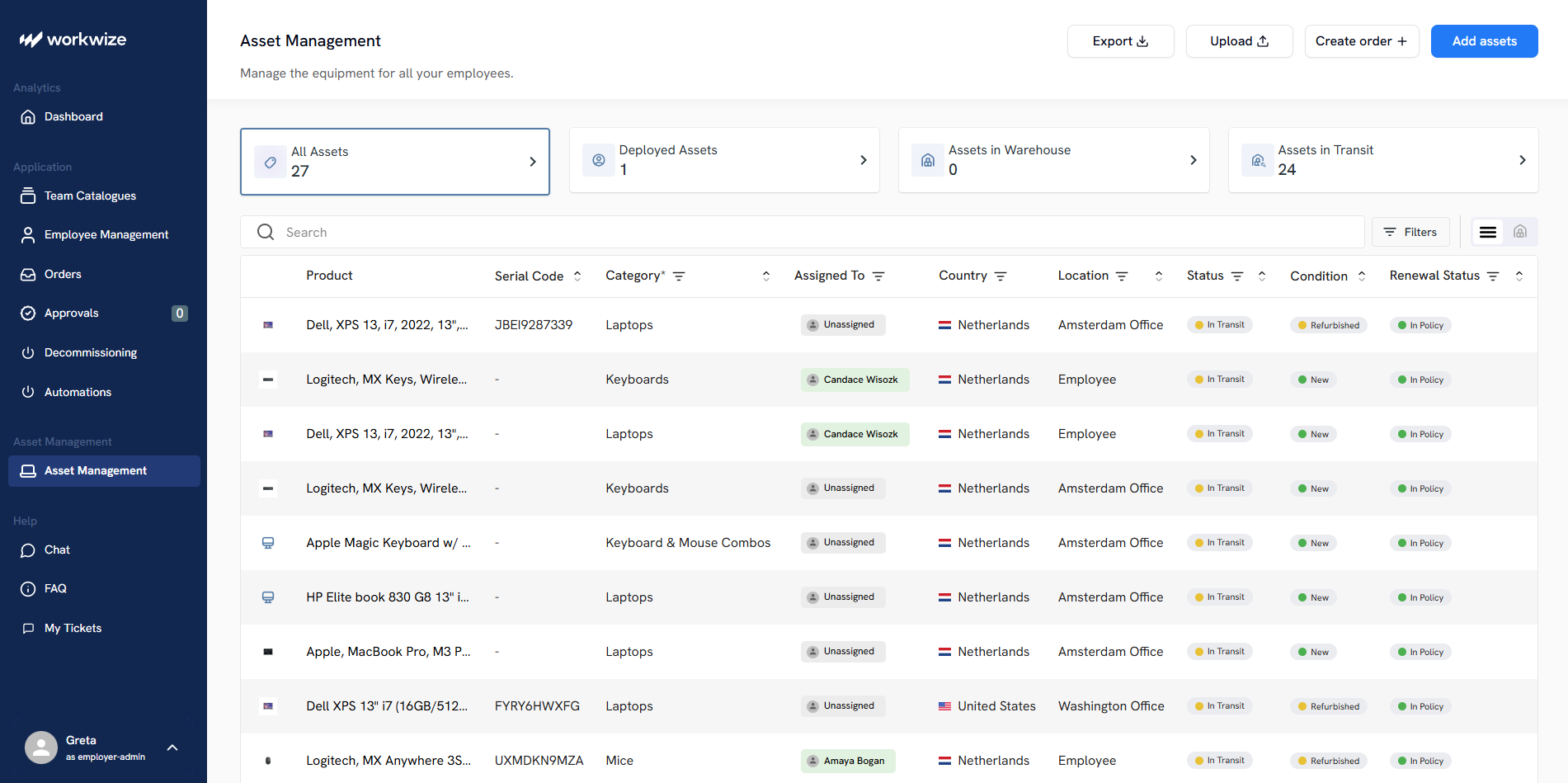
It’s clean, modern, and gives you a complete overview of all the assets you have, including details such as serial code, category, country, location, status, condition, renewal status, and more. This info lets you make informed decisions, like ordering new devices based on renewal status.
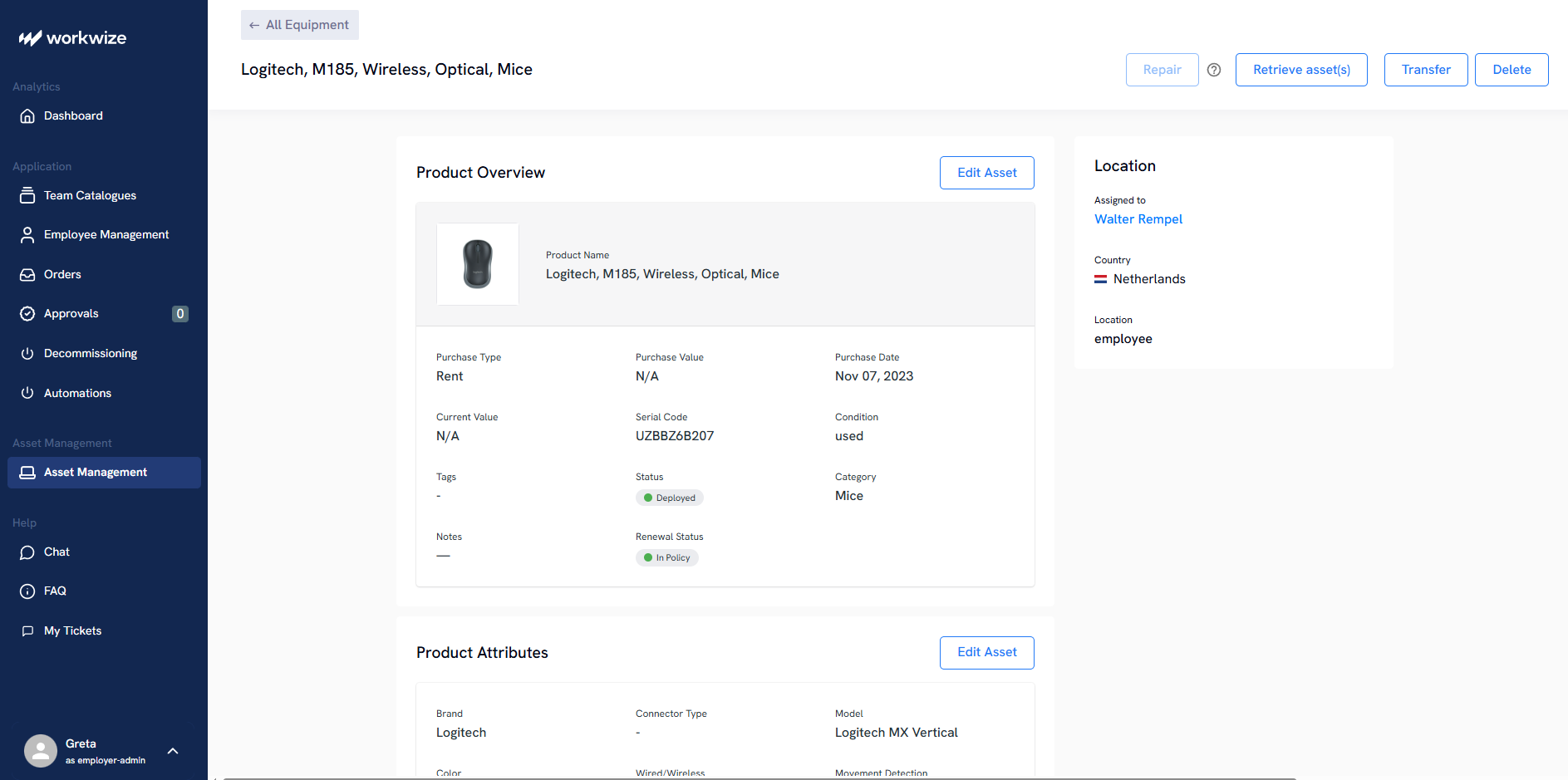
You can just click into any device and edit details, or initiate asset transfer or retrieval.
Workwize integrates with your HRIS platform like HiBob, BambooHR, and more and triggers onboarding/offboarding workflow when a new user joins/leaves your organization. This automates redundant tasks, reduces manual effort and improves efficiency.
You can even build automations for restocking and deployment.
For instance, you can choose the product and warehouse location, then set the threshold to 5. Whenever the device quantity falls below 5, it’ll automatically restock at the said location.
This automation completely removes manual steps, saving you time.
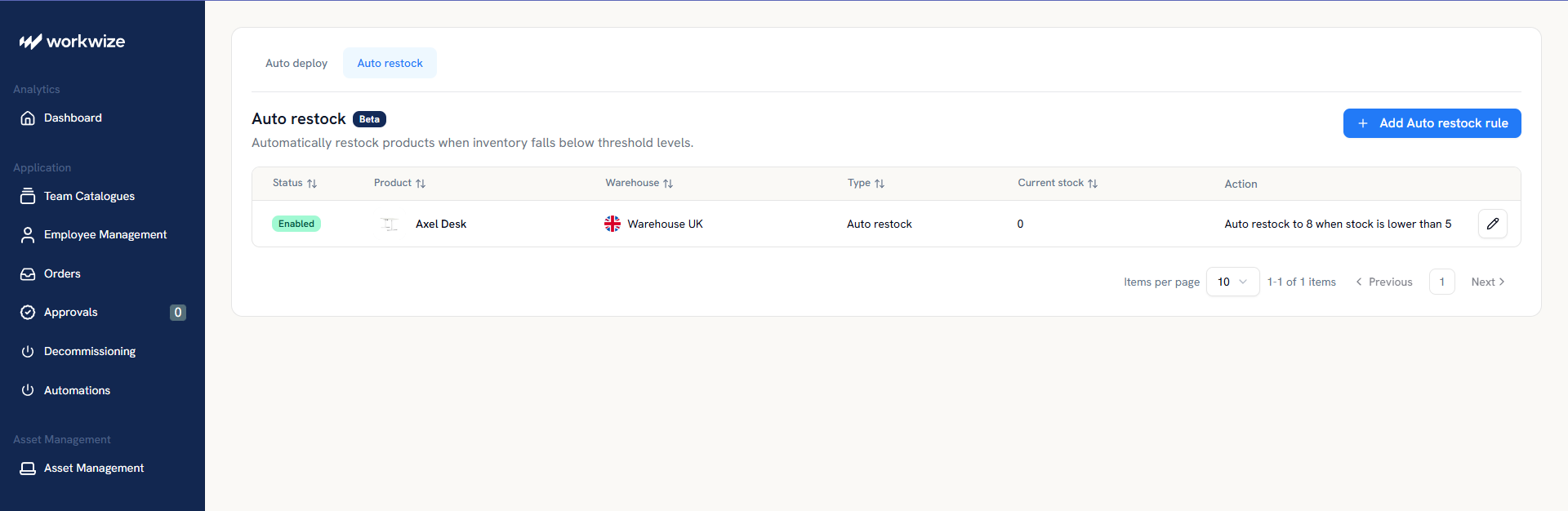
Another major advantage of Workwize is the vast network of warehouses across the globe: the European Union, the United Kingdom, the United States, Canada, India, Australia, Brazil, the Philippines, Mexico, Japan and the UAE.
This network of warehouses and suppliers ensures you get assets delivered locally. And this means on-time deliveries, low carbon footprint, and massive savings on international shipping costs.
Pricing
Workwize offers 3 plans:
- Basic
- Professional
- Enterprise
We understand that different organizations have unique needs and thus deserve customized pricing. Book a free demo, explain your requirements, and get quotes tailored to your needs.
Pros
- Users love how well Workwize integrates with their HRIS and MDM platforms to create automated workflows (Source)
- Self-service feature lets user order equipment on their own, without involving management, which saves time (Source)
- Support for 130+ countries makes it ideal for companies with workforces distributed in multiple locations
Cons
- Users would want to see Workwize support more locations.
Ratings
- G2: 4.4/5 (8 reviews)
- Gartner: N/A
- Capterra: 4.4/5 (17 reviews)
2. Firstbase
Source: Firstbase
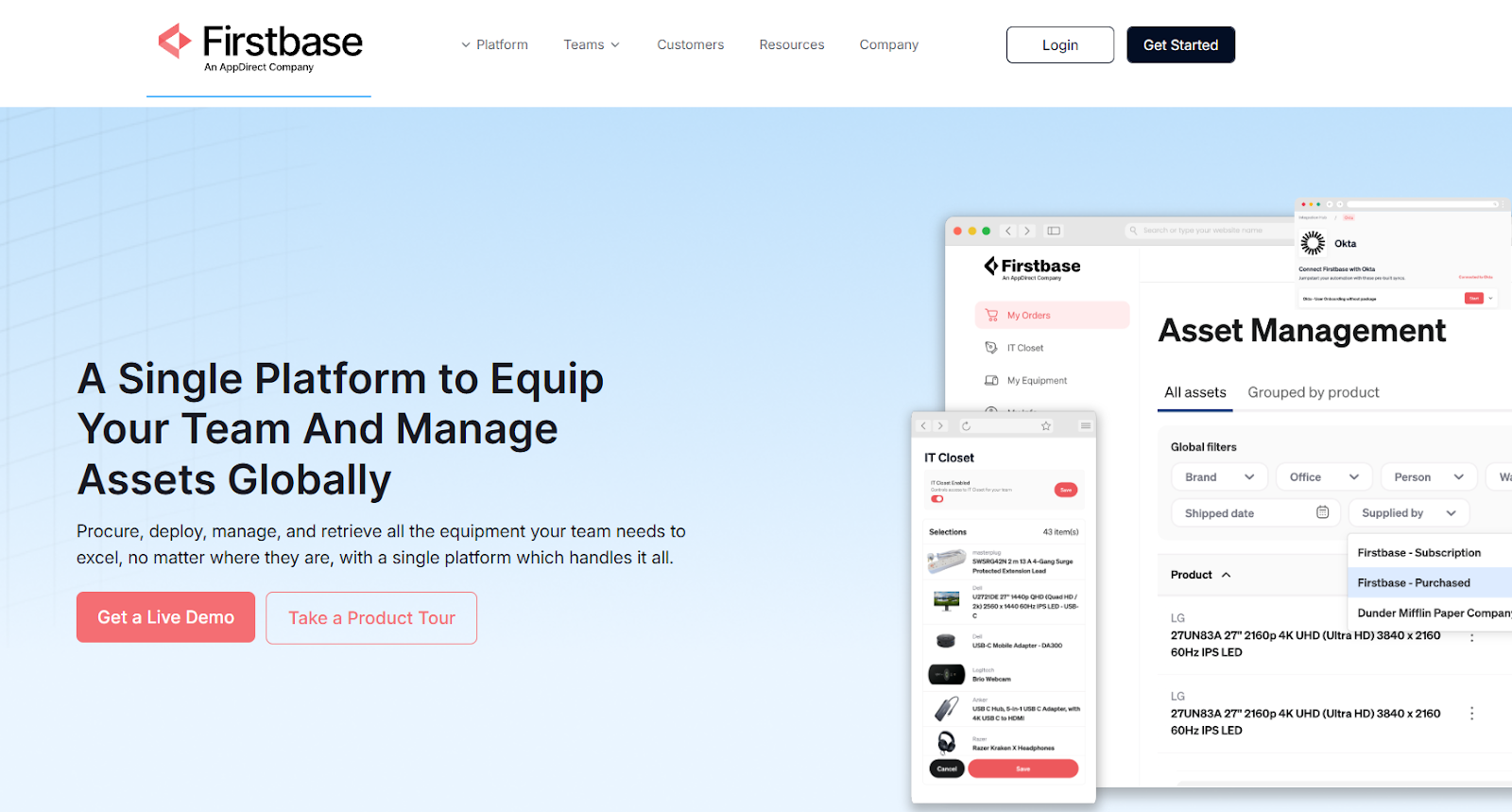
Firstbase is a global IT asset lifecycle management platform ideal for distributed organizations that want to automate onboarding and offboarding through HRIS integrations while maintaining visibility into assets across regions.
Firstbase stands out for its clean interface, warehouse network, and end-to-end procurement and retrieval workflows. However, its predefined catalog and inconsistent international shipping experiences can be limiting for some teams.
Source: Firstbase’s self-Guided Tour
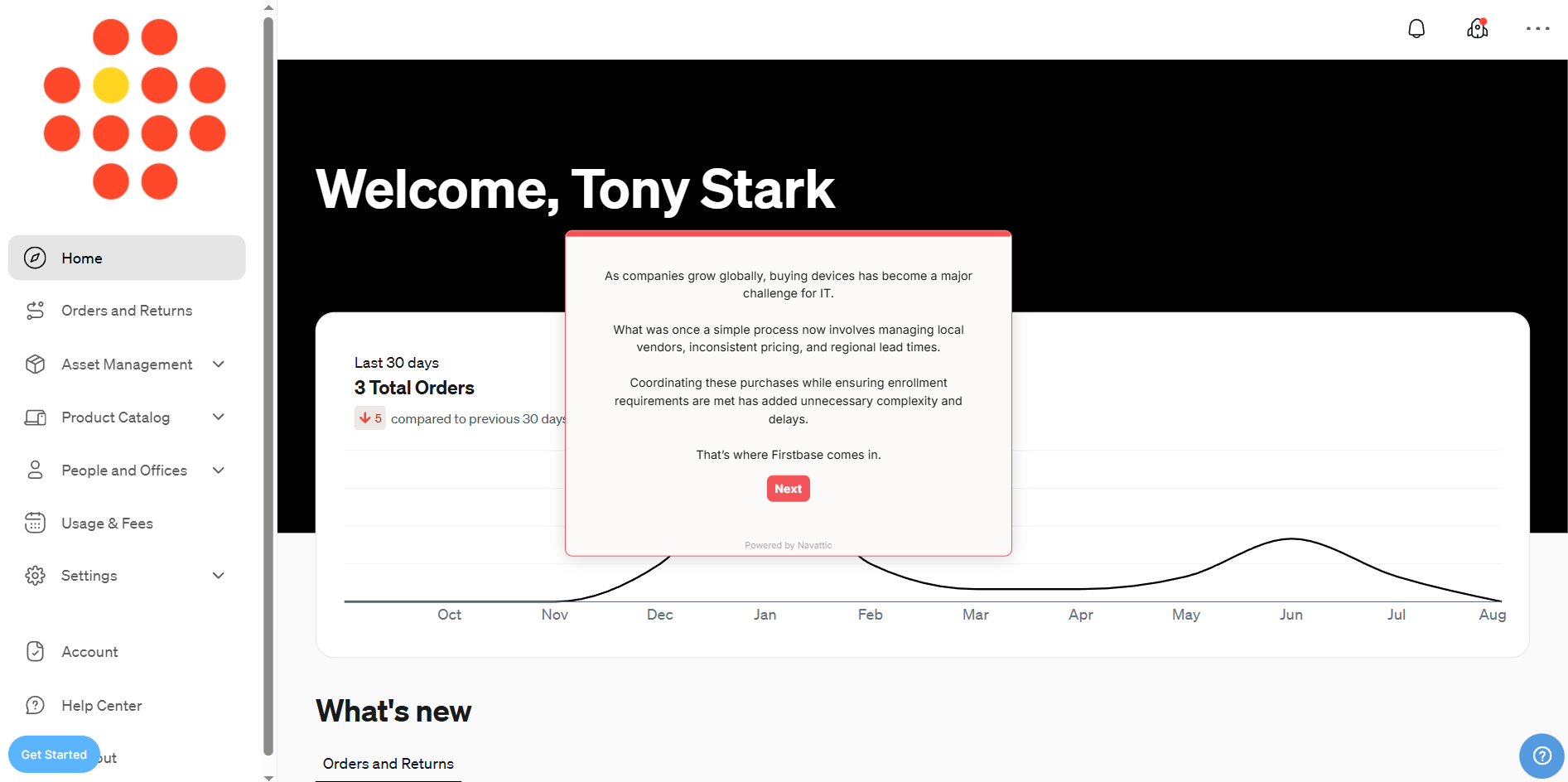
I opted for a self-guided product tour and tried out Firstbase’s onboarding, offboarding, and procurement features. Right off the bat, I liked how clean the platform looked.
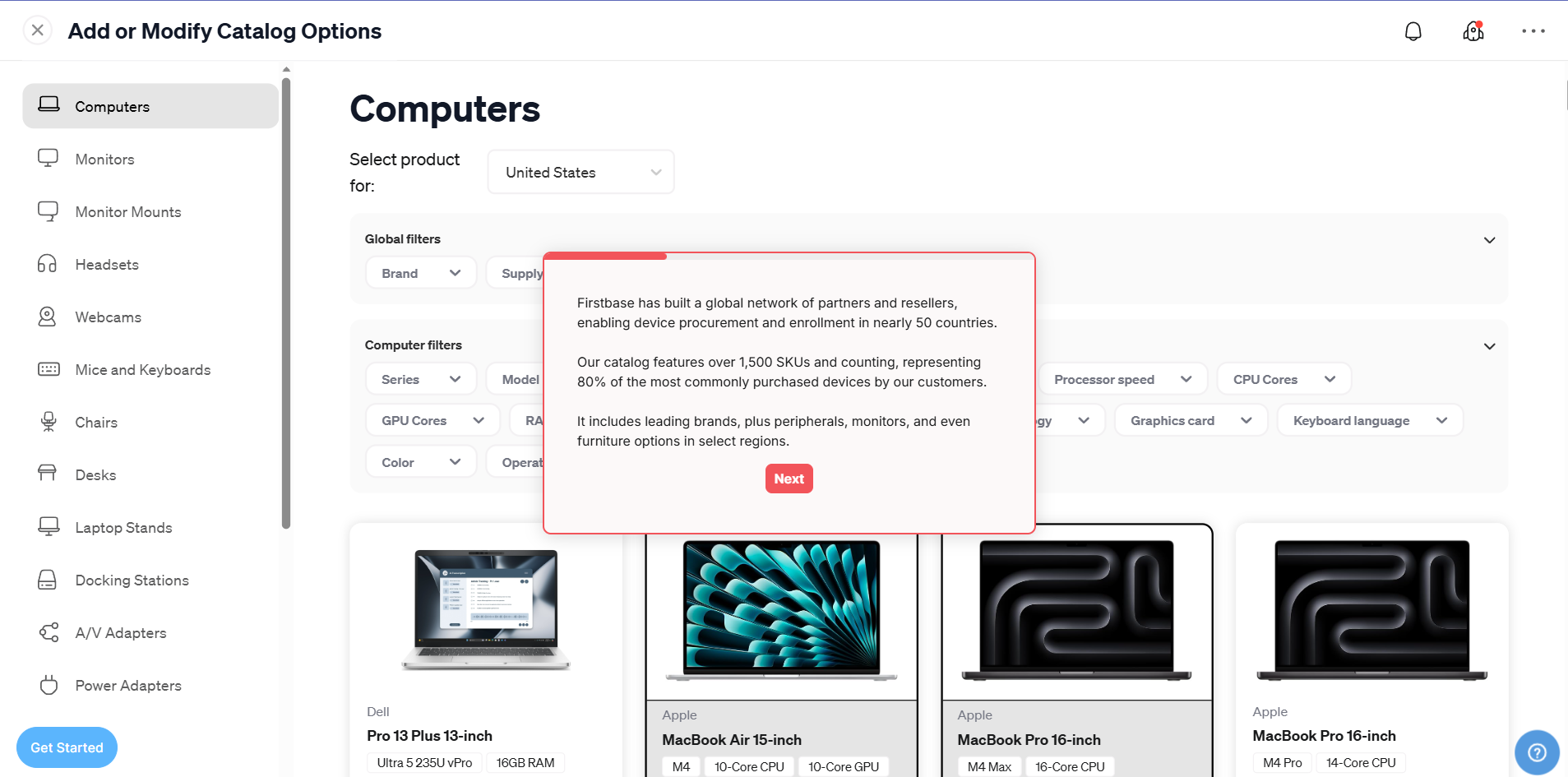
Firstbase has a catalogue of 1500+ products that represent 80% of the most commonly purchased devices by its customers.
And because they have a network of partners and resellers, Firstbase facilitates procurement and enrollment in almost 150+ countries.
This is how the dashboard looks. The catalogue will only show you the products that are available in the selected country:
Source: Firstbase’s self-Guided Tour
To understand what the product will cost and how early it can be shipped, just select the product you want to order. And this is what you’ll see.
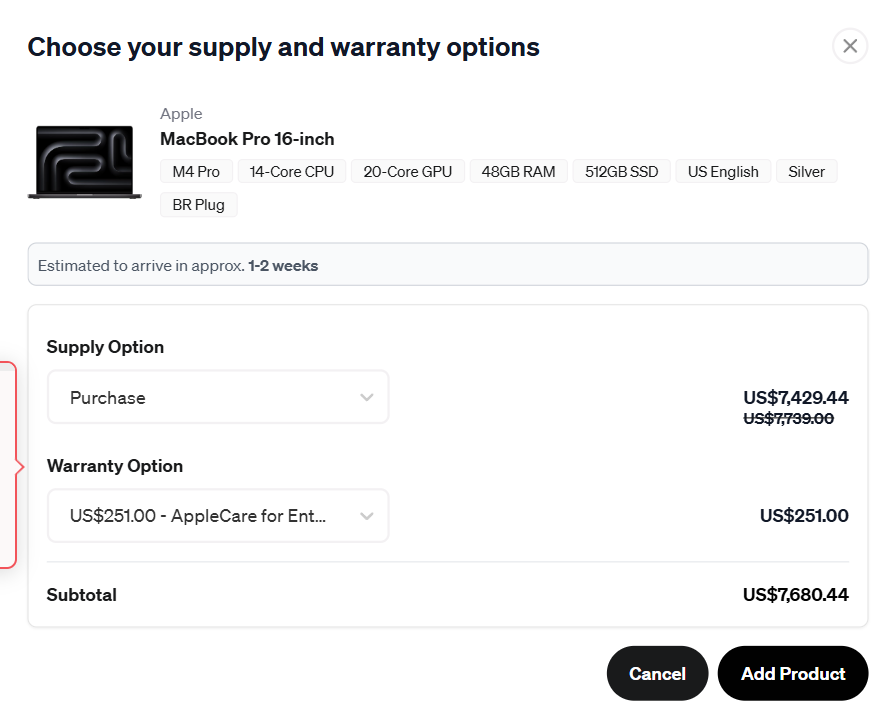
Source: Firstbase’s self-Guided Tour
Once the order is initiated, you can easily track it.
Firstbase integrates with your HRIS platform (BambooHR, Hibob, Okta, Workday and more) to help you create an automated workflow for both onboarding and offboarding. So, when a new employee is added to your HRIS, Firstbase automatically initiates the onboarding workflow.
For instance, Firstbase sends an automated email to employees and helps create their credentials. After that, employees can order whatever equipment they want from a pre-approved list based on their role, department, and other factors.
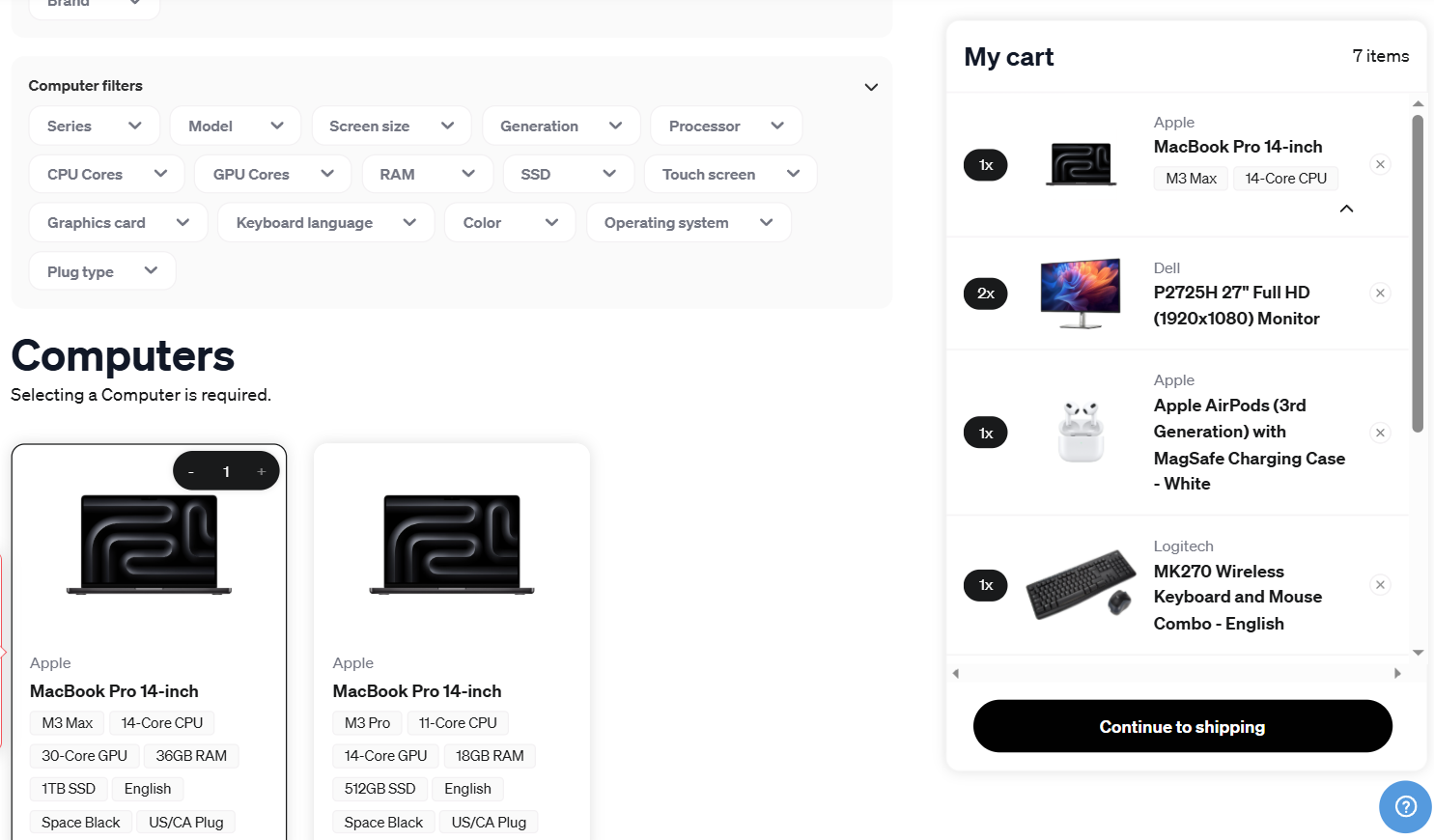
Source: Firstbase’s self-Guided Tour
Because this list is pre-approved, and the onboarding is triggered automatically, minimal manual input is required, saving both the IT and HR teams a lot of time.
Once the order is placed and shipped, the employee will be notified. Admins can edit the order or change the shipping and track the orders post-shipping from the dashboard. Because of this visibility, admins can determine where the assets are and solve issues if they’re reported.
However, Firstbase features a pre-defined catalogue with a limited set of items. If you need something outside of that, you may have to talk to their team. It would have been great if companies could easily order whatever equipment they want, without having to choose from what’s available.
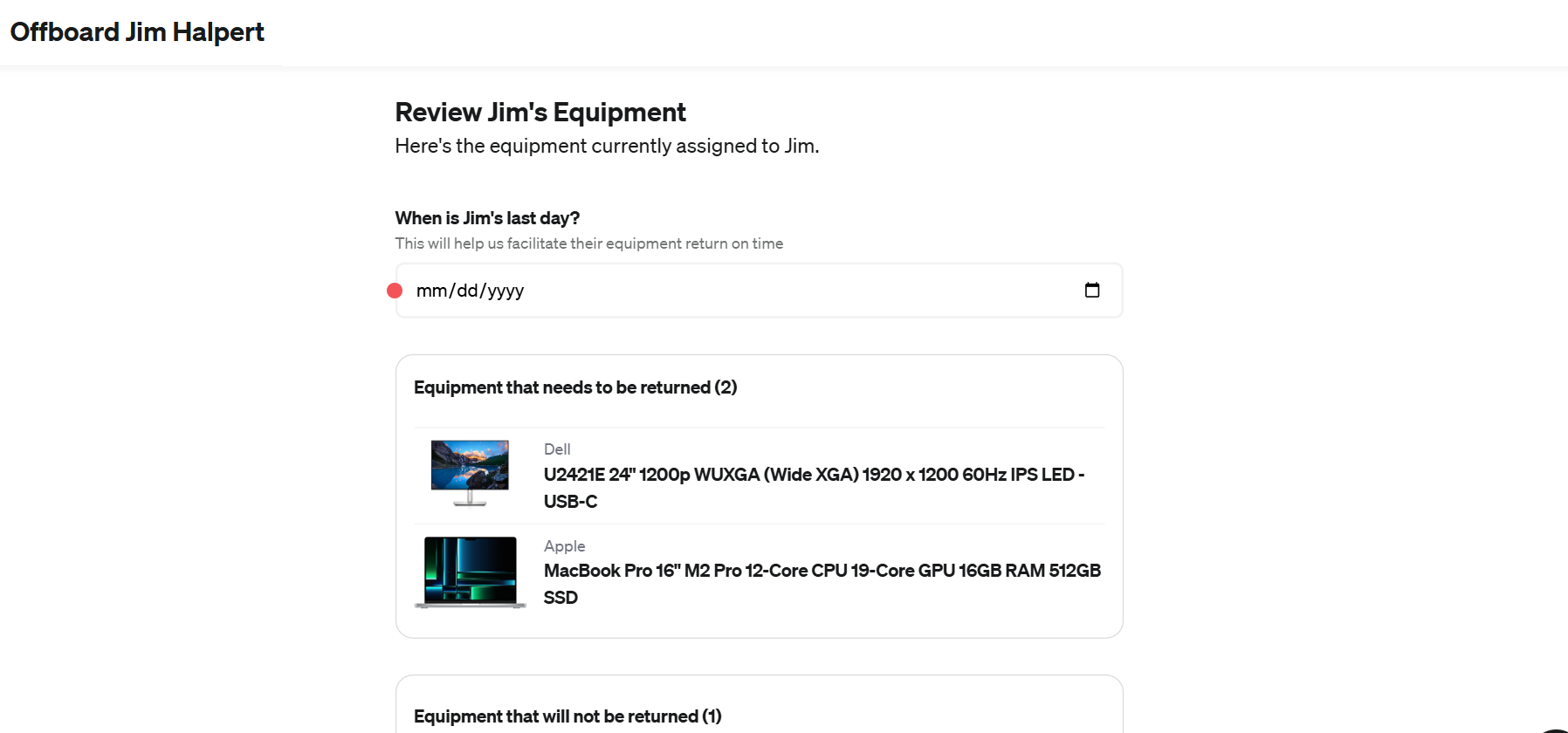
To trigger offboarding, you just need to enter the employee’s last date, select the equipment, add some contact details.
Firstbase will confirm the address and their preference (pickup or drop off) for returning the asset, and then send a retrieval kit. And because real-time tracking is available, you never lose sight of a return.
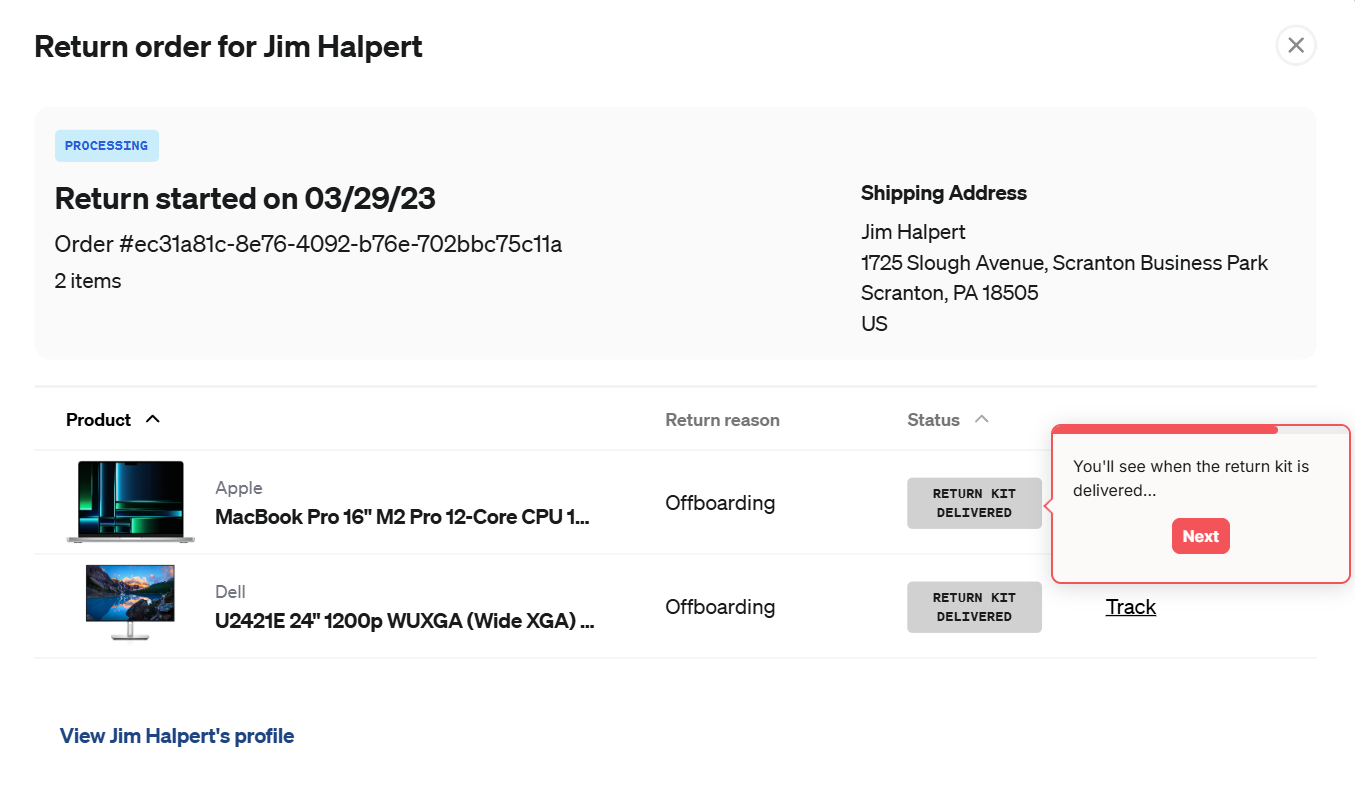
Source: Firstbase’s self-Guided Tour
Once the return is received in the warehouse, Firstbase’s team will test, grade, repair, and re-inventory your equipment so it's ready for reuse.
Even though they support 150+ countries, several users on G2/Capterra mention that their international shipping coverage network is smaller. Also, users report delayed shipping in certain regions, which can lead to poor onboarding and offboarding experiences.
Another limitation is the absence of a native CMDB. While Firstbase offers strong asset visibility, it doesn’t map relationships between assets, users, and services. And that’s something crucial for enterprises that rely on impact analysis, change management, and deeper ITSM integration.
Pricing
Firstbase offers customized pricing. You need to add some details and submit a request for the pricing.
Pros
- Firstbase has multiple warehouses that let users procure assets locally, saving time and money (Source)
- Almost every user loves how prompt and responsive their customer support team is (Source)
- The platform is modern, easy to use, and helps automate tasks, which reduces manual effort and improves efficiency (Source)
Cons
- Shipping times can be a little inconsistent, as reported by multiple users (Source)
- Multiple users say Firstbase’s international coverage is limited (Source)
Ratings
- G2: 4.8/5 (50 reviews)
- Gartner: N/A
- Capterra: 4.5/5 (10 reviews)
3. ManageEngine AssetExplorer
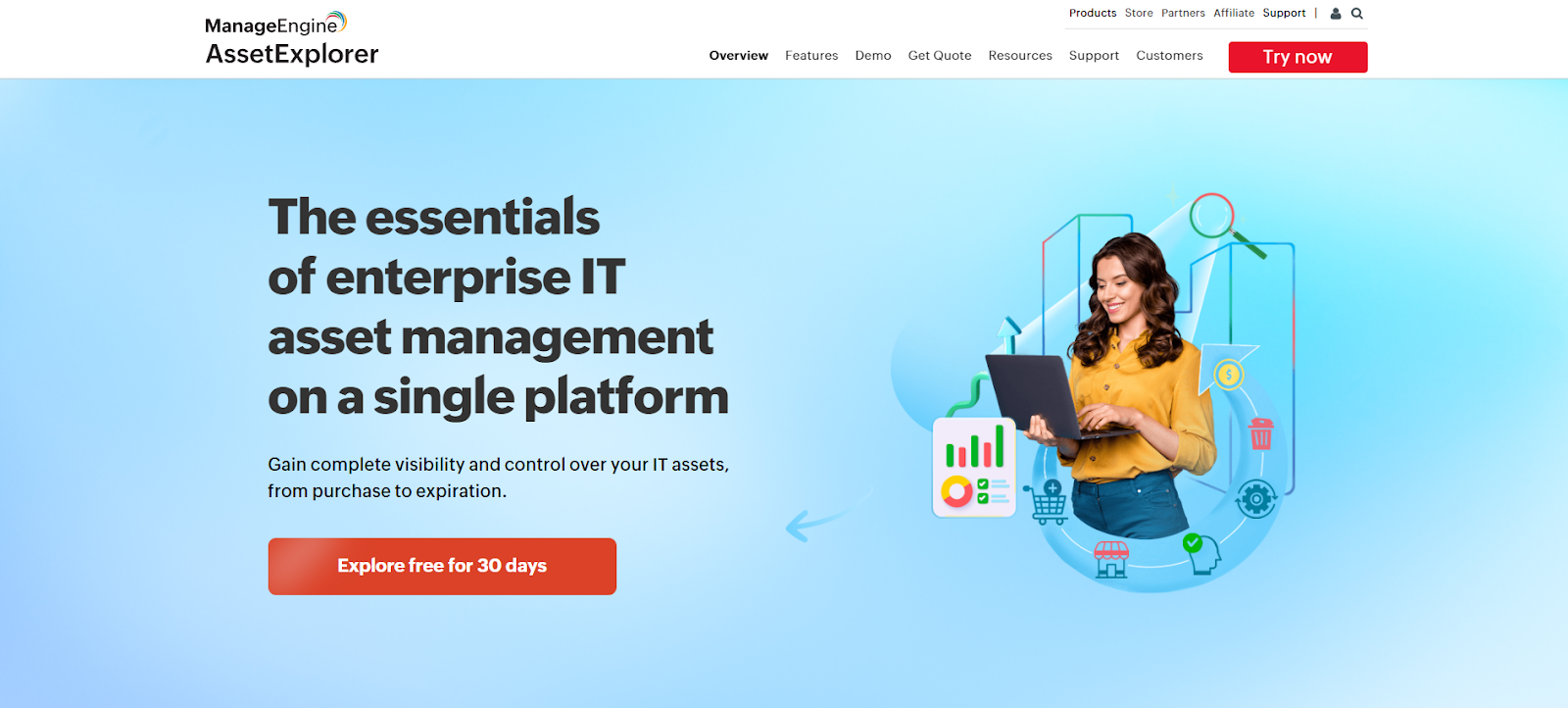
ManageEngine is an ITOps, cybersecurity, and service management platform that also offers IT Asset Management (ITAM), which helps IT managers gain control of IT assets spread across multiple sites.
It’s suited for small- to mid-sized organizations (if you’re already in the ManageEngine ecosystem, then go for it) seeking comprehensive asset management features at an affordable price.
One of AssetExplorer’s biggest advantages is its built-in CMDB combined with automated network discovery, which helps IT teams quickly identify assets and visualize relationships across their infrastructure.
However, the interface feels dated compared to newer platforms, and the relatively small number of recent user reviews makes it harder to gauge widespread adoption.
Source: ManageEngine AssetExplorer
Out of the box, you can perform hardware and software asset discovery and inventory management, implement custom workflows to automate life cycles, manage purchases and vendors, and use a CMDB to visualize the digital infrastructure.
I signed up for ManageEngine AssetExplorer's free trial for a closer look. The UI looks a little dated when compared to Workwize and Firstbase. However, it gets the job done.
It lets you add assets using multiple methods, including agent configuration, Windows domain scan, network scan, and import assets from CSV.
The network scanning feature saves a lot of time as it runs automatically and discovers and adds assets on the network to the inventory.
You can track and manage all your assets, software, hardware, and cloud from the same dashboard and create automated workflows to minimize manual work.
For instance, this dashboard shows you all the software licenses you have, what are about to expire, and what have already expired:
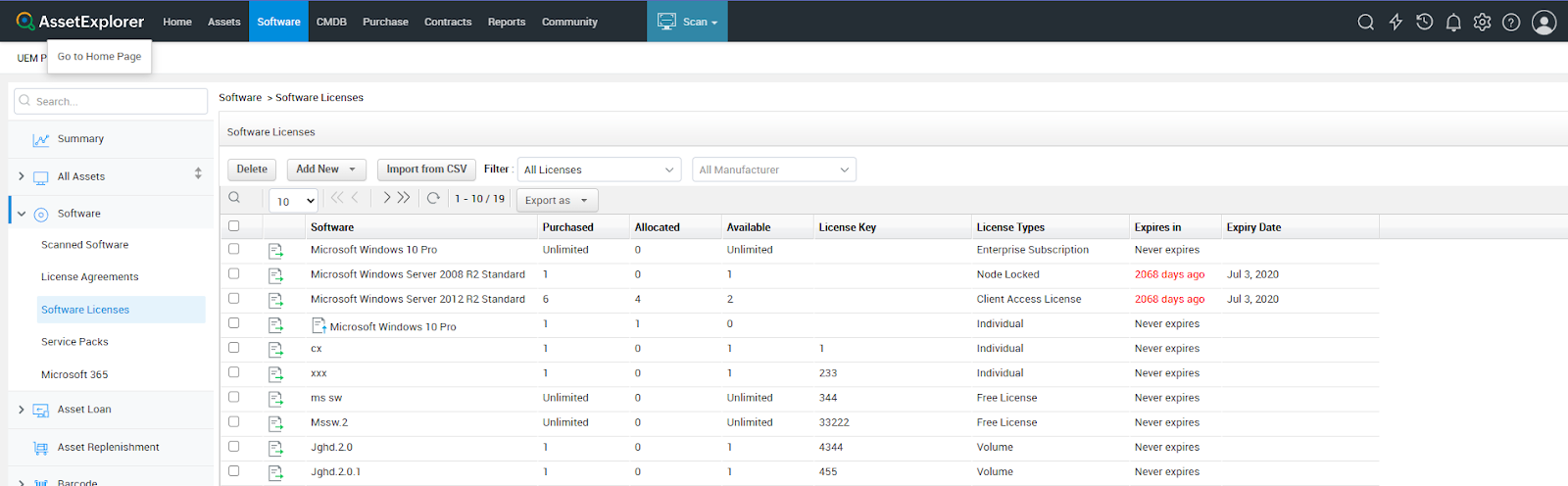
Using this information, you can renew your licenses on time and stay compliant.
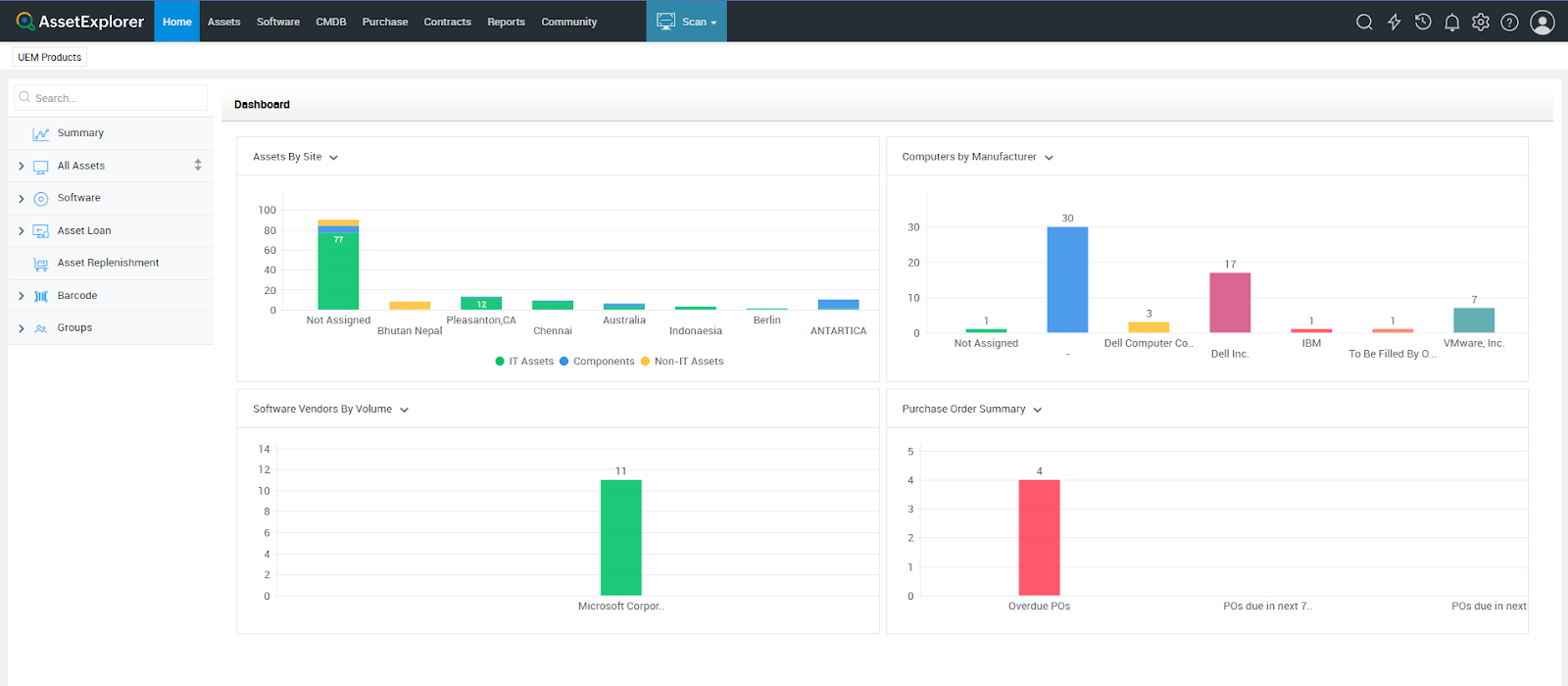
Additionally, ManageEngine AssetExplorer gives you a complete view of all your assets (IT and non-IT) and details like state, barcode, department, location, site and more:
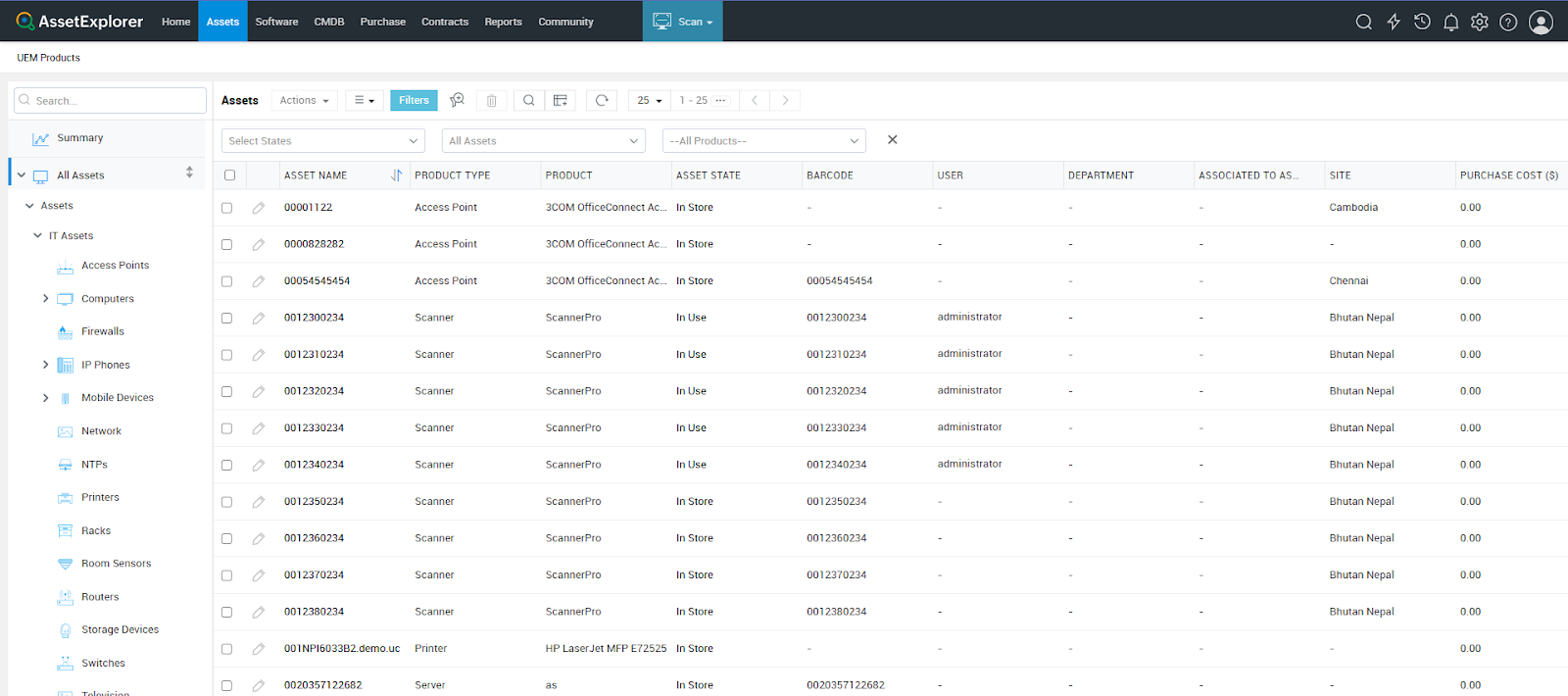
However, Asset Explorer has just 12 user reviews on G2, and the latest one is from 2024. This raises questions about its adoption rate. Also, their interactive demo is also obsolete, at least 4-5 years old.
Pricing
Both on-premise and cloud versions are available at different prices:
- The on-premises version starts at $955 annually for 250 assets.
- The cloud version starts at $115 a month for 250 assets or $1245 annually.
For complete pricing details, visit here.
Pros
- Multiple users find it affordable and easy to use (Source)
- Automated network discovery of tools saves time (Source)
- Integrates very well with the ManageEngine ecosystem (Source)
Cons
- A limited number of user reviews indicates low popularity. And the last review is from 2024.
Ratings
If you don’t want to use ManageEngine Asset Explorer for some reason, here are the Top 5 ManageEngine Asset Explorer Alternatives.
4. ServiceNow
ServiceNow is a behemoth that offers multiple enterprise-grade solutions, including ITOps, ITSM, Service Management, GRC, SecOps, IT Asset Management, and a lot more.
It is best for large enterprises with complex IT environments, especially those already using ServiceNow ITSM.
One major advantage is its depth. It gives teams strong lifecycle visibility, automation, and compliance reporting. However, ServiceNow requires a lot of time (years in some cases) and effort to set up. It is expensive, complex, and rarely a plug-and-play solution.
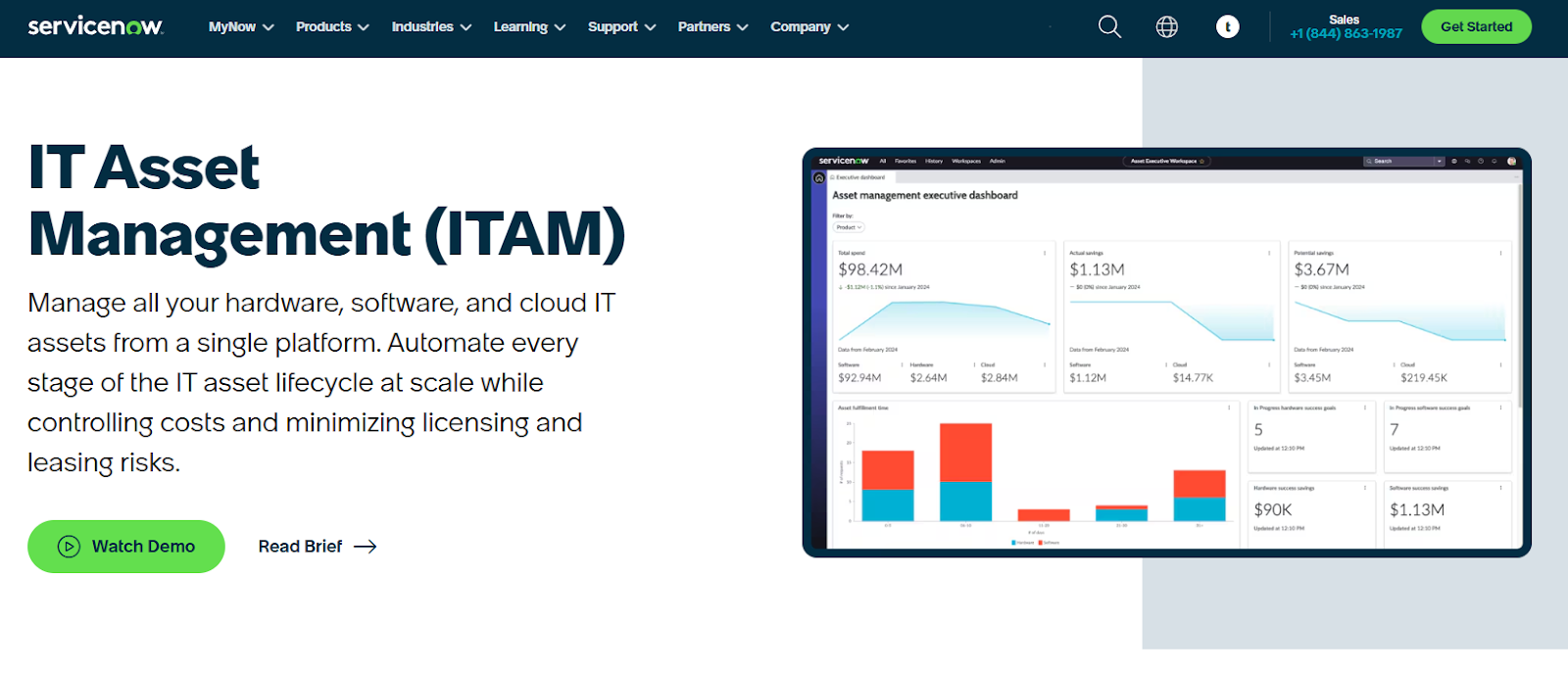
Source: ServiceNow
To understand SNOW’s ITAM features and to get a feel of the platform, I explored their interactive demos and video walkthroughs.
ServiceNow lets you track and manage your software, hardware, and cloud assets using the same platform.
So, you get complete visibility and control of all your assets across the organization, remote or onsite, throughout the asset lifecycle (from procurement to retirement) in a single dashboard. No need to switch between different tools to get information.
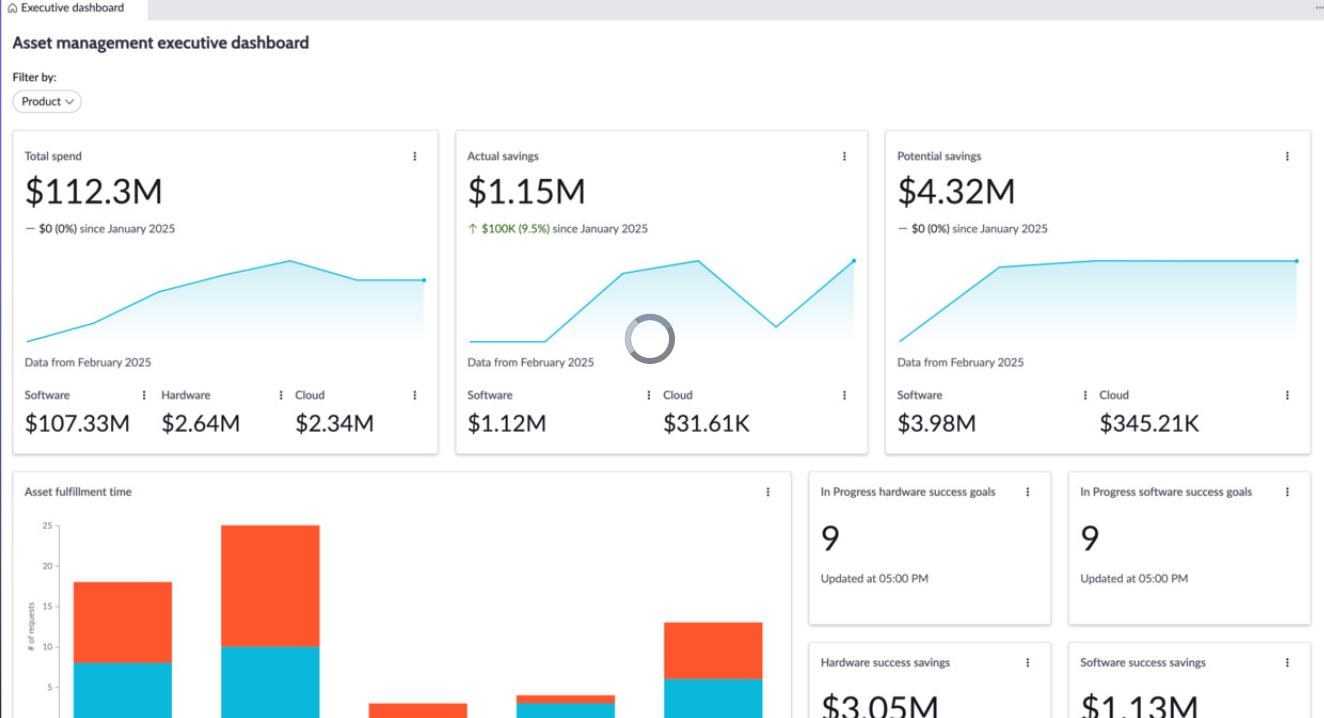
Source: ServiceNow Demo Video
With the in-depth software, hardware, and cloud asset data, you can easily identify duplication, underutilization, or overutilization and mitigate them to reduce waste and maximise ROI.
SNOW also lets you build automated onboarding and offboarding workflows, which substantially reduces the burden on your IT team.
Their reporting is pretty strong. With SNOW’s lifecycle management reporting, you can gain actionable insights and best practices to stay compliant and audit-ready from day 1.
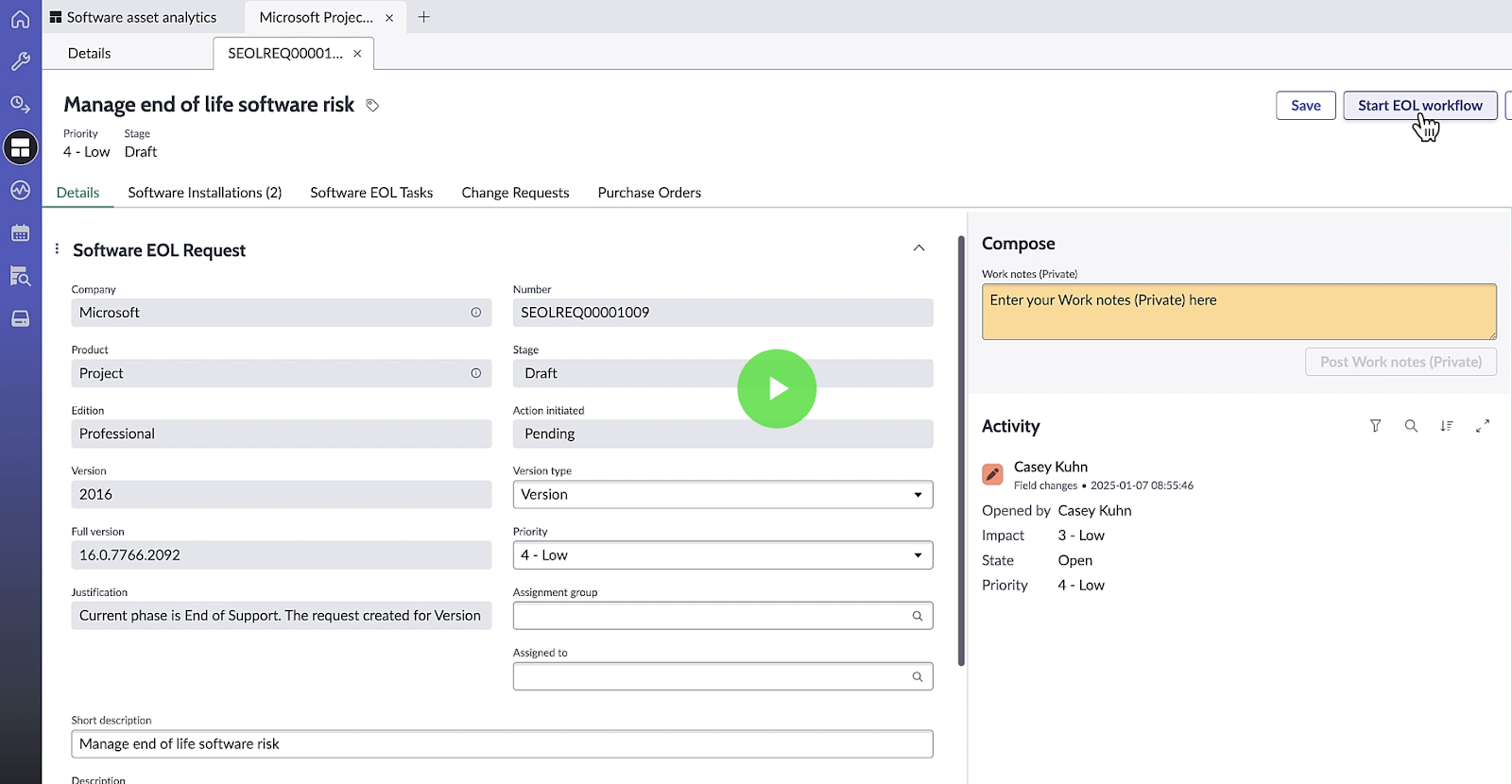
Source: ServiceNow Demo Video
Talking about SNOW ITAM’s potential, it’s immense, and labelling it as the most comprehensive ITAM solution won’t be wrong. And if you’re already using Service Now's ITSM, their ITAM solution is a great choice.
However, SNOW is built strictly for enterprises with thousands of employees and probably tens of thousands of assets. In fact, several users with 1000+ employees find it expensive.
Secondly, I found SNOW to be very hard to set up. You'd be gravely wrong if you think ServiceNow is a plug-and-play solution.
It would take a team of SNOW experts (external), hundreds of thousands of dollars, and several years to use the solution to its full potential.
This Reddit user also says it’d take at least half a million and 3 years to be able to customize and implement SNOW.

Pricing
ServiceNow requires you to fill out a simple form to provide a customized quote.
Pros
- A comprehensive ITAM solution that integrates seamlessly with the SNOW ecosystem (Source)
- Provides full visibility and control across the asset lifecycle and optimizes software and hardware costs through real-time insights (Source)
- Functions as a single system of record for all types of assets: software, hardware, and cloud (Source)
Cons
- Comes with a learning curve and is expensive and time-intensive to set up (Source)
- Users experience performance lags in very large environments (Source)
- Multiple users find the UI to be non-intuitive (Source)
Ratings
- G2: 4.4/5 (152 reviews)
- Gartner: 4.2/5 (134 reviews)
- Capterra: N/A
5. Snipe‑IT
Snipe-IT is an open-source IT asset management solution designed for small to mid-sized teams with limited employees and budgets who need something better to track assets than spreadsheets.
Snipe-IT’s biggest advantage is that it’s open-source and free to use. This makes it an excellent entry-level asset tracking tool for small teams moving beyond spreadsheets.
However, it lacks automated asset discovery and advanced lifecycle automation, making it less suitable for large distributed teams managing devices at scale.
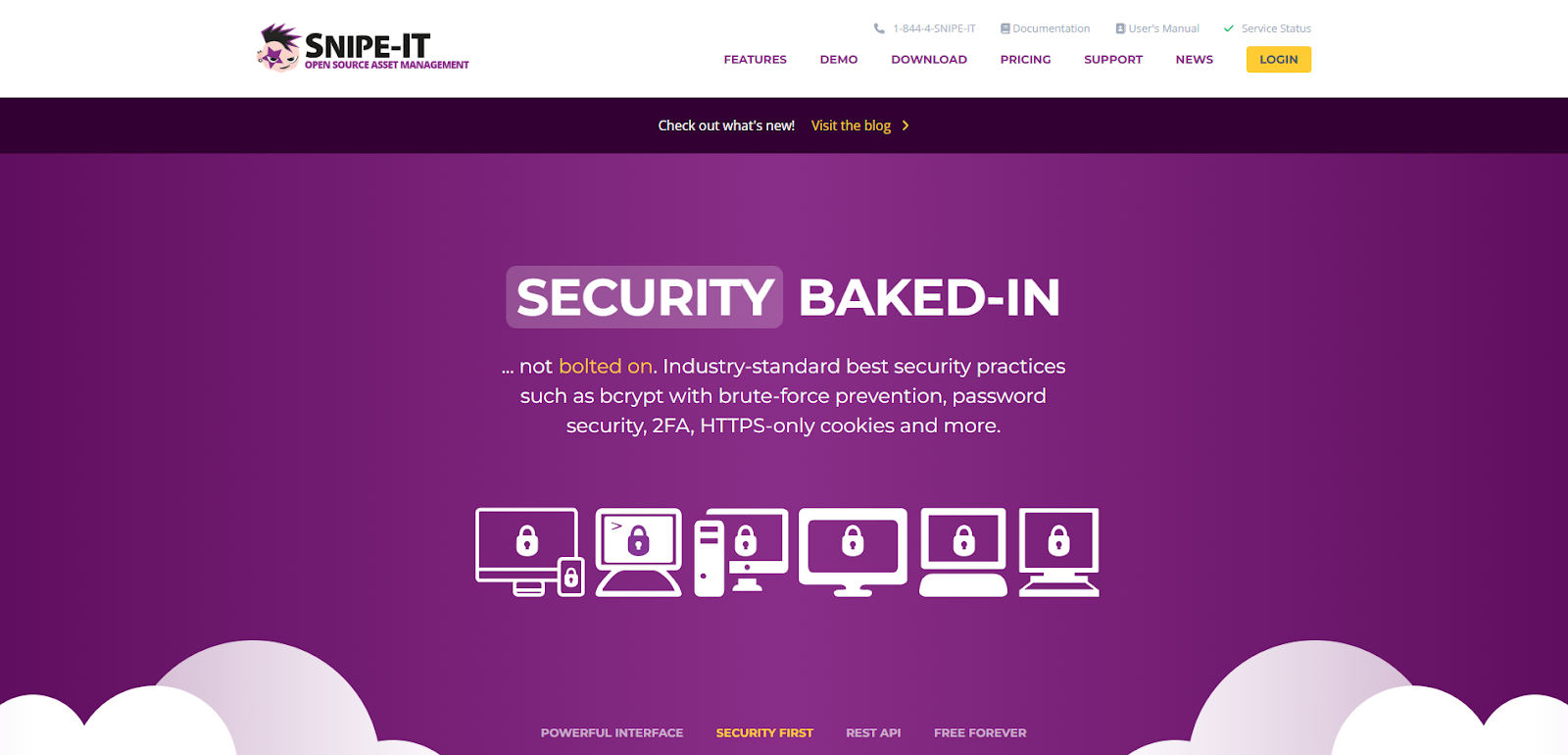
Source: Snipe-IT
To understand more about Snipe-IT, I signed up for their demo, analyzed tens of reviews, and Reddit threads.
I think Snipe-IT has a clean UI and is easy to use. Although it looks a bit old when compared to other tools, the UI is not a deal breaker.
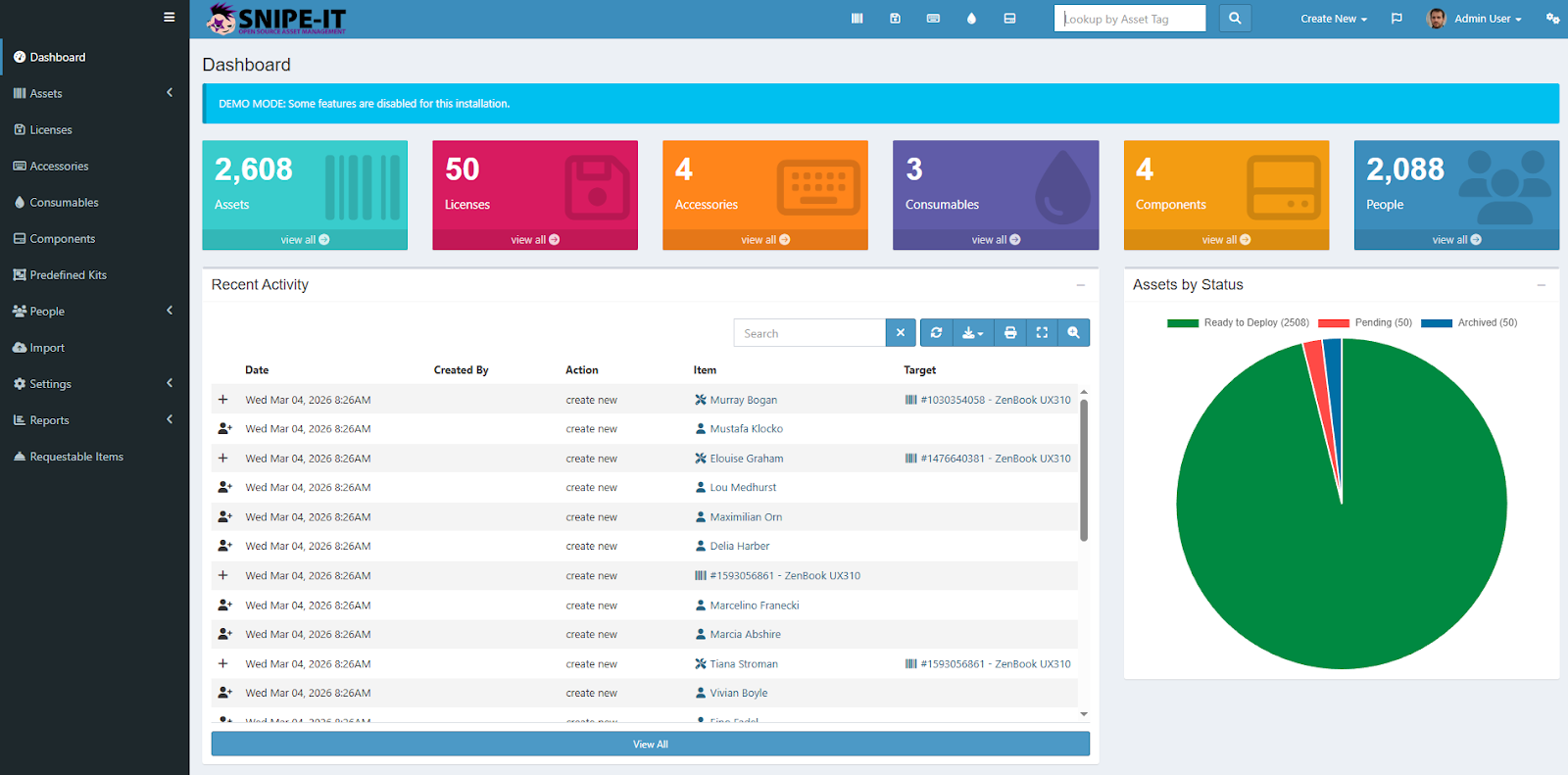
This dashboard shows you the number of assets, licenses, accessories, consumables and people you have. It also tells you which assets are ready to deploy and which ones are in pending status.
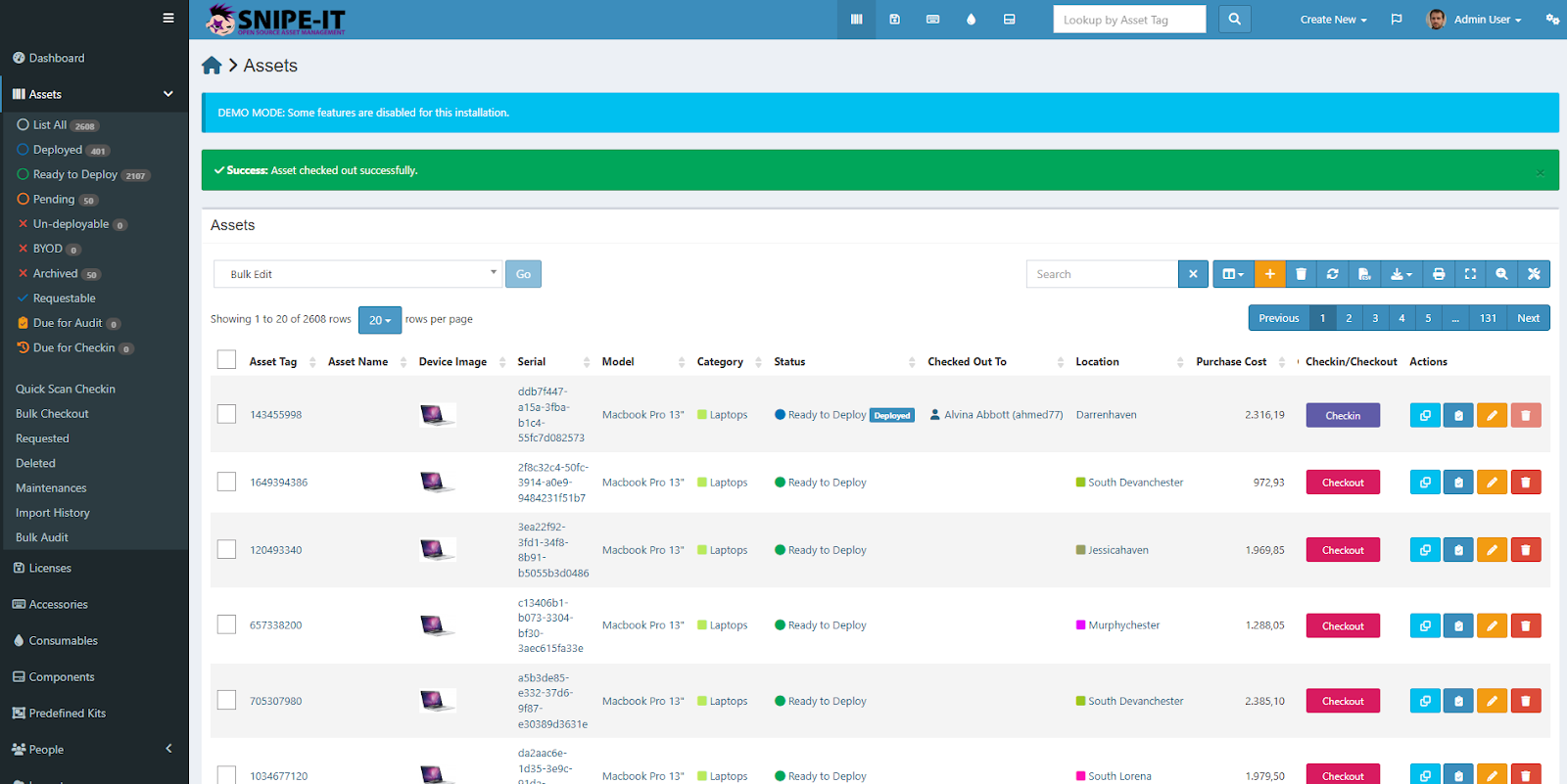
You can click assets to access the assets dashboard and get more granular details. Snipe-IT lets you check in or check out assets based on the device status and make edits to the device details.
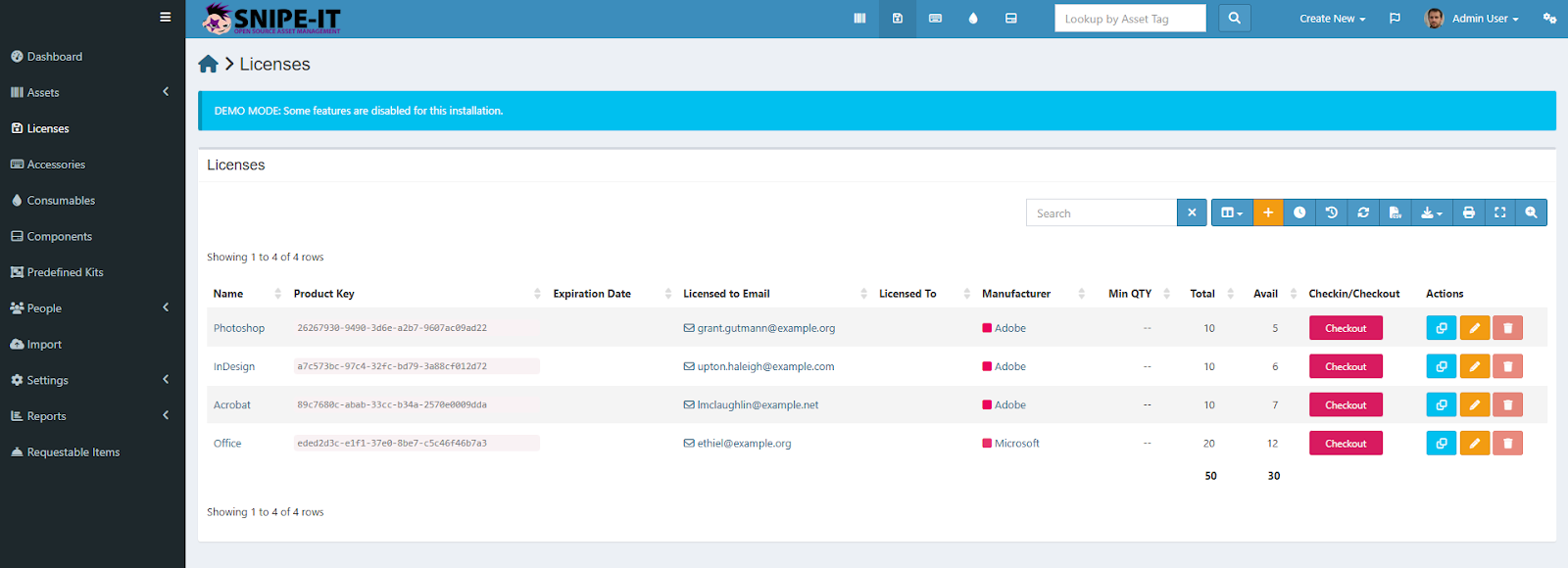
With Snipe-IT, you can check in and check out licenses just like you do for assets. Click checkout, select the user, and you’re done.
One great feature of Snipe-IT is its Predefined Kits. You can simply add the assets you want to assign to new employees when they’re onboarded.
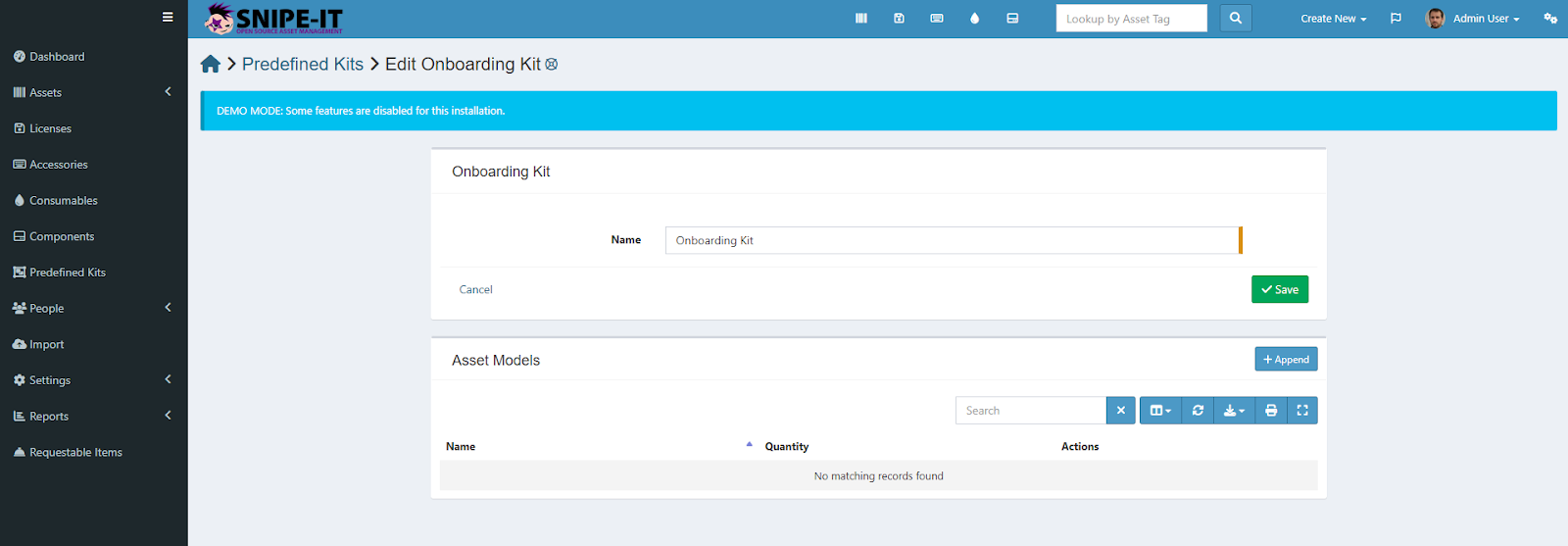
However, with Snipe-IT, you can only upload a CSV to import your assets, i.e. there’s no network discovery option, which makes the process of adding assets manual.
Plus, you need a separate tool like Workwize to handle the logistics, i.e. procurement, deployment, repairs and retrievals.
While there are multiple positive user reviews, I believe most users love it because it gets the job done and is very affordable. And this Reddit user backs my statement:

Source: Reddit
Also, Snipe-IT is not scalable, since you have to use custom integrations or scripts to do things, which can be easily automated out-of-the-box with other ITAM solutions.
It’s definitely better than a spreadsheet, but what’s the purpose of an asset tracking software if you’re doing tasks manually, especially when better options are available at affordable prices?
Take a look at this Reddit user’s comment. He explains how people aren’t aware of the better and automated options available out there:
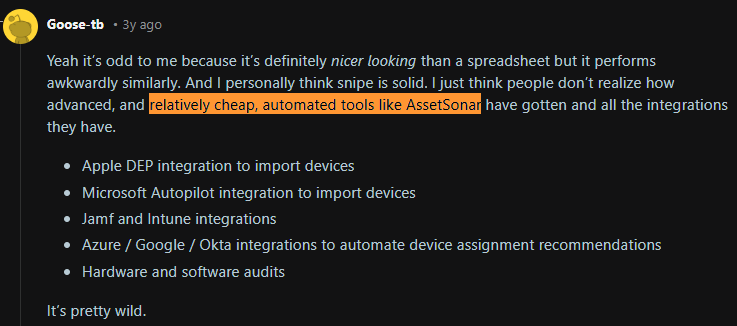
Source: Reddit
To know more about Snipe-IT, check out our detailed review: Snipe-IT Review 2026.
Pricing
The self-hosted version is free forever. However, the basic hosting plans start from $399.99 annually. Click here to find all the pricing details.
Pros
- The tool is open-source and free, and the interface is simple, which makes tracking equipment and assignment very clear (Source)
- A perfect upgrade for small teams struggling with spreadsheets.
- Community help is available for users who encounter issues while setting up or using Snipe-IT
Cons
- Installation is hard, especially if you’re self-hosting Snipe-IT (Source)
- No provision to detect assets on the network, which is time-consuming.
- Some steps require too many clicks and manual reliance, making it unsuitable for scaling companies.
Ratings
- G2: 4.6/5 (25 reviews)
- Gartner: N/A
- Capterra: 4.4/5 (22 reviews)
6. Lansweeper
Lansweeper is an asset intelligence and discovery platform that helps IT teams automatically detect and inventory IT, OT, and cloud assets within their environment.
It’s ideal for mid-sized organizations that need strong network discovery and visibility into devices, software, and vulnerabilities without manual asset entry.
What makes Lansweeper stand out is its powerful agentless and agent-based discovery engine, which continuously scans networks to keep asset inventories accurate.
However, several users report pricing increases at renewal, which can make the platform expensive over time.
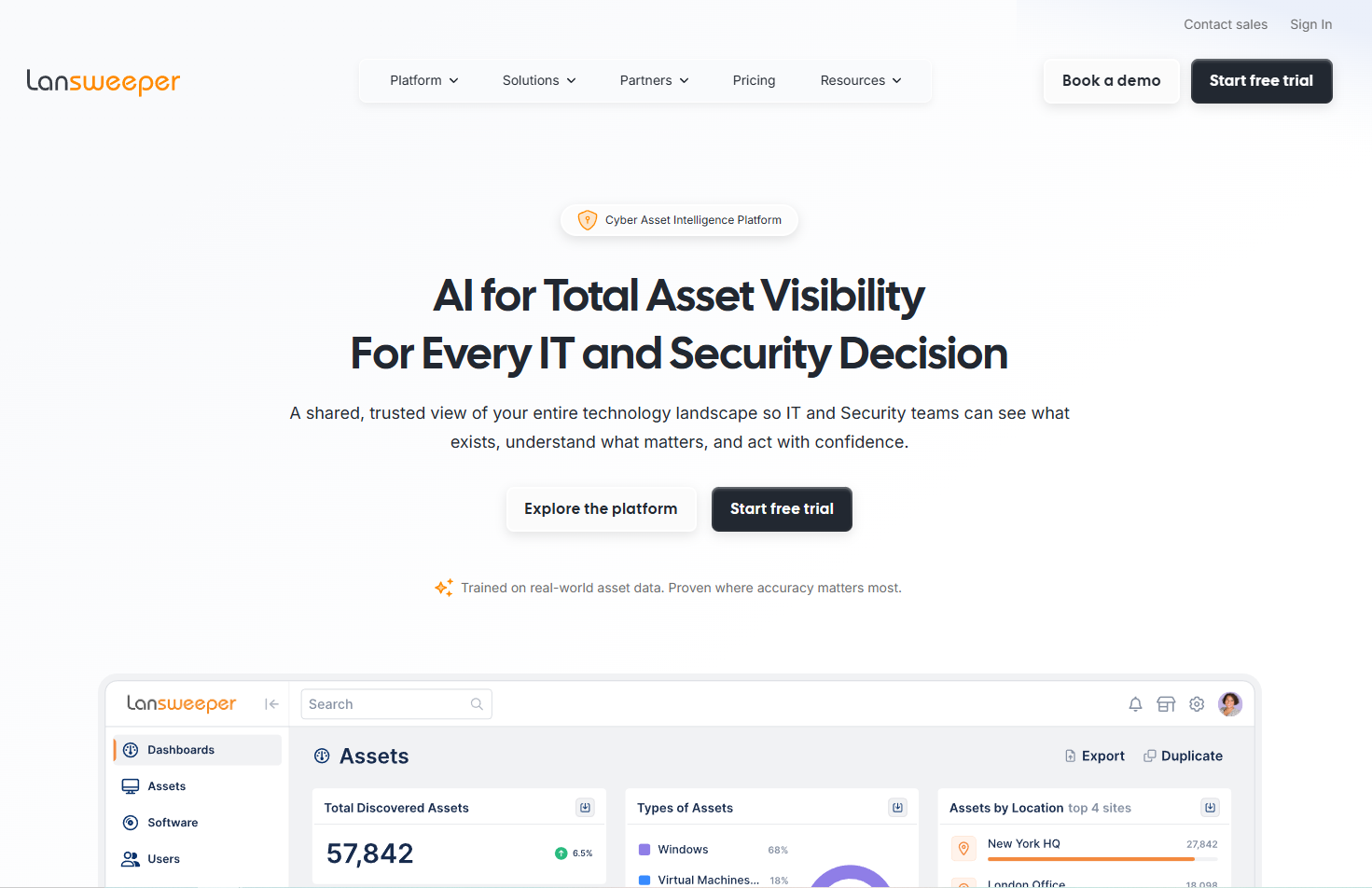
Source: Lansweeper
To understand the tool better, I signed up for their free trial. But since I didn’t have any data, I had to take a self-guided tour to explore the platform.
Lansweeper is easy-to-use and has a modern-looking UI. The dashboard is very colorful and gives insights like the total number of assets, their types, vulnerabilities, lifecycle status, among other details:
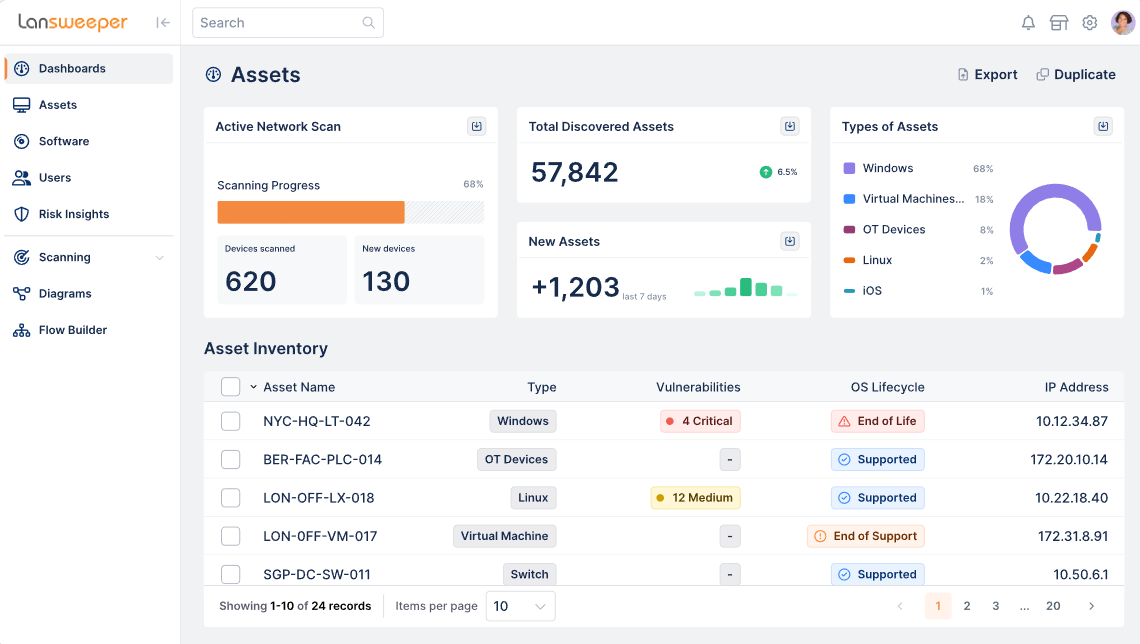
Source: Lansweeper
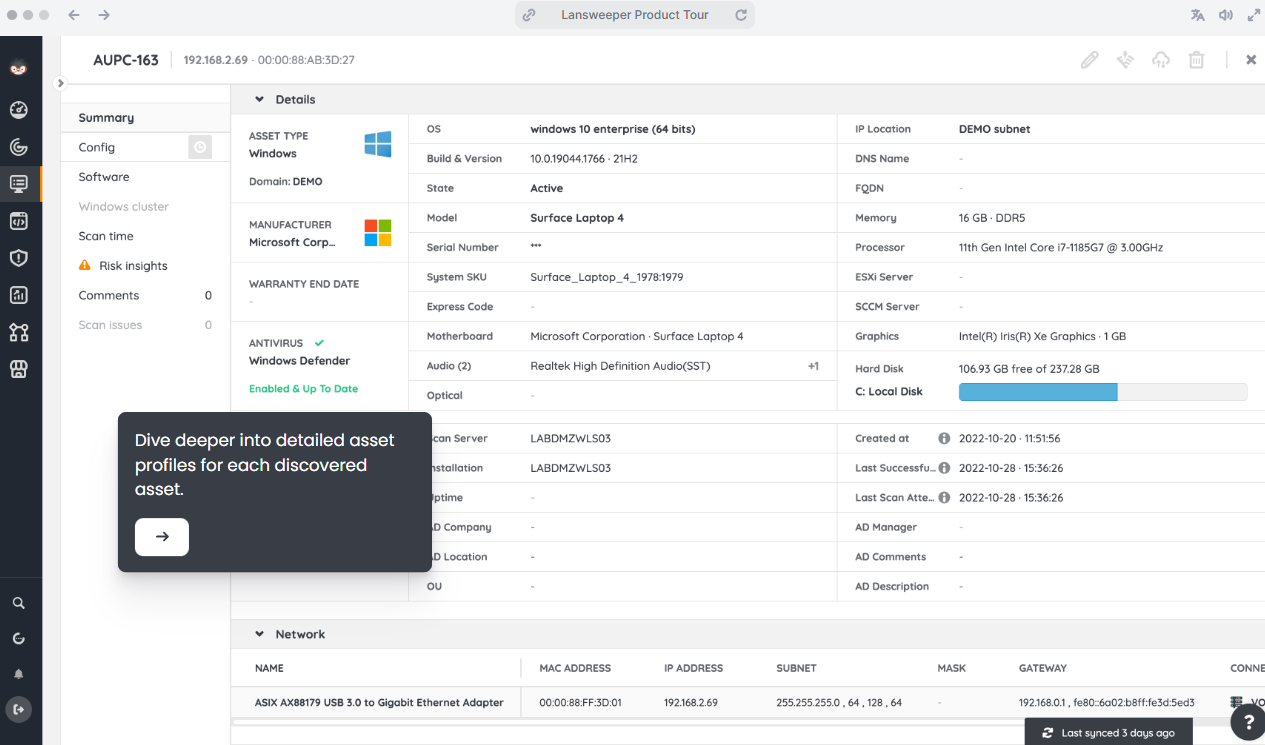
You can go to the discovered assets and dive deeper into detailed asset profiles of each asset for information like device serial number, memory, manufacturer, MAC address, IP and more:
Source: Lansweeper
The same goes for the software you have. Lansweeper gives you an overview of the total software, publishers, and the OS details for each software.
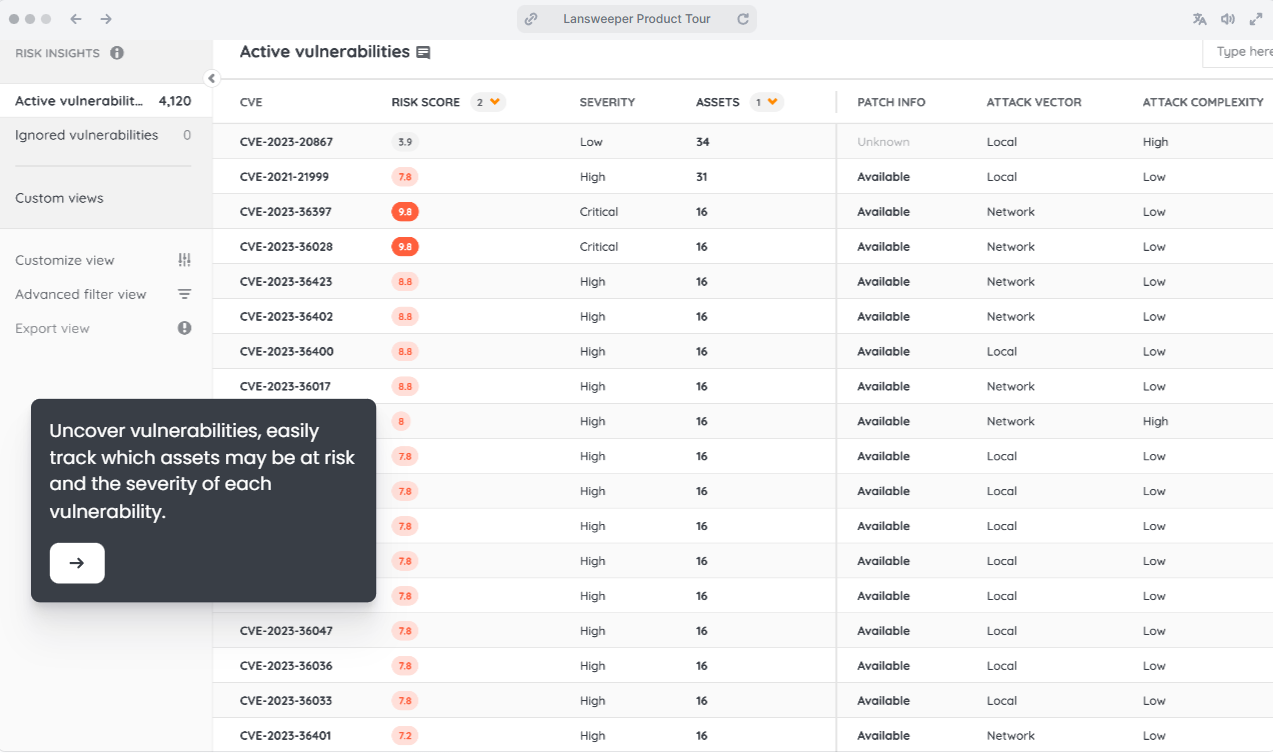
I liked how Lansweeper tells you the potential vulnerabilities that might be impacting your assets, along with their severity, patch info, attack vendor, and complexity.
Source: Lansweeper
Make sure to remember that Lansweeper is primarily known for discovering assets (using agentless and agent-based methods) on your network, adding them to an inventory, and offering you AI-powered insights to make data-driven decisions.
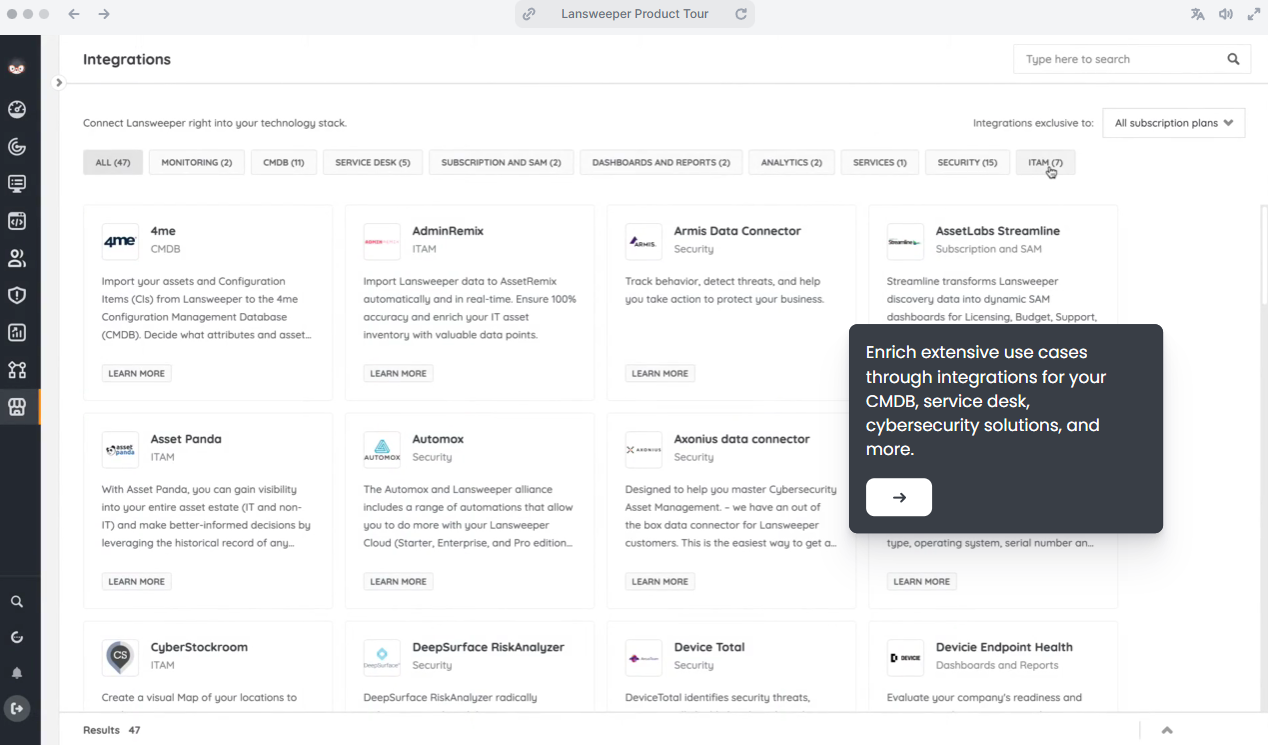
Lansweeper continuously scans for assets and syncs with your CMDB to ensure you have access to accurate and up-to-date data.
Furthermore, you can integrate Lansweeper with your ITSM platform to handle service requests and ITAM platforms for full lifecycle asset management.
Source: Lansweeper
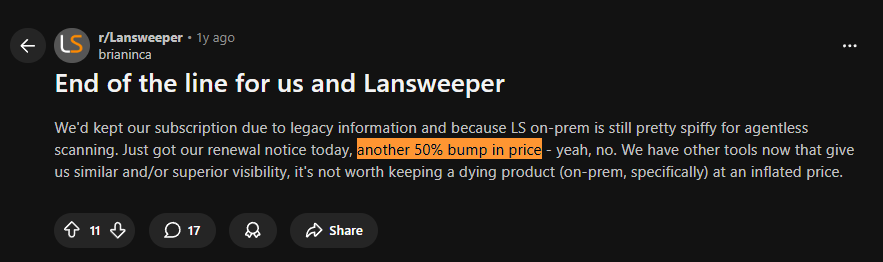
On the downside, Lansweeper is known for bumping its price on renewals. Several users on Reddit have highlighted this issue and switched to a more affordable provider.
Here are two examples wherein Reddit users are looking for alternatives because of inflated pricing:

Source: Reddit
Source: Reddit
Another thing I noticed in their pricing was that the lowest tier costs you € 219 for 2,000 assets.
And the free version supports 100 assets.
Imagine you have 300 assets. By using Lansweeper, you’d be paying unnecessarily for 1700 more assets that you don’t even have. At this point, Snipe-IT makes more sense.
In my opinion, Lansweeper isn’t suited for small IT shops or large enterprises. It’s an ideal asset tracking tool for very small (less than 100 assets), mid-sized businesses.
For a detailed review of Lansweeper, make sure you read this article: Lansweeper Review 2026.
Pricing
There’s a free plan available for users managing up to 100 assets. And the paid plans are as follows:
- Starter: € 219
- Pro: € 399
- Enterprise: Custom
Pros
- Users appreciate how easy it is to discover (agentless and agent-based) assets (Source)
- Discovers all types of devices and captures crucial information: hardware, software, printers, routers, switches, VMs, lo, and more. (Source)
- Multiple integrations are available, enabling automated workflows.
Cons
- Multiple users report serious price bumps at renewals, making the tool expensive to use in the long run (Source)
- The initial setup can be time-consuming and complex (Source)
Ratings
7. InvGate Asset Management
InvGate is an IT management platform that has two primary offerings: IT Service Management (ITSM) and IT Asset Management (ITAM) platforms.
Its ITAM offering is suited for mid-sized IT teams and organizations already using InvGate’s ITSM platform. This is because both the products integrate tightly for incident, change, and asset workflows.
InvGate’s IT asset management platform has flexible asset discovery options (agent-based, network discovery, integrations, and manual imports) to ensure that every asset is captured.
However, its node-based pricing can become expensive as asset counts grow. And the relatively small number of recent user reviews makes it harder to gauge widespread adoption.
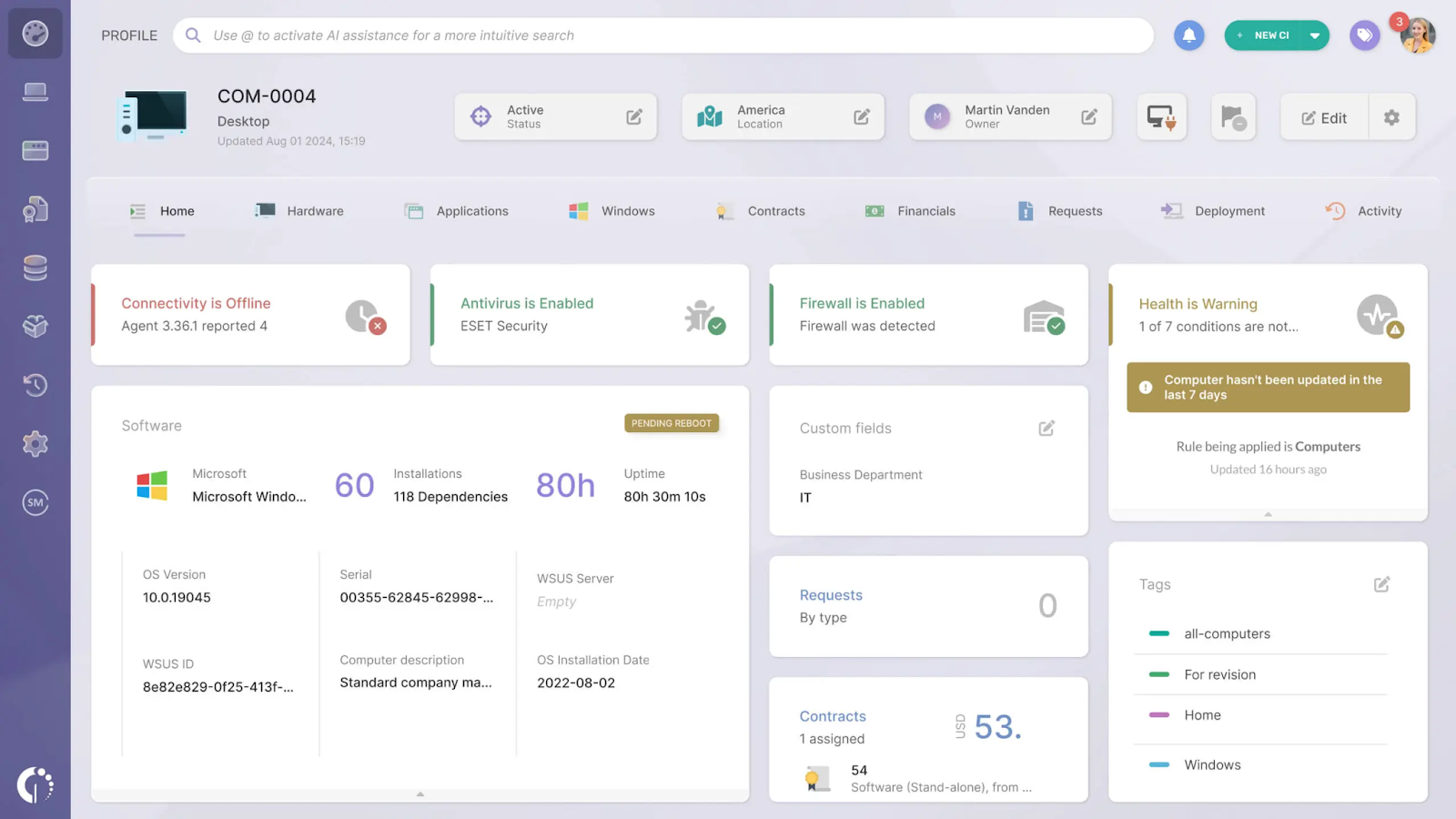
Source: InvGate
I made sure to analyze multiple 3rd party user reviews, Reddit threads, and product tour videos, and sign up for InvGate’s free trial to understand how the tool works.
Starting with the UI, it does look a little old when you look at the colors, and the sidebar icons. But that doesn’t make it any less functional or hard to use.
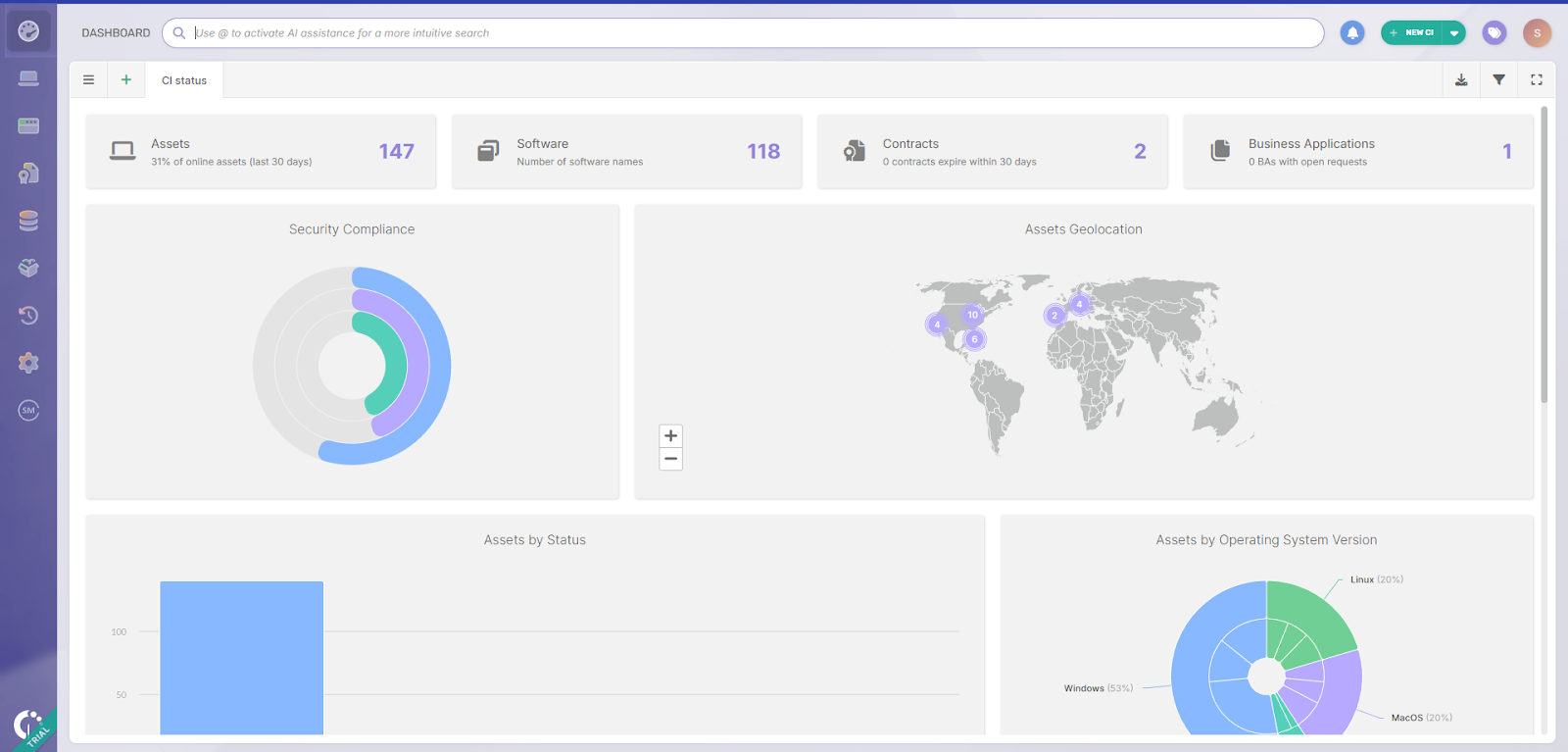
When it comes to adding assets, InvGate gives you plenty of options: manual asset creation, through an agent, network discovery, and integrations. Multiple options add convenience and help companies ensure that no asset is missed.
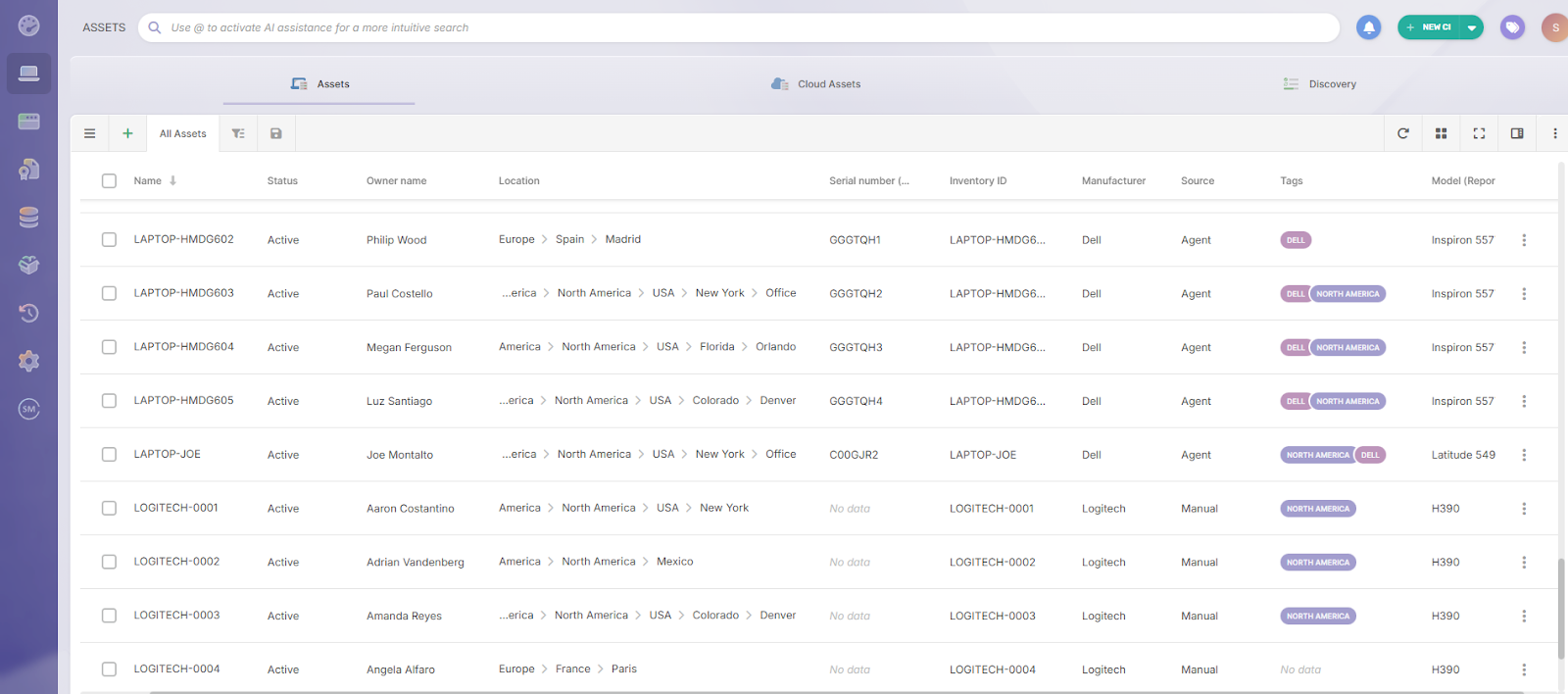
After adding the assets, this is how the dashboard looks. It tells you the serial number, location, and how the device was added, among other details.
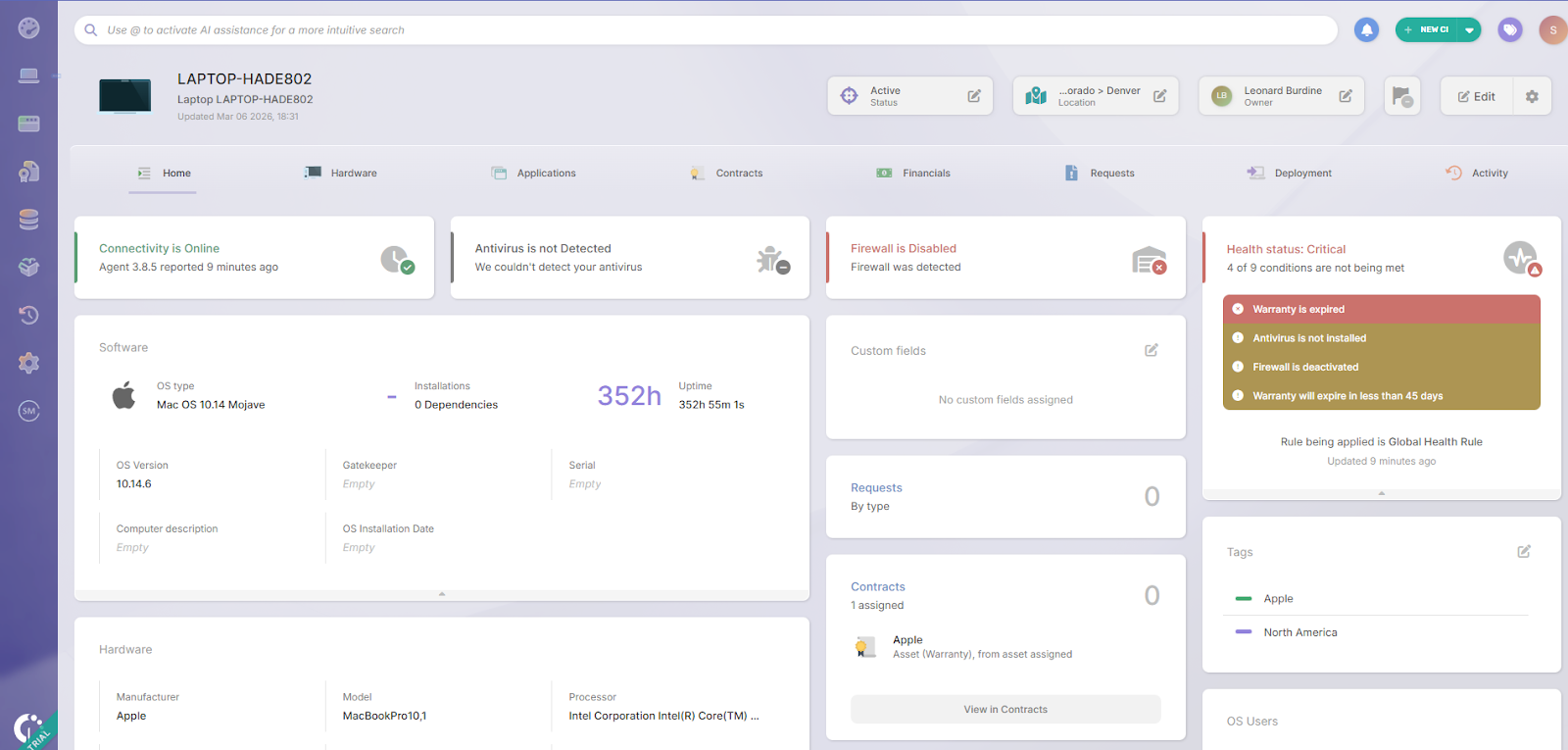
If you want to dive deeper, you can click any asset, and you’ll have this type of view with details like RAM, memory, OS, manufacturer, software or apps installed, among other things:
The software module not only lets you view all the software you have in your IT estate, but also lets you deploy software using scripts or simply by selecting the apps, without code:
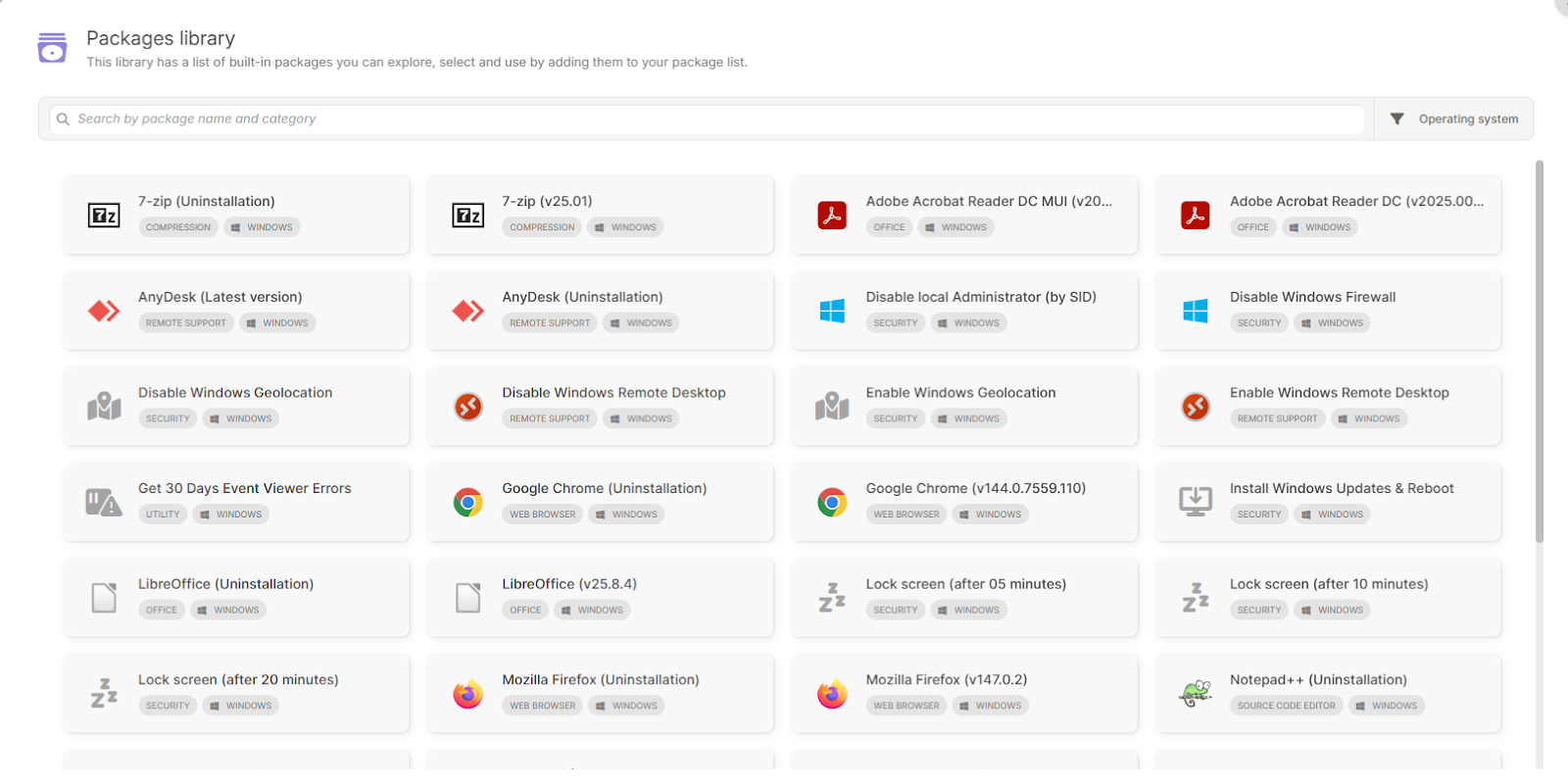
While the platform was easy to set up and use, it sometimes slowed down, even with almost no data loaded into it. Also, most user reviews are at least 2-3 years old, so there’s not much user perspective around InvGate.
Pricing
InvGate offers node-based pricing, wherein every asset represents a node. Their starter plan starts at $0.21/node per month, $1250 billed annually and supports 500 nodes. Click here to check InvGate’s pricing in detail.
Pros
- InvGate is easy to set up and use, and provides deep visibility into assets, and supports automations, reducing manual reliance (Source)
- Offers multiple methods (agent-based, network discovery, integrations, and manual) to add all types of assets (Source)
- The dashboards are customizable and display crucial information that shapes decisions.
Cons
- A limited number of user reviews (most are 2-3 years old) makes me question it’s adoption rate.
- Node-based pricing might make it very expensive for enterprises with hundreds of thousands of assets.
Ratings
8. Flexera One
Flexera ITAM is an enterprise-grade IT asset management platform designed for organizations with hundreds of thousands of assets and complex software licensing and cloud cost management needs.
What makes Flexera stand out is its advanced software license intelligence and normalization, particularly for complex vendors like Oracle and IBM.
However, the platform comes learning curve during implementation, especially for teams new to enterprise ITAM systems.
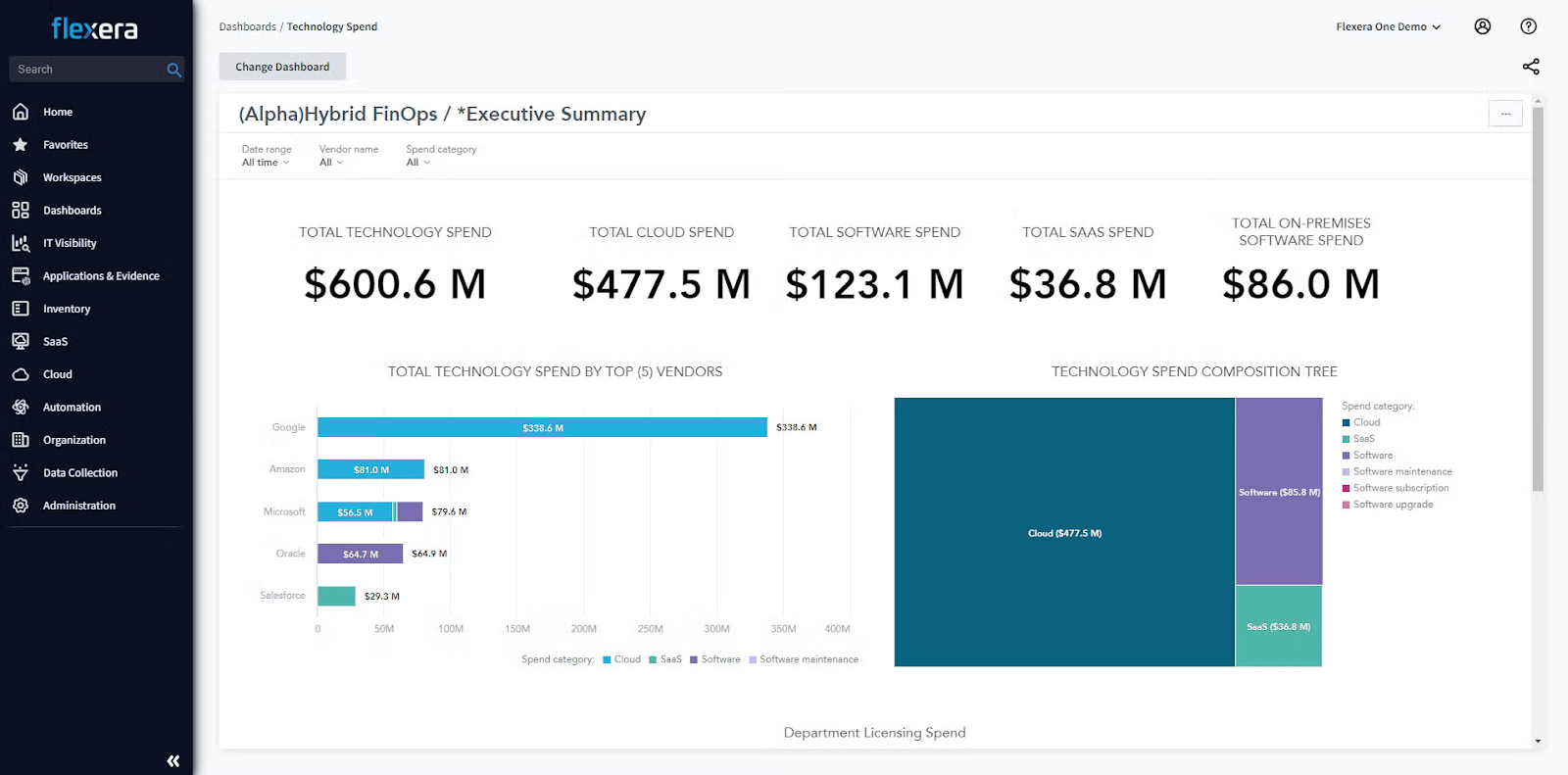
Source: Flexera ITAM
Flexera One ITAM unifies Software Asset Management, Hardware Asset Management, and SaaS management into a single platform.
You can manage asset lifecycles, maximize software license utilization, defend against audits, and strengthen your position in vendor negotiations.
The hardware summary dashboard gives you detailed information about your hardware assets, including manufacturer details, products, models, devices, categories and more. And this hardware not just includes laptops or servers, it also includes hubs/switches, virtual machines, firewalls and more.
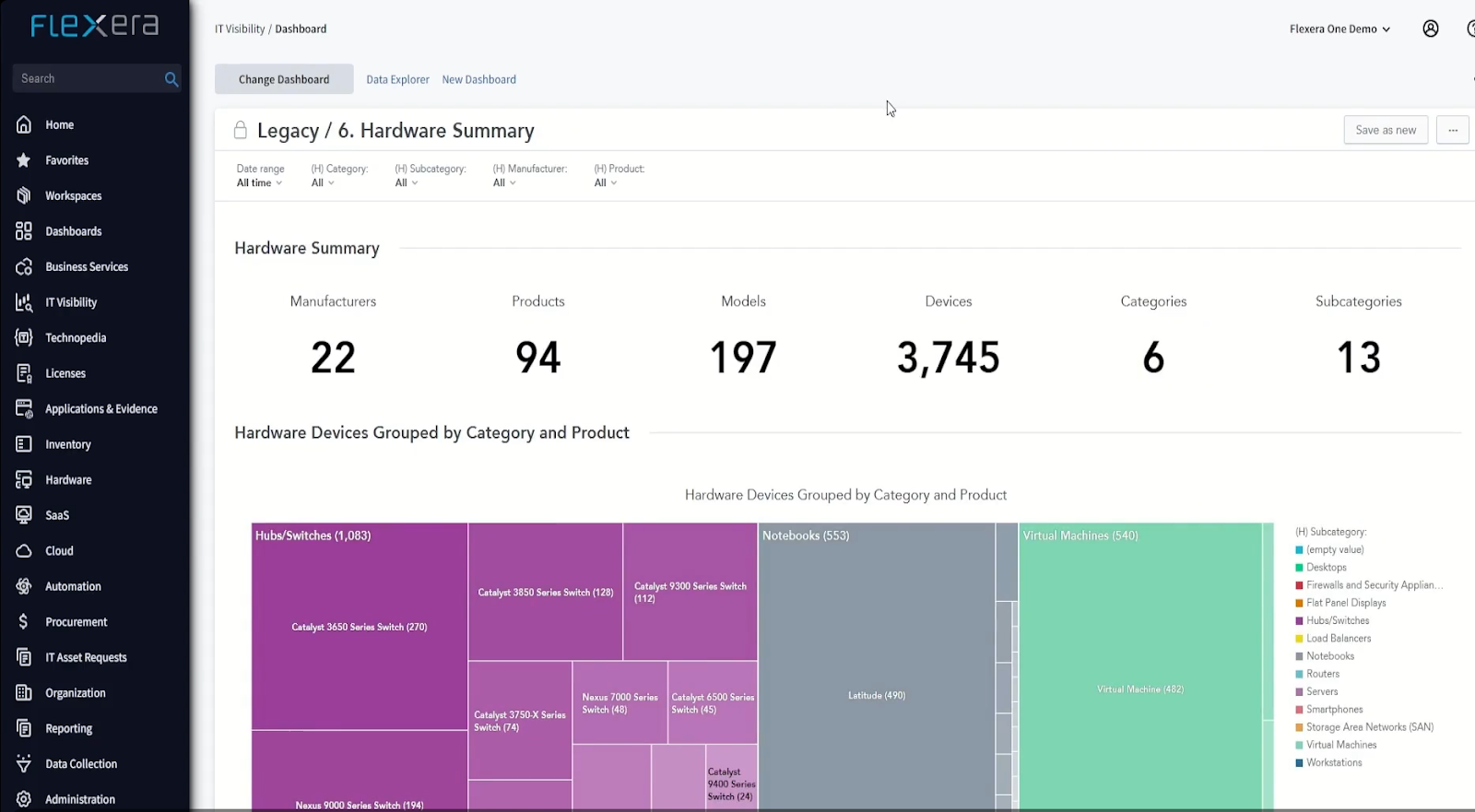
Source: Flexera ITAM
After watching its walkthrough videos, I found Flexera One ITAM to be very similar to ServiceNow ITAM in terms of the key offerings.
For starters, both offer deep visibility into assets and support software, hardware, and cloud-based asset management. Also, Flexera’s dashboards (similar to SNOW’s) offer in-depth hardware asset information, making data-driven decisions easier:
For instance, you can instantly determine which assets/devices are obsolete and which ones are becoming obsolete in the coming days.
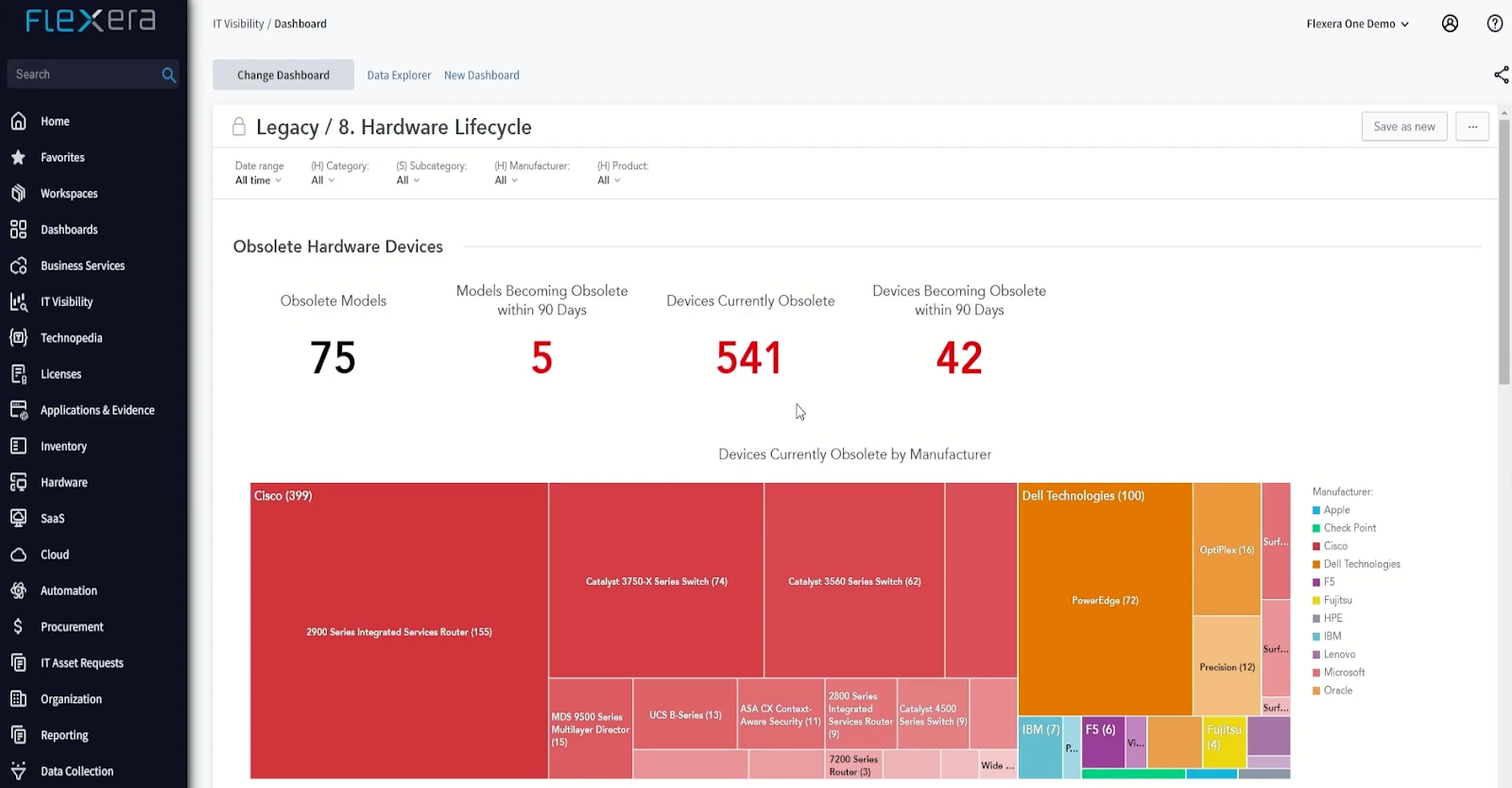
Source: Flexera Hardware Asset Management Walkthrough
However, one thing that Flexera does better is the software license intelligence & normalization. Flexera One is known for very deep software usage recognition, normalization, and entitlement calculation, especially for complex vendor licensing (e.g., IBM, Oracle).
Another key differentiator is the ease of setup/implementation and use. Flexera One is easier to use, simpler, and more affordable to implement than ServiceNow’s ITAM. In fact, Flexera One is rated higher on G2 for ease of setup and ease-of-use.
While both tools are intended for enterprise use, I firmly believe Flexera One is a great choice if you aren’t in the ServiceNow ecosystem. And if you are (i.e., using ServiceNow ITSM), you should definitely go for ServiceNow ITAM as it integrates like a breeze.
Pros
- Deep visibility allows users to identify unused licenses and rightsize cloud resources, driving cost savings (Source)
- Integrates smoothly with ITSM and other platforms, simplifying automation (Source)
- Multiple users find the customer support to be top-notch, which is impressive for a tool of this size (Source)
Cons
- Performance lag is a popular issue among Flexera ITAM’s users (Source)
- There is a learning curve, especially during implementation (Source)
- Users face issues while creating customized reports (Source)
Ratings
I could not find ratings specifically for Flexera’s ITAM solution. But here are the ratings for the entire platform:

9. AssetTiger
AssetTiger is a lightweight cloud-based asset tracking tool designed to help organizations manage and monitor physical assets such as laptops, equipment, and inventory.
It’s ideal for schools, nonprofits, and small businesses (with limited budgets) that need a simple way to track asset ownership, location, warranties, and depreciation.
What makes AssetTiger stand out is its ease of setup and generous free tier supporting up to 250 assets. This makes it very attractive for budget-conscious teams.
However, it lacks automated asset discovery, software license tracking, and lifecycle automation, limiting its usefulness for mid-sized or enterprise IT environments.
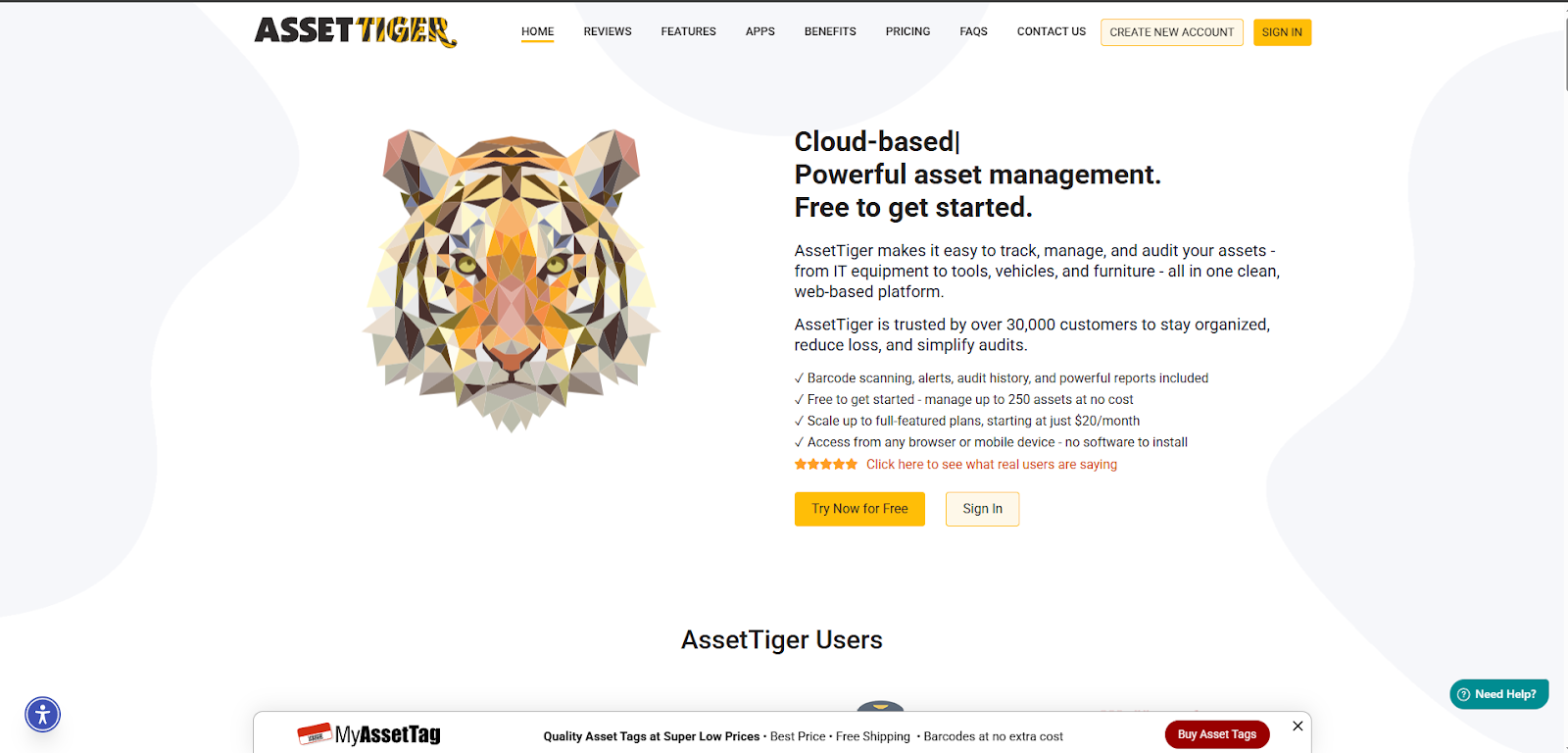
Source: AssetTiger
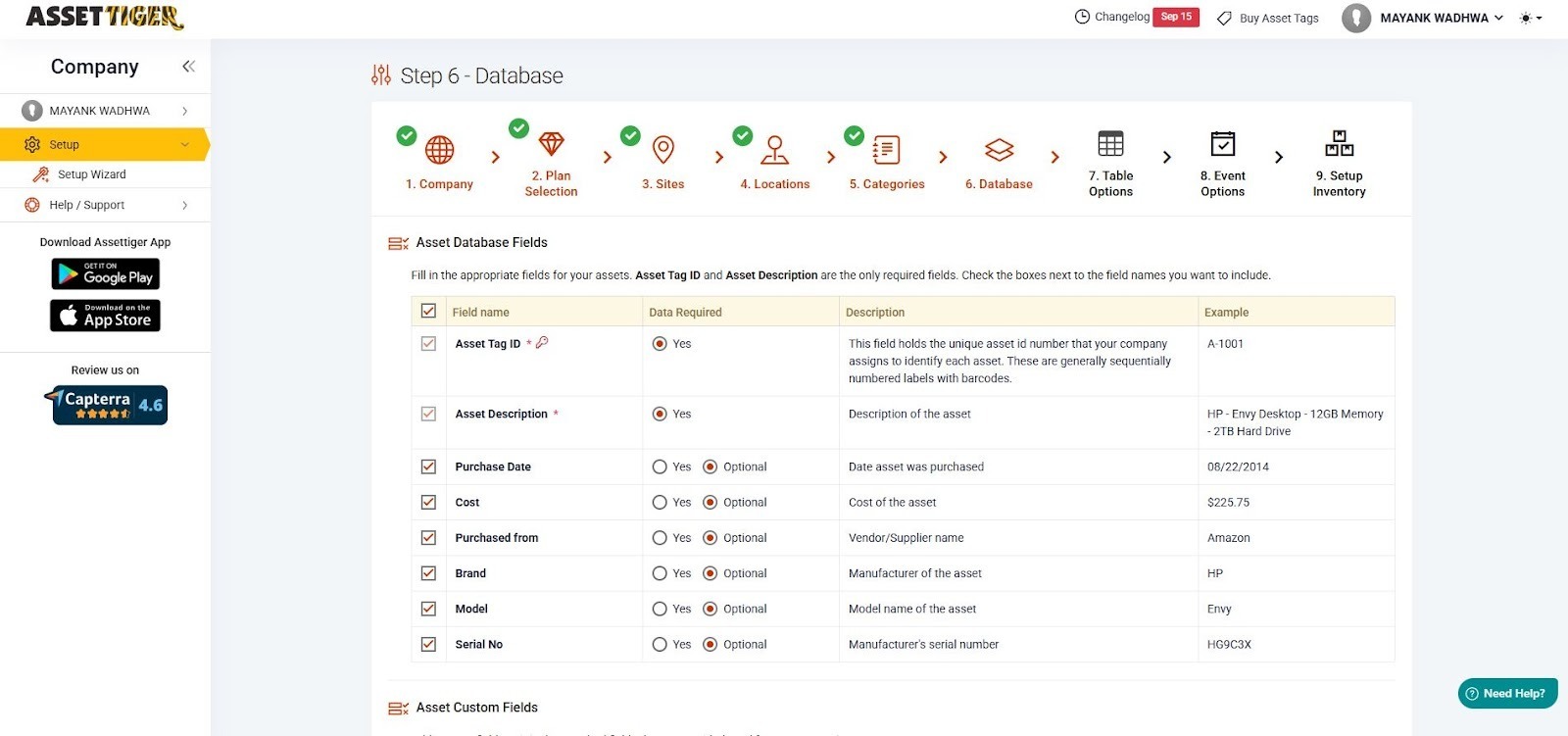
To understand it’s functionality, I signed up for Asset Tiger’s free trial and also reviewed multiple demo videos on their platform. The platform was very easy to set up. Just enter a few simple details, and you’re good to go.
For instance, it asks you to add any custom fields so that you can track more asset information:
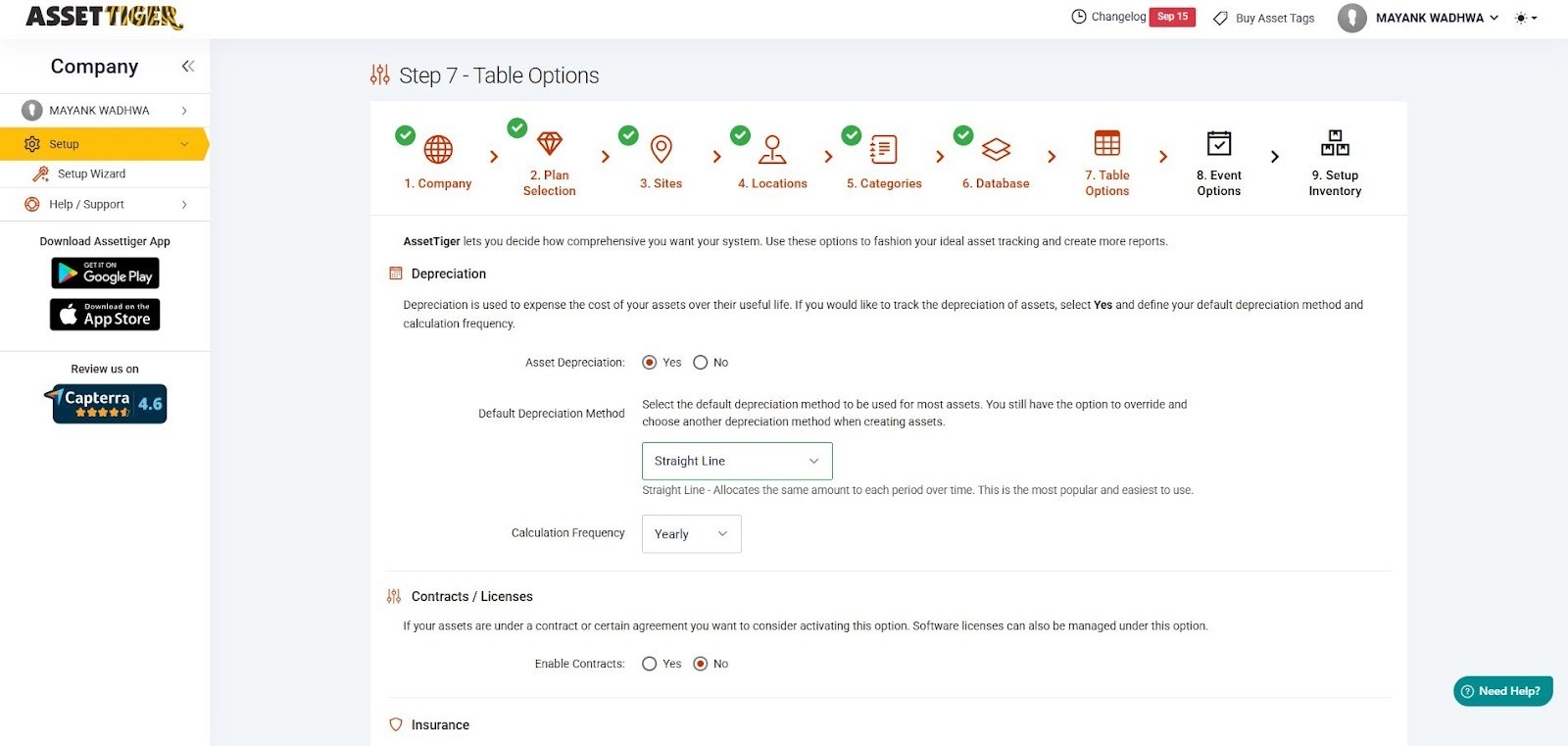
It lets you track crucial information like depreciation, contracts, warranties, and more:
You can even set up custom alerts wherein Asset Tiger will notify you if the assets are past the lease date, or the warranty is due:
After analyzing the platform and demo videos, I got to know that Asset Tiger has no asset discovery capabilities.
You can either manually add assets one-by-one or upload a template-based spreadsheet to add assets to Asset Tiger. Plus, it lacks software tracking capabilities.
And this makes it unsuitable for mid-sized or large organizations, as the ability to track software and network discovery is a must.
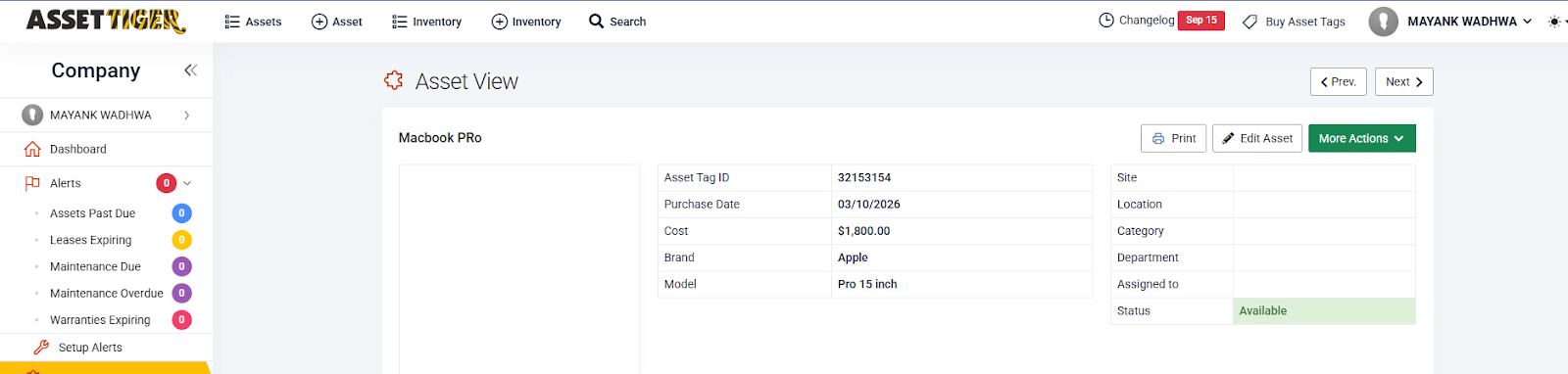
Nevertheless, after adding asses manually, here’s how the dashboard looks:
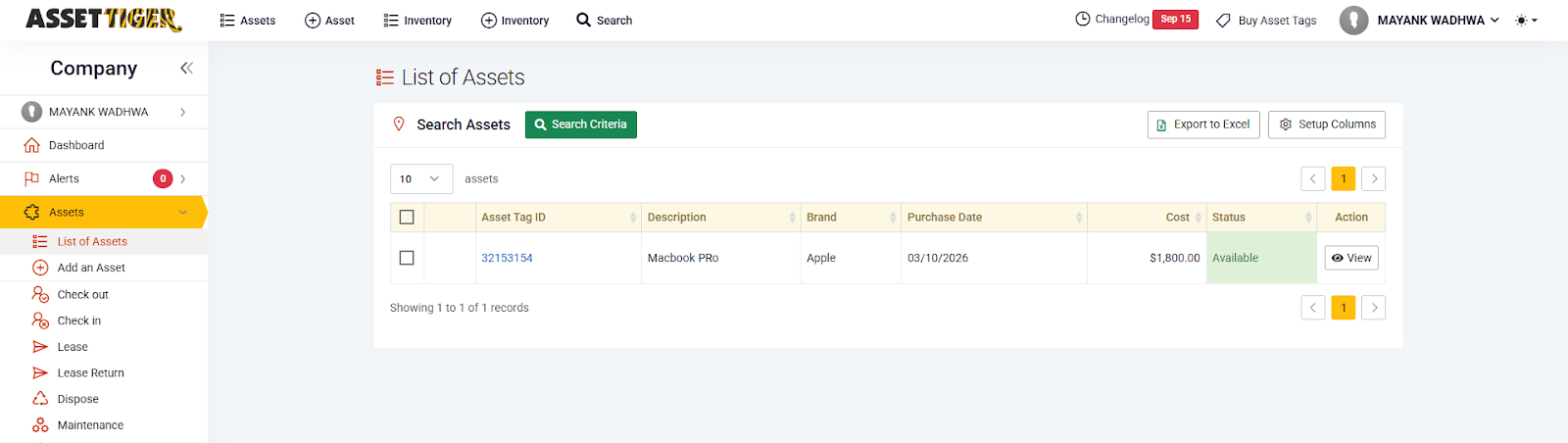
You can select the asset, add more details, and perform actions like check-in or check-out, update its status, and more.
Finally, based on multiple 3rd party user reviews, I find AssetTiger suited for a price-sensitive audience seeking basic asset tracking abilities.
Pricing
There’s a free tier that supports up to 250 assets. And the paid plans start at $20 a month. For complete details, you can check their pricing here.
Pros
- Affordable solution: Offers a free plan for up to 250 assets.
- Because it has a mobile app, you can add or update the inventory on-the-go.
- Very easy-to-setup and use.
Cons
- Lacks the ability to track software assets.
- No network discoverability or integrations available with ITAM platforms.
- Limited to simple estates with entry-level asset tracking requirements.
Ratings
Use this format:
- G2: 4.5/5 (15 reviews)
- Gartner: N/A
- Capterra: 4.6/5 (270 reviews)
Here’s a detailed Asset Tiger review to help you determine if it’s the right IT asset management (ITAM) solution: AssetTiger Review 2026.
10. Reftab
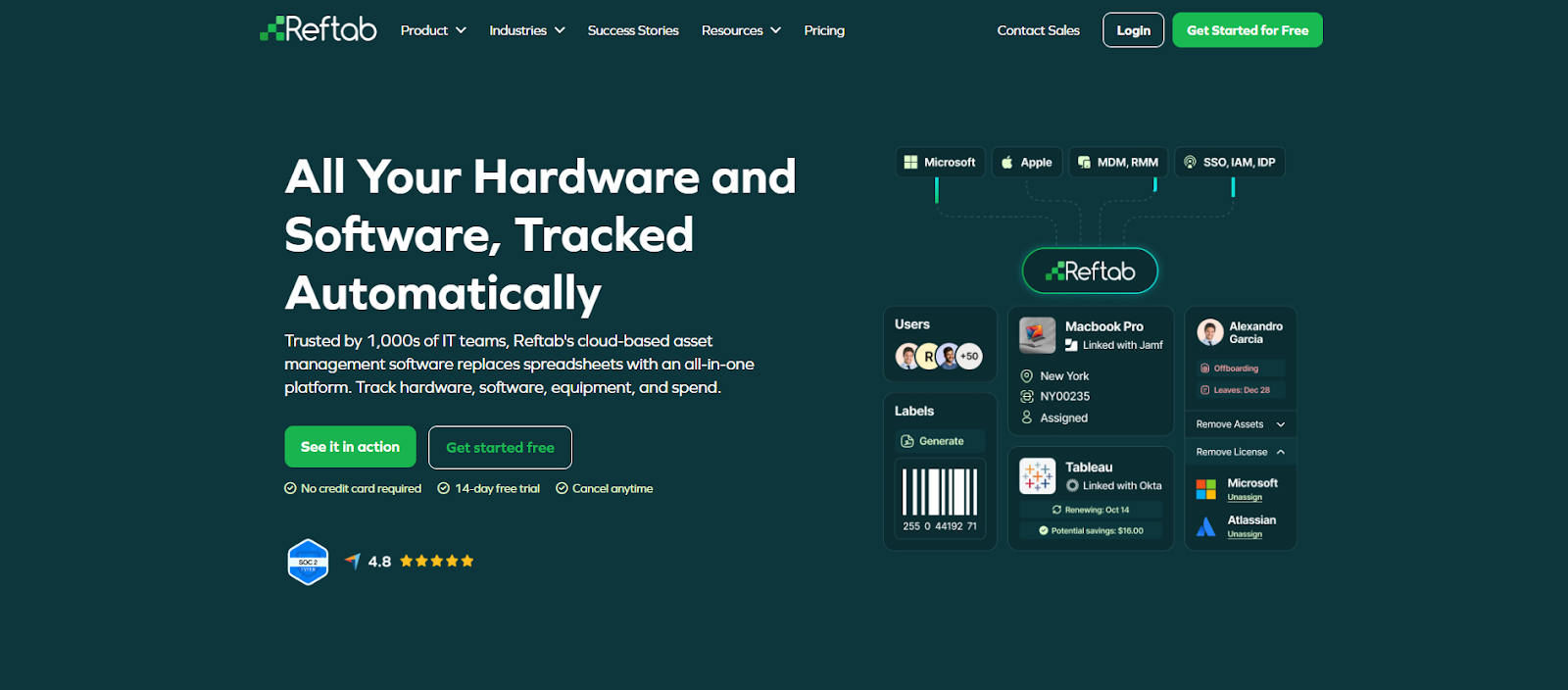
Reftab is a cloud-based asset tracking platform designed for SMB IT teams, MSPs, schools, and healthcare organizations managing hundreds or a few thousand assets.
It integrates with MDM tools like Jamf and Microsoft Intune, which automatically sync devices and installed software into the asset inventory.
However, it lacks deeper enterprise ITAM capabilities like automated network discovery and fully automated lifecycle workflows.
Source: Reftab
To get a better understanding of the tool, I analyzed multiple case studies, user reviews, and also signed up for their free 14-day trial. This is how the dashboard with just one asset (I could add one) looks like:
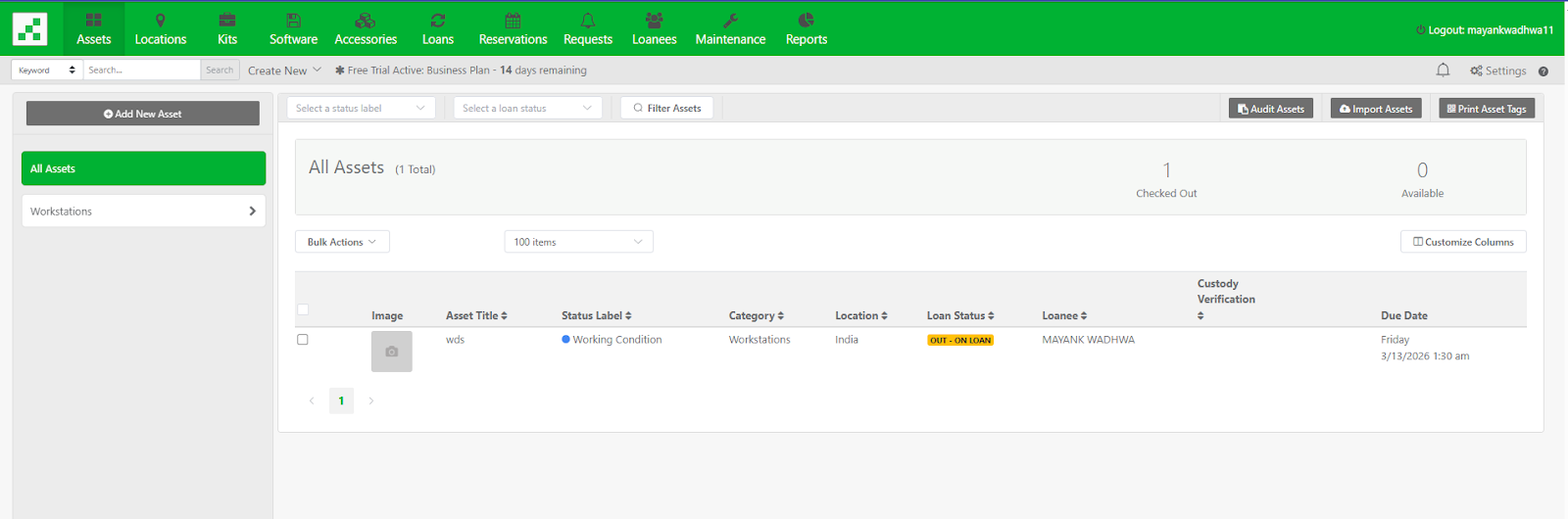
But it lets you add assets using multiple methods, including manual data entry, importing from a CSV, or directly syncing assets and users from multiple platforms, including Jamf, Microsoft Intune, Apple Business Manager, Google Workspace, and more. This actually saves time, unlike AssetTiger, where you can only import users via CSV upload.
Reftab captures details like purchase cost, lifespan, and warranty information. With this data, you can plan for new equipment, forecast replacements, stay compliant, and avoid surprise costs.
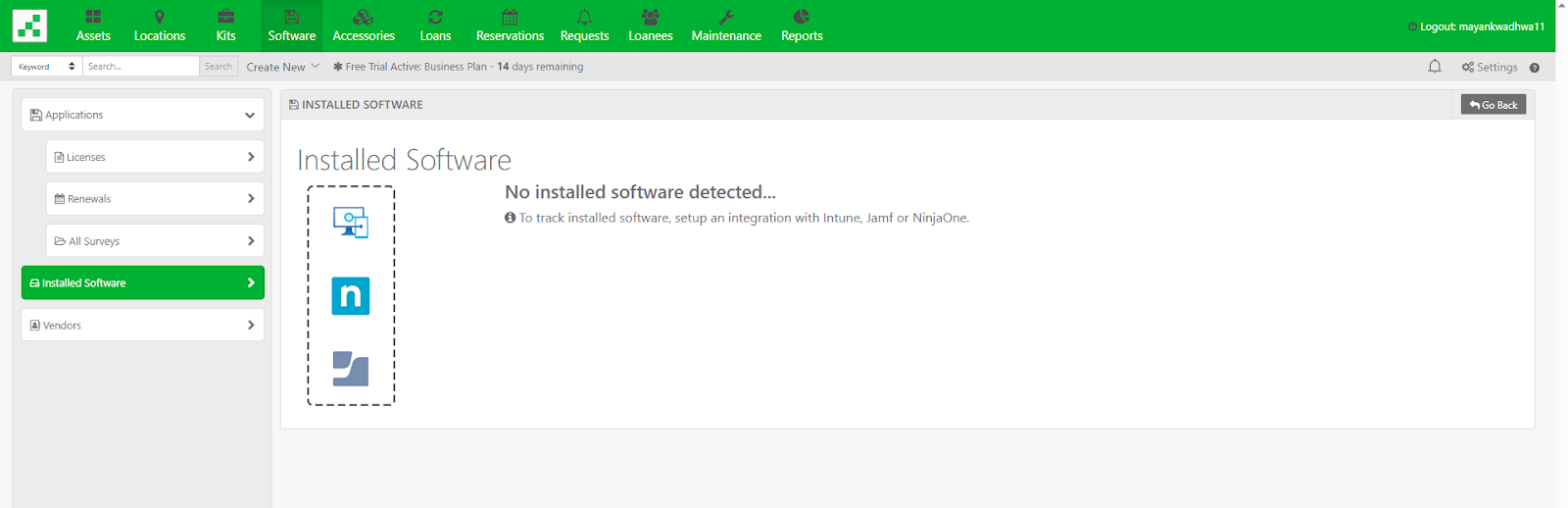
Even for software, you can either add apps manually or sync them from MDMs like Intune, Jamf or NinjaOne. This data helps you identify unused software, eliminate duplicate tools, and control costs before they get out of hand.
Reftab lets you create automated workflows by triggering actions when a certain condition is met. For instance, whenever an asset is returned, it’ll start maintenance and set the status label to “Needs Repair” until maintenance is done.
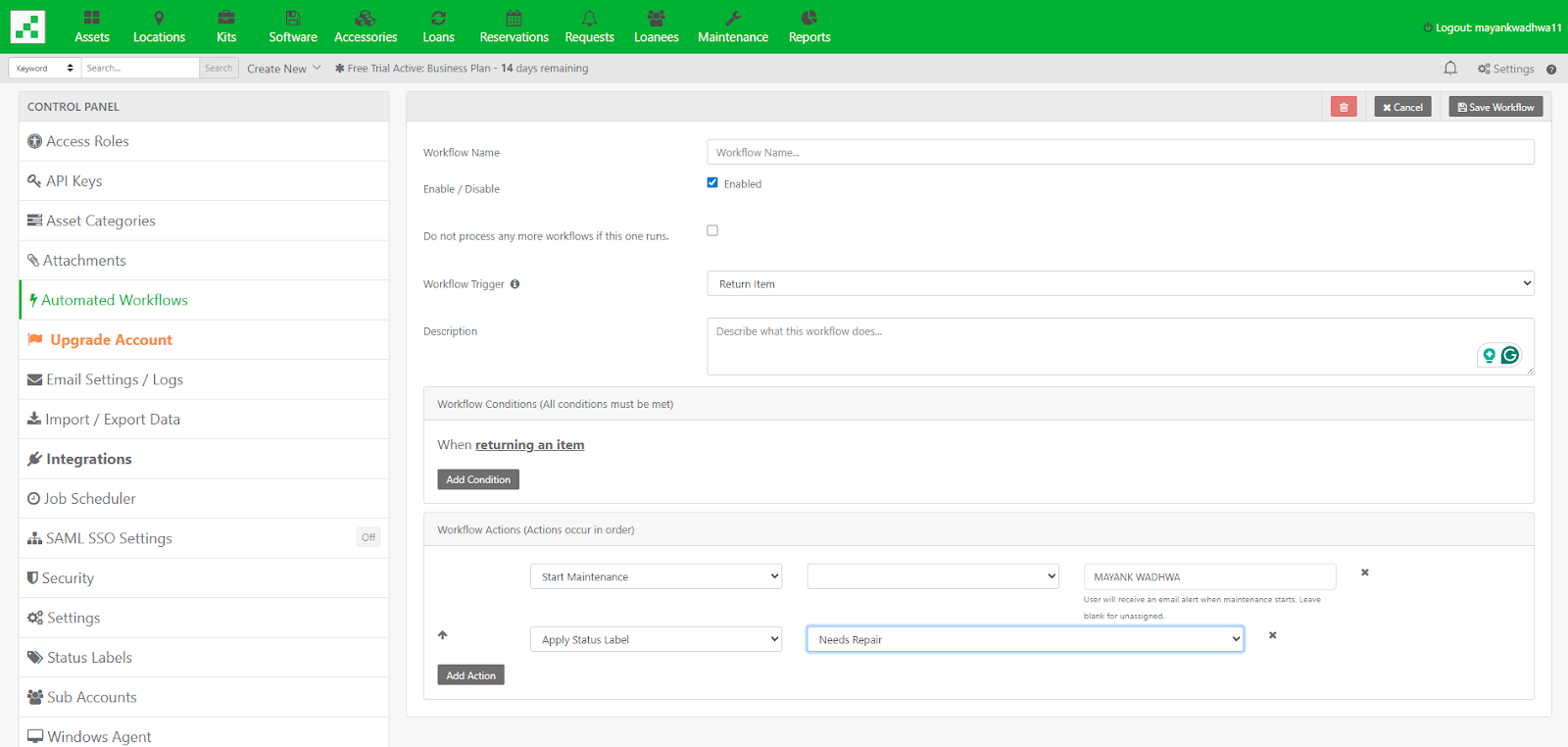
Based on my research, Reftab provides you with decent visibility into your IT estate: where your assets are, who they’re assigned to, their status, and what software is installed on them. And you can use that data to decide how many more devices you need or identify unused licenses.
But it’s not like ServiceNow or Flexera, which help you build automated end-to-end IT asset lifecycle management workflows, enabling zero-touch deployment and offboarding.
Also, while Reftab supports multiple industries, I found it’s mostly used by educational institutions (based on their case studies).
Pricing
Reftab has tiered pricing. The monthly prices increase as you increase the assets for every plan. For instance, the starter plan costs $31.25 a month for 250 assets. If you double the assets to 500, the monthly cost would jump to $58.75.
For complete pricing details, click here.
Note. There’s also this free plan that supports up to 25 assets.
Pros
- Offers powerful integrations with MDM platforms to auto-populate asset inventory and service desks to promote easy resolution of tickets.
- The platform has a user-friendly interface and a support team that’s always there to help.
- The reserve feature lets users reserve assets in advance to avoid conflicts.
Cons
- Lacks automated discovery features.
- Can’t build true automations that enable zero-touch onboarding and offboarding.
Ratings
- G2: 4.3/5 (5 reviews)
- Gartner: N/A
- Capterra: 4.7/5 (130 reviews)
11. Asset Sonar
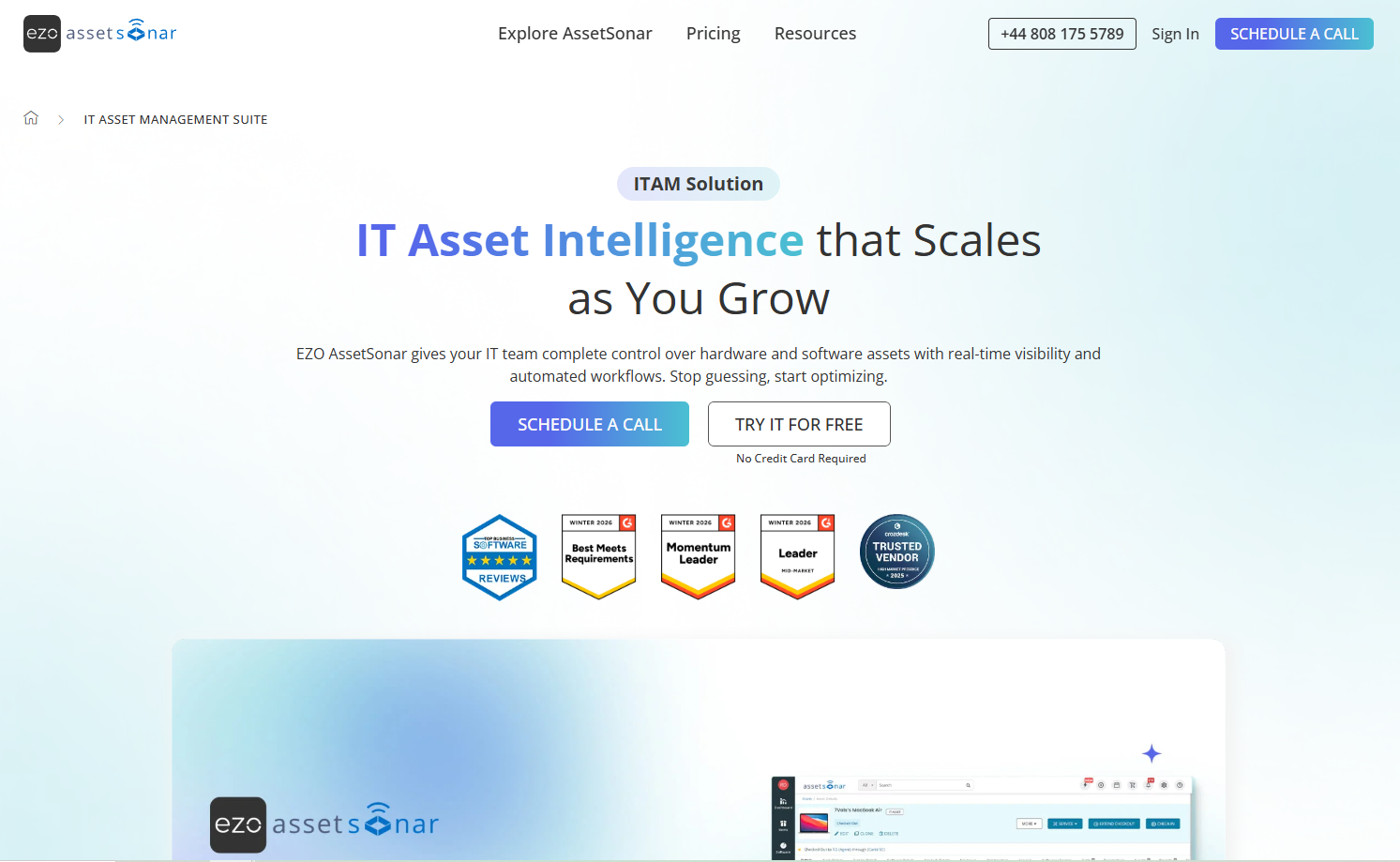
EZO AssetSonar is an IT asset management platform ideal for mid-sized IT teams that need automated discovery and lifecycle tracking without enterprise-level complexity.
Asset Sonar stands out for combining hardware, software, and license management in one platform with strong asset visibility.
However, the customization and reporting can be limited compared to larger enterprise ITAM platforms.
Source: EZO AssetSonar
I signed up for the free trial and watched multiple product tours and demo videos to get familiar with the platform. Here’s what the dashboard looks like after you sign up and add an asset:
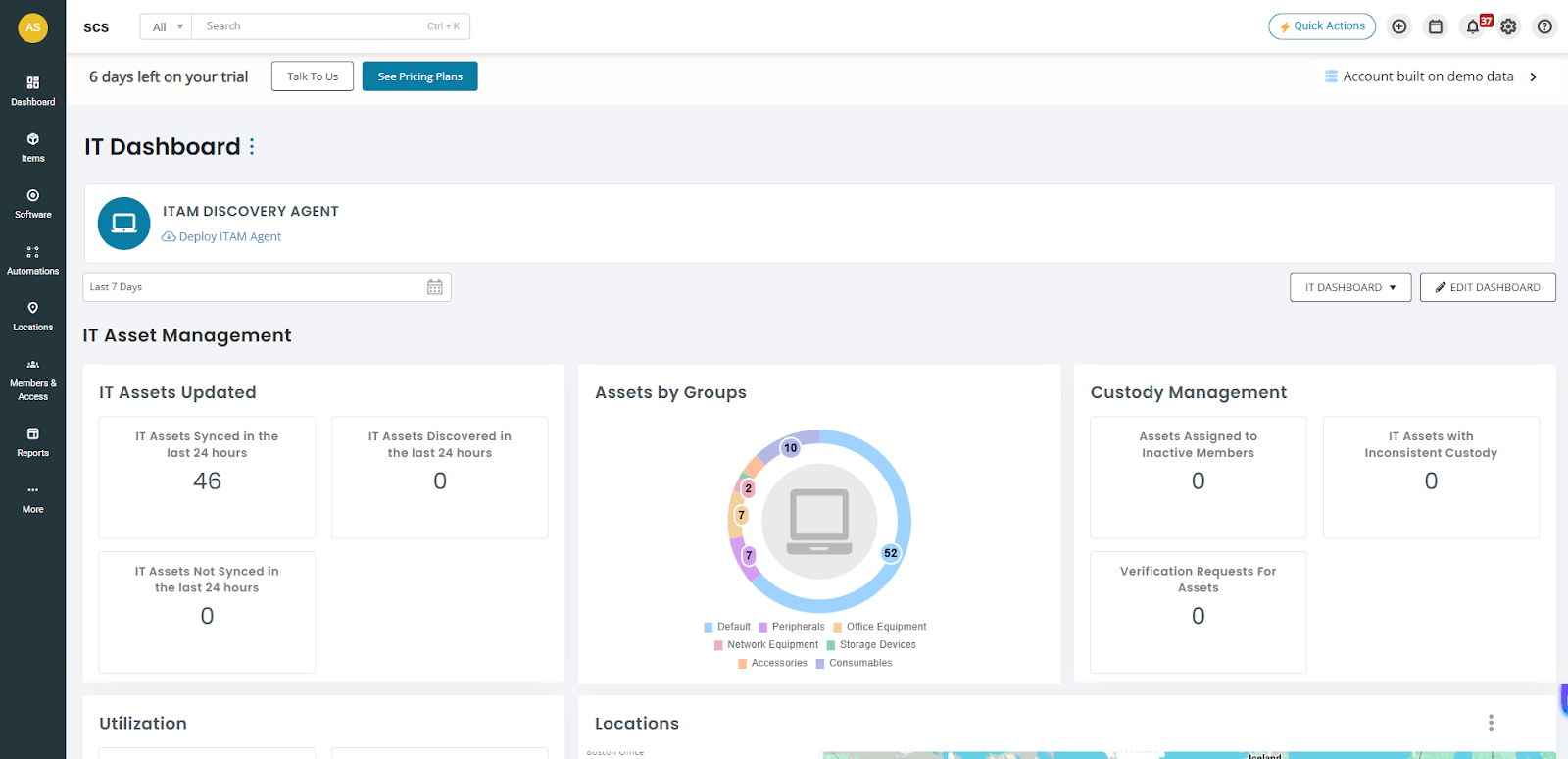
In addition to the details about hardware assets (asset utilization, total assets, locations, status, and more), this dashboard also shares insights about the software installed on your devices:
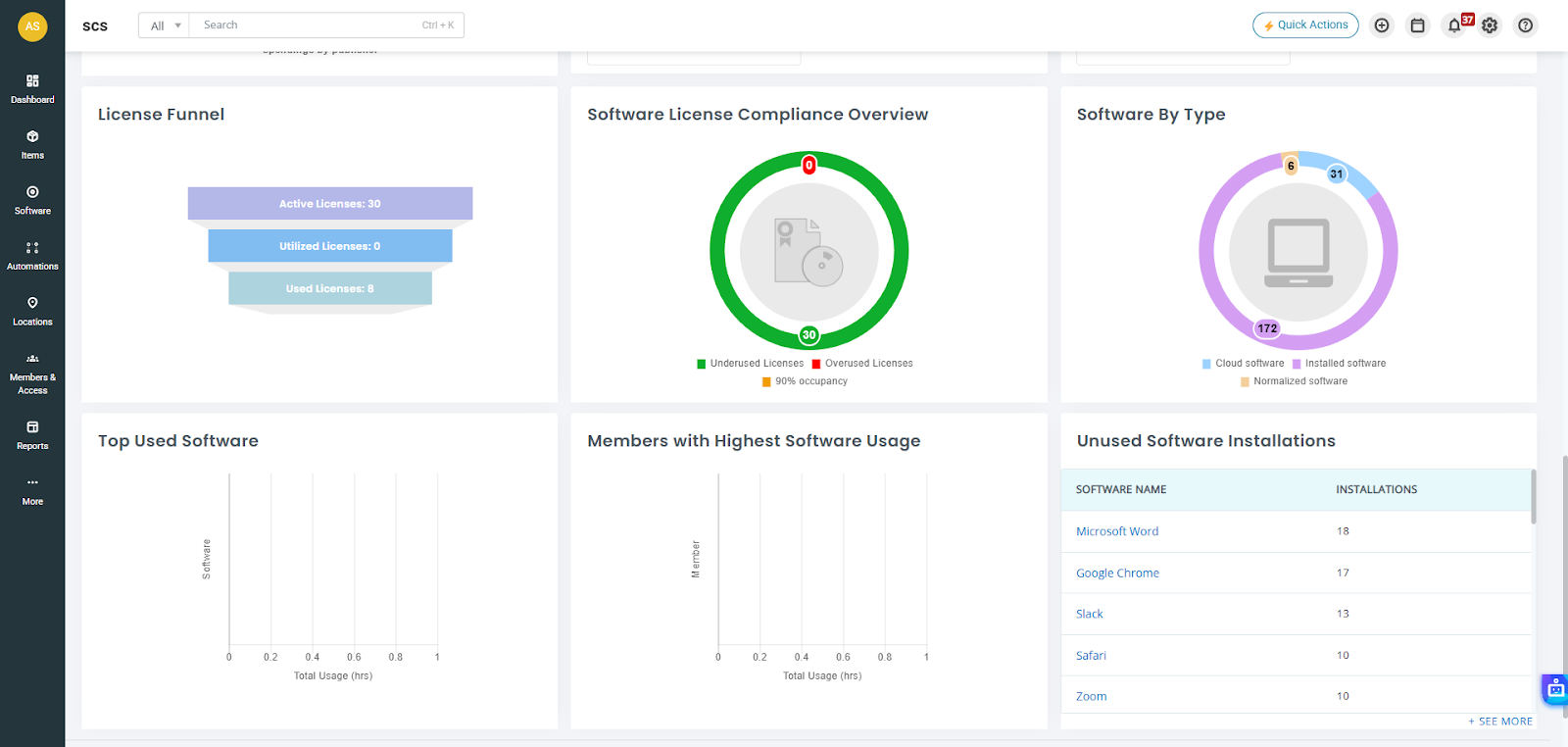
For instance, you can see how much you’re spending on each software, potential opportunities to save money, active licenses, about to expire, compliance overview, unused software, and more.
These insights inform decisions during renewal season or when you need to order new IT equipment.
During my research, I found that Asset Sonar lets you add assets using multiple methods, including manual asset creation, agent installation, network-based discovery, barcode scanning, and MDM integrations. Multiple sources ensure every asset in your estate is tracked.
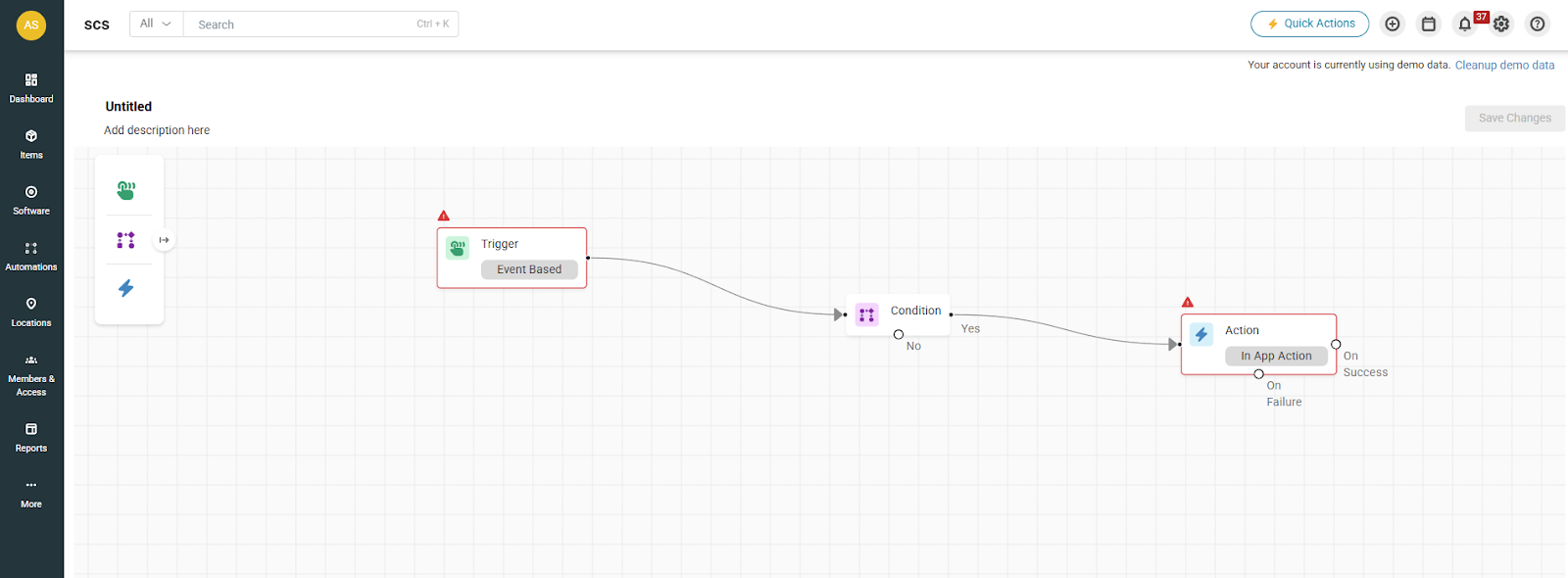
I also explored their drag-and-drop automation builder. You can create automated workflows by selecting a trigger, setting a condition, and then deciding what action should take place once the conditions are met.
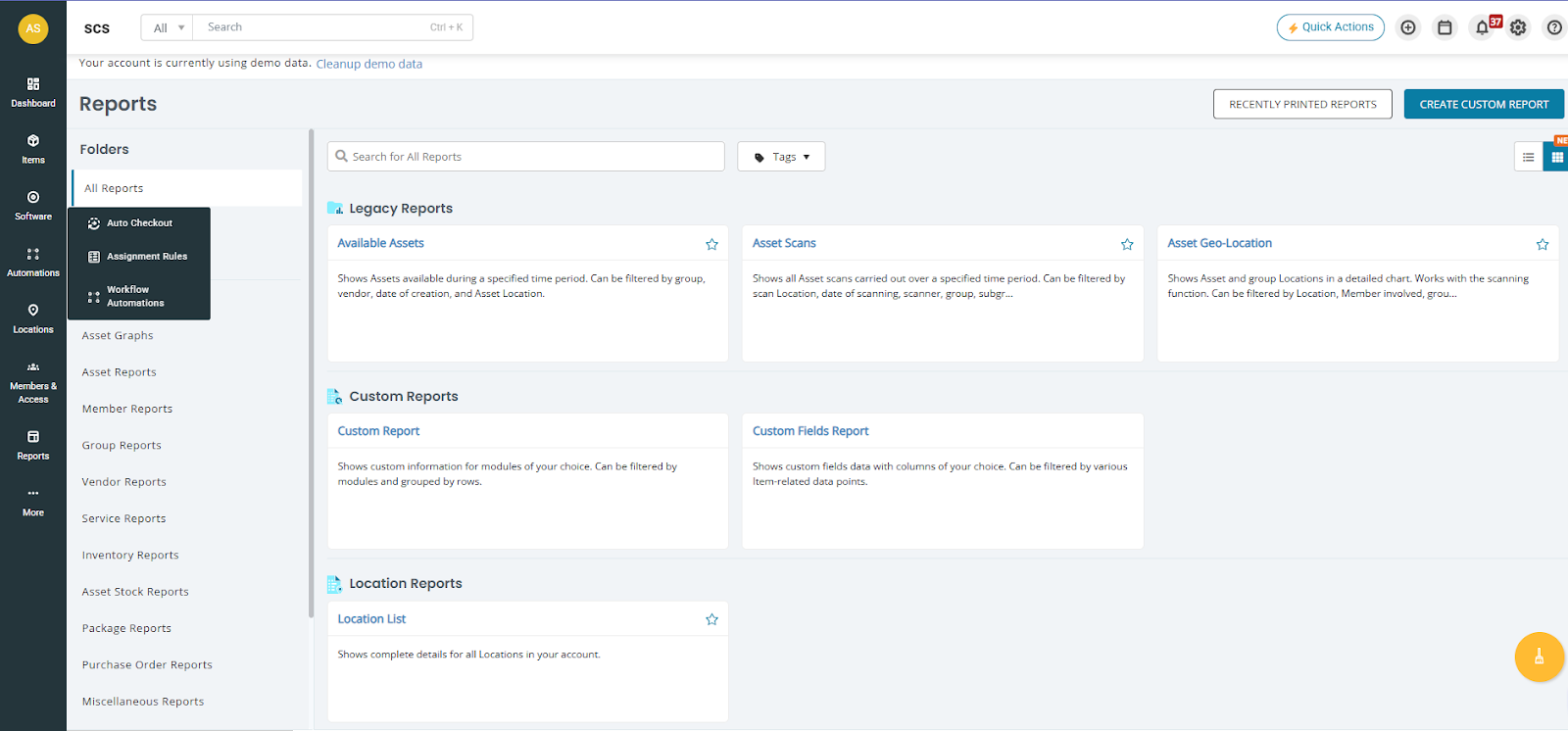
Then there are multiple types of template-based reports, which you can also customize based on your needs and even talk to them through their AI agent:
Pricing
Asset Sonar offers 3 plans
- Hardware Asset Management
- Software Asset Management
- Complete IT Asset Management
However, to know the pricing details, you need to contact Asset Sonar’s sales team.
Pros
- Easy to use, and supports software, hardware and license management in the same platform (Source)
- Offers centralized tracking of all assets across their lifecycle (Source)
- Users love how easily Asset Sonar integrates with Zendesk for ticket management (Source)
Cons
- Multiple users say it has a complicated initial setup process (Source)
- Reporting features could be more customizable, based on users’ needs (Source)
Ratings
- G2: 4.5/5 (73 reviews)
- Gartner: N/A
- Capterra: 4.6/5 (38 reviews)
12. Shelf
Shelf.nu is an open-source and free IT asset management software designed for small teams, schools, or studios needing simple hardware tracking without a complex setup.
One advantage is its free open-source model with customizable asset categories and reservations. However, the lack of automated discovery or software asset tracking makes the software more manual and limited, respectively.
I watched product tour videos, demos, and also signed up for their free trial to learn more about how Shelf.nu works.
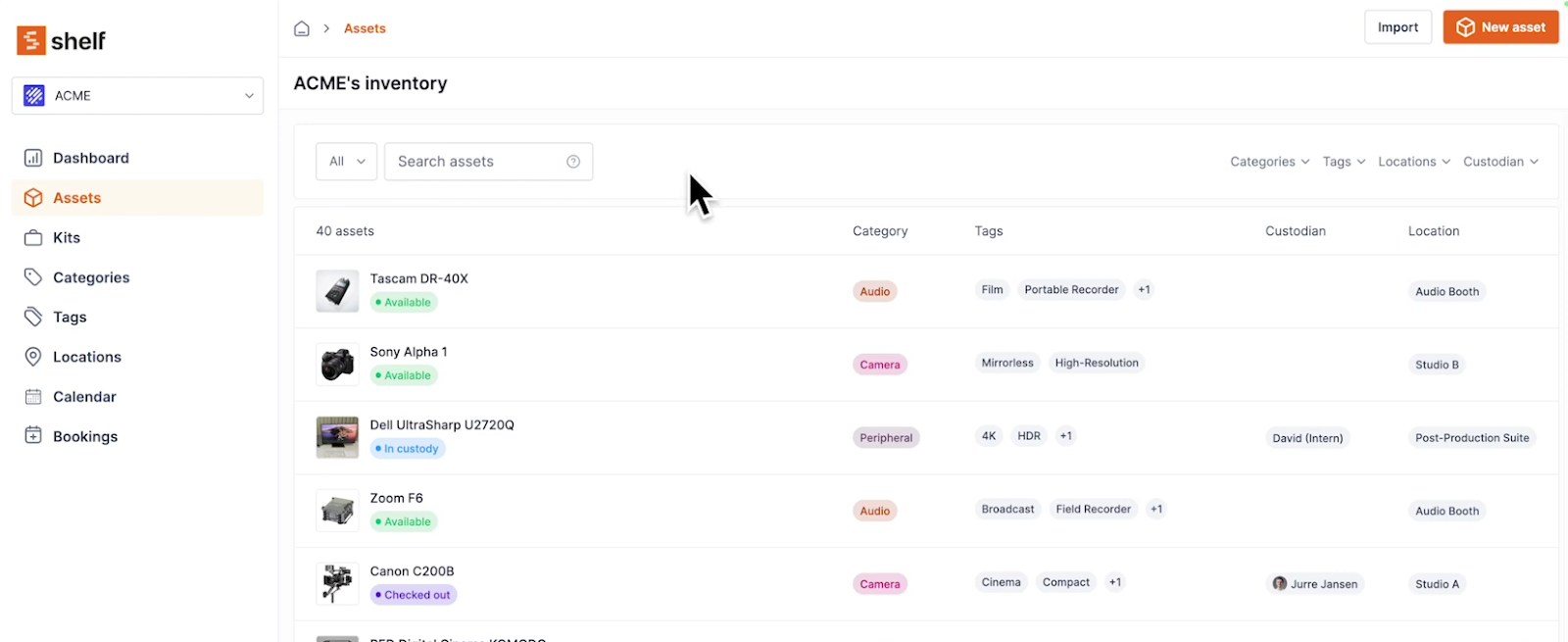
Shelf.nu gives you deep visibility (location, category, custodian, and more) into your asset estate, so you can instantly locate all your assets when required. Just use the search bar or apply filters to find specific assets.;
For instance, you can simply search for laptops, and the platform will list all the available laptops.
Source: YouTube Demo
You can use the category option to add new categories or edit existing ones to customize them based on the assets you manage:
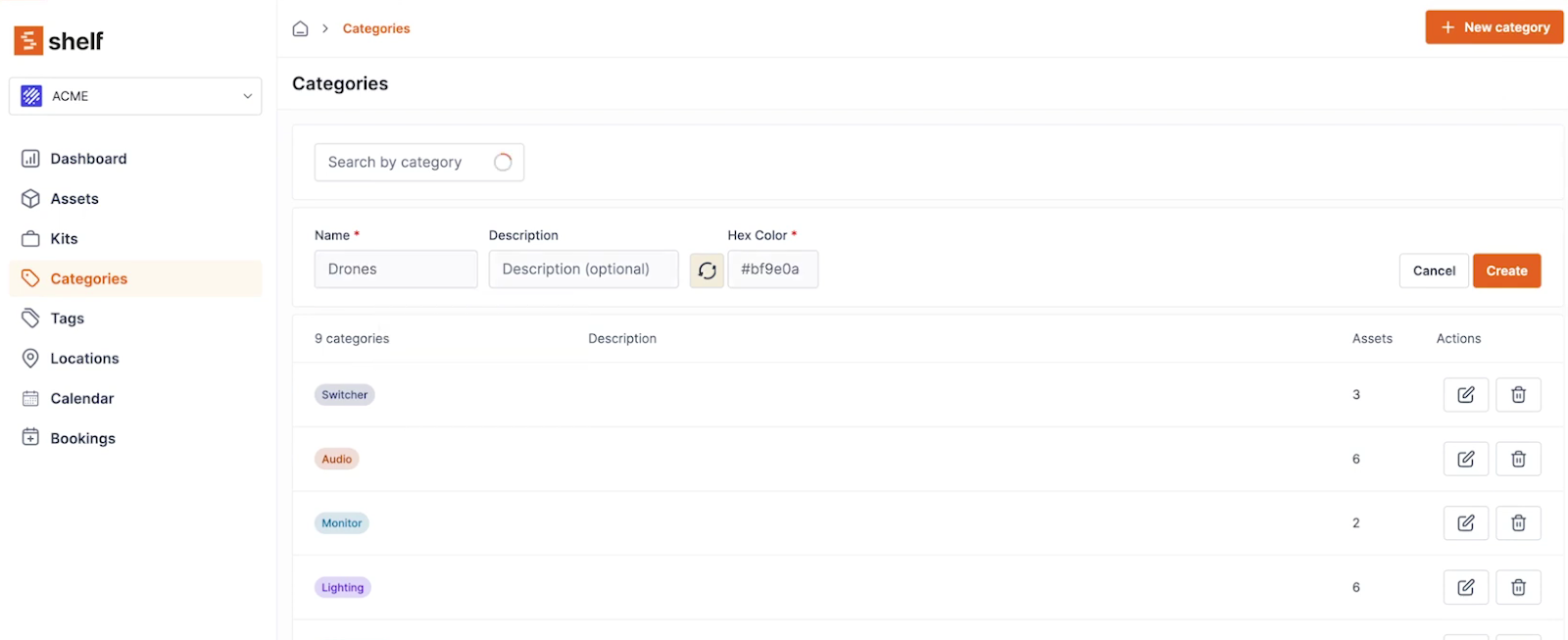
But the sad part is that you can add assets manually or through a CSV. It does not offer network discovery or through integrations, making the process of adding assets time-consuming.
Also, there’s no provision to track software using Shelf.nu. So, it’s essentially a hardware asset management solution.
Ideally, Shelf.nu is suited for companies needing a simplified hardware asset tracking solution with real-time visibility that doesn’t require deep system knowledge.
Pricing
Shelf.nu’s free Personal plan lets you manage unlimited assets for free. And the paid plans start at $34 a month, going all the way up to $67 a month, and a custom plan. To check their complete pricing details, click here.
Pros
- As an open-source tool, it has an active community that helps users resolve issues (Source)
- The asset reservation feature ensures bookings don’t overlap for assets used by multiple users (Source)
- Very easy to use and set up, and the support is also reliable (Source)
Cons
- Does not offer tracking for software, making it unsuitable for companies seeking a complete asset management solution.
- Automated network discovery is unavailable.
Ratings
- G2: 5/5 (10 reviews)
- Gartner: N/A
- Capterra: 4.8/5 (106 reviews)
Criteria for Choosing the Best IT Asset Tracking Software in 2026
Factors you considered when choosing the best IT asset tracking software
- Scalability: Check whether it can handle thousands of assets without slowing down or becoming painfully manual.
- Asset discovery: Prefer tools with network discovery, agent-based discovery, or MDM integrations.
- Hardware + software tracking: Basic hardware tracking is not enough for most IT teams. You also need software, SaaS, and license visibility to control spending and stay compliant.
- System integrations: Look for integrations with Intune, Jamf, HRIS, procurement, and ITSM tools. Otherwise, your data stays fragmented.
- Pricing model: Review how pricing changes as asset counts grow. Reddit discussions often call out tools that become expensive at renewal or force you into oversized tiers.
- Support and setup effort: Strong support matters. So does ease of rollout. A cheap tool that takes months to configure usually costs more in practice.
- Ease of audits and reporting: Can you quickly pull asset history, ownership, warranty, depreciation, and compliance reports without manual cleanup? This matters a lot during audits and renewals.
- Lifecycle workflow support: Check whether it supports procurement, assignment, repair, retrieval, refresh, and disposal. Many tools track assets, but fewer help manage the full lifecycle.
- Data accuracy and deduplication: Ask how the tool handles duplicate records, stale devices, and mismatched user data. Bad data makes the whole system unreliable.
- Mobile access and barcode/QR scanning: This is useful for stockrooms, offices, schools, and field teams. It matters less for fully remote setups, but it can save time in physical audits.
How Workwize Streamlines Asset Tracking for Teams?
Most asset tracking tools are designed to give you visibility into assets, and not to physically move them across the lifecycle.
They can tell you who owns a device, where it was last seen, or when a license expires.
But when it comes to actually procuring devices, shipping them globally, handling repairs, retrieving equipment, or disposing of old hardware, most platforms rely on manual coordination or third-party vendors.
That creates a gap between tracking assets and managing them operationally.
And when IT teams manage distributed employees across multiple countries, this gap becomes painfully obvious. Someone still has to handle procurement, shipping, customs, repairs, retrievals, and redeployments.
This is where platforms like Workwize fit in.
Workwize is a global IT hardware management solution that helps you:
- Procure IT and non-IT assets from verified vendors of your choice.
- Enroll them in the MDM of your solution.
- Deploy them pre-configured across 130+ countries to your employees or offices.
- Handle repairs and replacement
- And finally, manage retrievals to facilitate disposals, reassignment, resale or recycling of those assets.
The entire hassle of customs, imports, shipping, and coordinating with multiple vendors is handled by Workwize across 130+ countries. And while all this happens, you can view your assets in real-time and get alerts if anything out of the ordinary happens.
So, when looking for an asset tracking solution, make sure it integrates with Workwize or vice versa. Otherwise, you’ll have to deal with two different solutions for tracking and shipping assets, which don’t even talk to each other.
Book a demo now to see how Workwize works with your favourite asset tracking solution, enabling you to handle both physical and digital aspects of asset lifecycle seamlessly.


Establish a single source of truth for every IT asset across the globe.
.png?width=258&height=318&name=g10%20(5).png)
More related resources to help you stop firefighting hardware operations.


Get monthly insights into how other IT leaders are improving their ops.



.png?width=2880&height=1232&name=Group%202147262874%20(1).png)
Stop coordinating
hardware like it's 2012.
.svg)
.png?width=172&height=68&name=apple%20business%20patner%20(1).png)
.svg)
.svg)
.svg)
.svg)