




.svg)
.svg)

.svg)


.svg)





.svg)
.png?width=500&height=424&name=Style-1---V1-(1).png)
.png?width=1230&height=692&name=Vector%20(13).png)
Every IT team has a plan for the first laptop a new hire receives. Procurement is budgeted, deployment is automated, MDM enrollment is enforced before the box is even opened.
But ask that same team what happens to the device three or four years later, when it's retired, replaced, or the employee moves on, and the confident answers tend to trail off.
That gap is the quiet failure point of modern IT asset management. We obsess over how devices enter the organization and pay far less attention to how they leave it.
Yet the exit is exactly where security, sustainability, and financial value are won or lost.
The lifecycle only counts if it closes
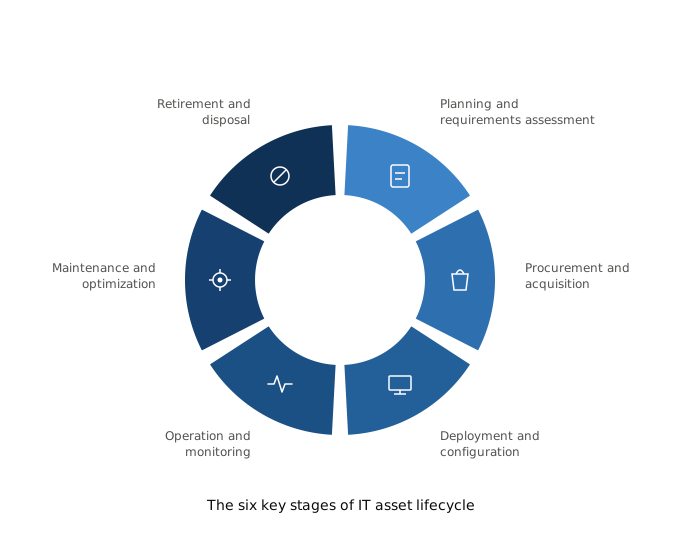
The IT hardware lifecycle is usually described in five stages: procurement, deployment, management, retrieval, and decommissioning. The first four get the attention because that's where the work feels active, and the value feels obvious.
Decommissioning (disposal and resale) gets treated as an afterthought, a box to tick once the "real" work is done.
But a lifecycle isn't a line, it's a loop. A device that's been retrieved but never properly decommissioned doesn't leave the lifecycle. It just falls out of view.
It sits in a drawer, a closet, or a warehouse shelf, still carrying data, still holding residual value, still counting as an asset on someone's books. The loop stays open, and open loops are where risk quietly accumulates.
Closing the loop means every device reaches a definitive, documented end state: securely wiped and recycled, or securely wiped and resold. Anything short of that isn't an ending. It's a liability with a delay.
What an open loop costs
Data that outlives the device. The most dangerous assumption in decommissioning is that a factory reset is enough. It isn't. A 2016 Blancco study that purchased 200 used drives from eBay and Craigslist found that 78% still contained recoverable data, and 11% held company information such as emails, spreadsheets, and customer records, despite having supposedly been wiped.
Each one left an organization that believed the matter was handled. The consequences aren't hypothetical, either: in 2022, Morgan Stanley settled with the SEC for $35 million after unencrypted drives from decommissioned data centers were auctioned off without being wiped.
An environmental bill the whole industry is running up. According to the UN's Global E-waste Monitor 2024, the world generated a record of 62 million tonnes of e-waste in 2022, up 82% since 2010, and it's on track to reach 82 million tonnes by 2030. Only about 22% of that was formally collected and recycled.
E-waste is now growing roughly five times faster than documented recycling, and the report estimates that tens of billions of dollars in recoverable materials are thrown away each year.
Every laptop that ends up in a landfill instead of a certified recycling or resale stream adds to that number.
Value left on the table. A three-year-old laptop is not worth zero. It has a resale market, and refurbishment extends the useful life of hardware that would otherwise be scrapped. Organizations that stockpile retired devices "to deal with later" don't just create security and storage overhead; they watch resale value depreciate to nothing while the hardware sits in a box.
Compliance exposure. Regulations from GDPR to HIPAA to sector-specific data-protection rules increasingly expect organizations to prove that data was destroyed, not just deleted. "We're pretty sure we wiped it" is not a defensible position in an audit. Verifiable proof of destruction is now part of the job.
Dispose or resell, but decide on purpose
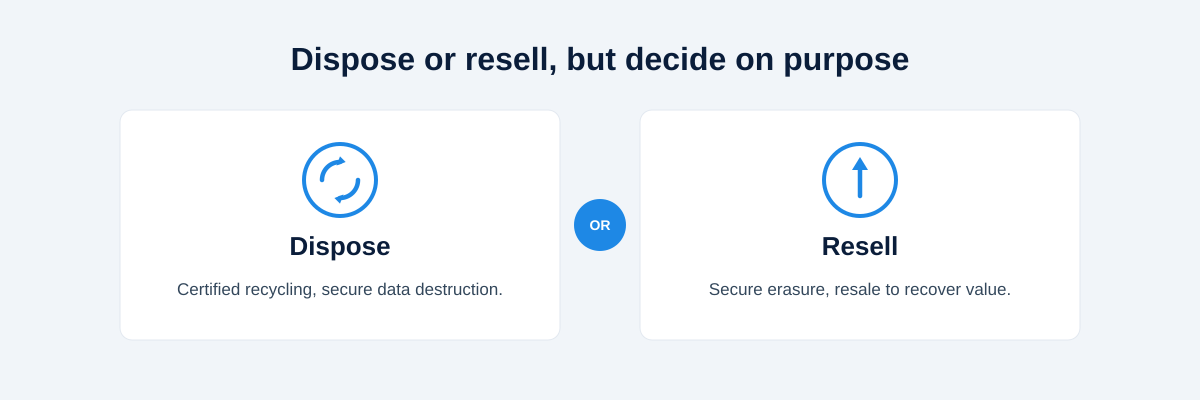
Responsible decommissioning comes down to two deliberate paths.
Dispose of the device through certified, environmentally sound recycling, with secure data destruction and a certificate to prove it. This is the right call for hardware that's genuinely end-of-life or too damaged to have residual value.
Resell the device to recover value and extend its working life, after securely erasing the data. This keeps hardware in the circular economy and turns a sunk cost into partial recovery.
The point isn't that one path is always better than the other. The point is that both should be a decision, made on purpose, not a default, and certainly not "it ended up in a skip because no one got around to it."
Fragmentation is the real enemy
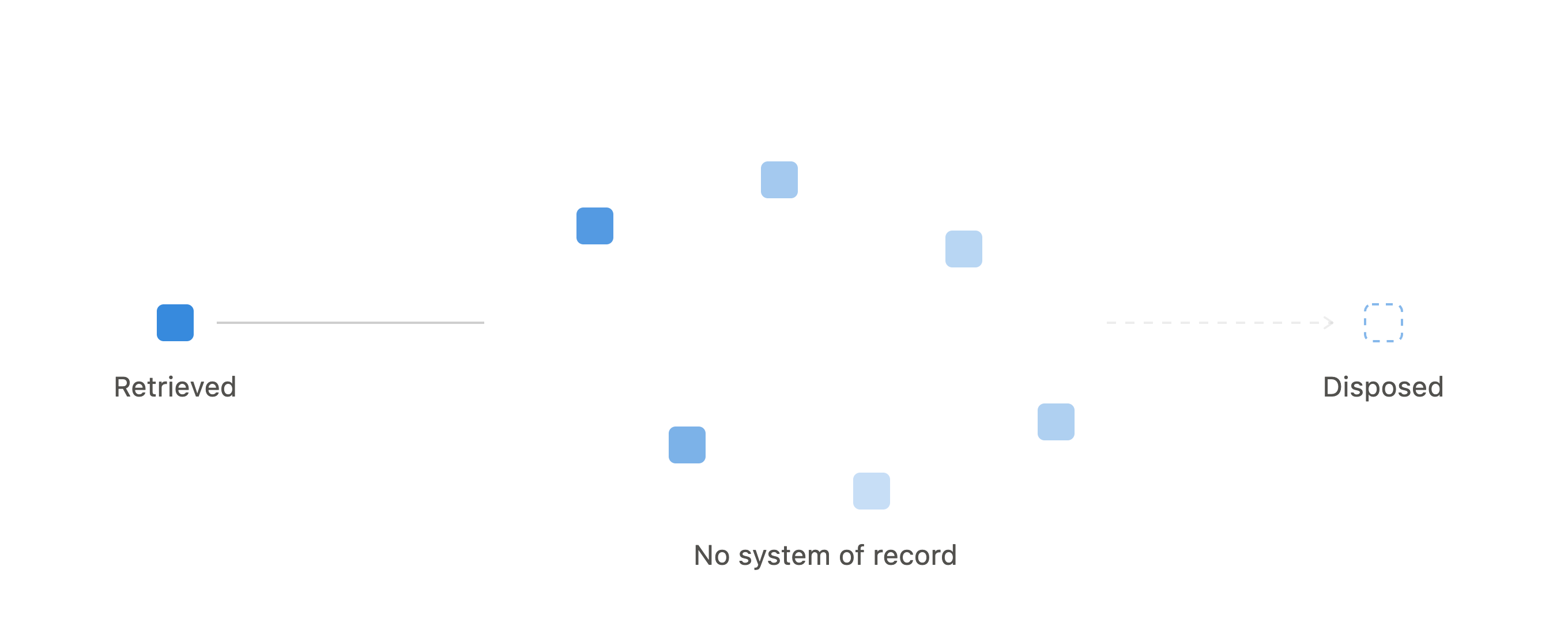
Here's why decommissioning gets neglected in practice: it's usually the most fragmented stage of the entire lifecycle. Devices are scattered across home offices, headquarters, and third-party warehouses in different countries.
So, one vendor handles retrieval, another handles disposal, a broker handles resale, and the record of what happened lives in a spreadsheet that's already out of date. Between the moment a device is retrieved and the moment it's finally disposed of, it often disappears from any system of record entirely.
You cannot decommission responsibly what you cannot see. When the last mile of the lifecycle is spread across disconnected tools and vendors, "closing the loop" becomes a manual, error-prone scramble, exactly the conditions that drive devices to be auctioned unwiped, and laptops to be forgotten in closets.
One platform, one source of truth
This is why the case for managing the entire lifecycle in a single platform gets stronger the closer you look to the end.
When procurement, deployment, management, retrieval, and decommissioning all live in one system, decommissioning stops being a bolt-on afterthought and becomes the natural final step in a process already being tracked.
A single source of truth means you always know where every device is, what condition it's in, and whether it has reached end-of-life, whether it's on an employee's desk in one country or sitting in a warehouse in another. It means the decision to dispose of or resell is made with full visibility, carried out without hunting down a separate vendor, and documented automatically. The loop closes because the system never lets the device out of view.
This is the philosophy behind how Workwize approaches the lifecycle: procure, deploy, manage, retrieve, and decommission devices across 100+ countries from one platform, so the end of a device's life is as controlled and as visible as its beginning.
Maturity is measured at the end
It's easy to judge an IT asset management strategy by how smoothly a new hire gets their first laptop. The harder, more revealing test is what happens to that laptop when it's no longer needed. Does it leave the organization with its data destroyed, its value recovered, or its materials responsibly recycled, and a clean record of the whole thing? Or does it just quietly drop off the radar?
Decommissioning isn't the unglamorous chore at the end of the lifecycle. It's the stage where all the discipline of the earlier stages either pays off or unravels. Close the loop, and the lifecycle finally lives up to its name.
Still closing that loop by hand? See what it looks like when procurement, deployment, retrieval, and decommissioning all live on one platform.

Establish a single source of truth for every IT asset across the globe.
.png?width=258&height=318&name=g10%20(5).png)
More related resources to help you stop firefighting hardware operations.



Get monthly insights into how other IT leaders are improving their ops.



.png?width=2880&height=1232&name=Group%202147262874%20(1).png)
Stop coordinating
hardware like it's 2012.
.svg)
.png?width=172&height=68&name=apple%20business%20patner%20(1).png)
.svg)
.svg)
.svg)
.svg)