




.svg)
.svg)

.svg)


.svg)




.svg)
.png?width=500&height=424&name=Style-1---V1-(1).png)

.png?width=1230&height=692&name=Vector%20(13).png)
If you want to pay your overseas contractors seamlessly or hire employees across the world, it’s normal to be confused between Remote and Deel.
Both these platforms are known for reliable global payroll and EOR services and have thousands of ratings and reviews on G2 and TrustPilot.
So how do you know which platforms fit the way your teams work?
Below, I have created a feature-by-feature comparison of Remote and Deel.
Trust me, this one is different from surface-level comparisons. I have analyzed 50+ demo videos, UI walkthroughs, vendor docs, and user reviews to create a comparison that uncovers differences and helps you decide.
By the end of this guide, you’ll know what tool you need for managing your global workforce in 2026.
TL;DR
| Feature |
Winner |
Why this wins (brief + factual) |
| Global EOR country coverage |
Deel |
Deel markets 150+ countries, giving teams more room to expand without switching EORs. Remote supports fewer countries, which can become limiting at scale. |
| Speed of hiring & onboarding |
Deel |
G2 reviewers consistently cite faster, more automated onboarding flows and self-serve setup, especially for contractors and new countries. |
| Compliance posture (EOR) |
Tie |
Both position themselves as compliance-first EORs and score similarly on G2 for legal confidence and contract accuracy. Differences show up more in execution than capability. |
| Performance management |
Deel |
Deel’s goals, OKRs, review cycles, and analytics are more advanced. Remote’s performance tools are solid but narrower in scope. |
| Compensation management |
Deel |
Deel has a live compensation review module tied to performance and payroll. Remote’s compensation tooling is still marked “coming soon.”. |
| Payroll reporting & analytics |
Deel |
Deel provides deeper real-time payroll reporting and clearer gross-to-net visibility across countries. |
| US payroll clarity |
Deel |
Deel explicitly offers a dedicated US payroll product with defined modes. Remote bundles US payroll into its global platform, which feels less explicit to buyers. |
| Contractor management |
Tie |
Both handle global contractors well. Deel is praised for bulk payments and UX; Remote is praised for misclassification protection. G2 sentiment is evenly split. |
| IT device management |
Deel |
Deel IT (ex-Hofy) is an in-house product with inventory, lifecycle, and MDM integrations. Remote relies on partners, which comes across as less mature. |
| Integrations ecosystem |
Deel |
Deel lists 100+ integrations, while Remote offers 20+. |
| Ease of use |
Tie |
Both score highly on G2 for clean UI and ease of implementation. No meaningful winner here. |
| Customer support access |
Deel (slight) |
Deel offers chat, email, and phone support. Remote relies on chat/email. G2 reviews for both mention occasional delays during peak periods. |
| Cost at scale |
Deel |
Deel’s EOR pricing starts lower, and broader coverage reduces the need for multiple vendors—something cost-sensitive teams mention often in reviews. |
Overview
Before we dive deeper, here’s a brief overview of Remote and Deel:
Remote
Remote is a comprehensive global EOR and HR/payroll solution designed to help companies hire and manage international workforces without local entities.
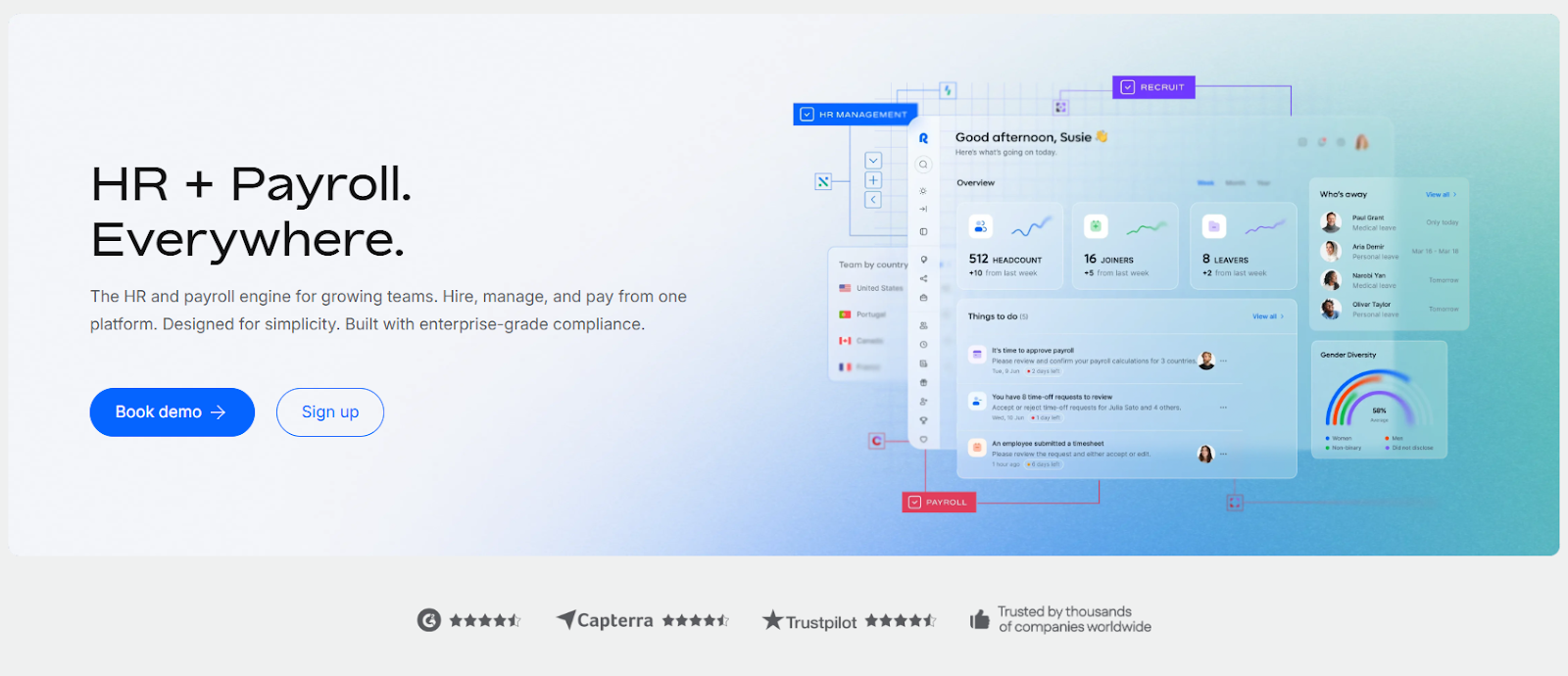
It’s popular among companies of all sizes (SMBs and enterprises) seeking a compliance-centered platform with payroll, benefits, and integrated HR tools.
G2 reviewers emphasize Remote’s user-friendly interface, clear cost transparency, and strong compliance control across multiple countries. Strengths include organized onboarding, reliable payroll, and intuitive employee self-service.
However, some users report slower support at times, occasional workflow delays, and limited flexibility in custom processes.
Deel
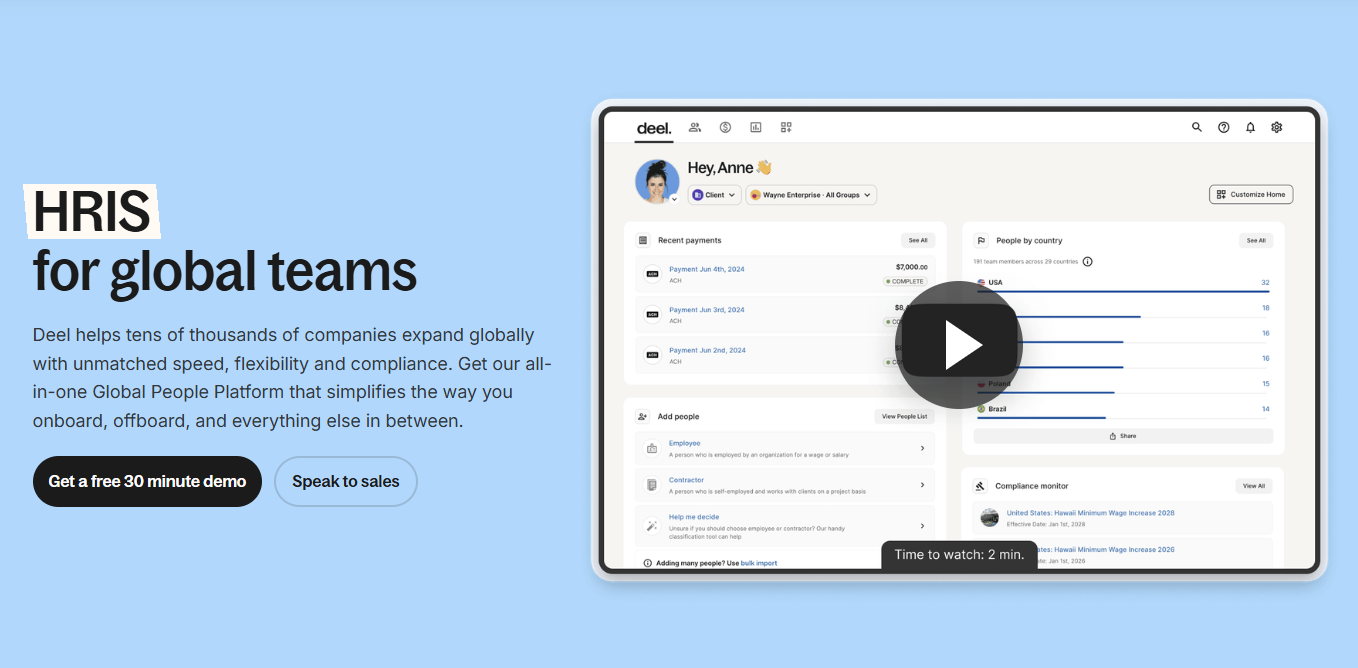
Deel is a global Employer of Record (EOR) and payroll platform that helps companies hire, pay, and manage international employees and contractors without setting up local entities.
It’s widely used by startups, scale-ups, and tech companies expanding globally, especially when speed and automation matter.
G2 reviewers highlight its intuitive UI, automated onboarding, and broad global coverage (150+ countries), making complex hiring and compliance far easier to centralize.
Remote Vs Deel: Feature-by-Feature Comparison
Here’s an in-depth feature-by-feature comparison of Remote and Deel:
HR Management
Human Resources Information System (HRIS)
Remote
Remote offers a core HRIS designed to manage employee records, documents, time off, and basic HR workflows for distributed teams.
While a free trial wasn’t available, I reviewed product videos and interactive demos to understand how Remote’s HRIS works in practice.
The main dashboard surfaces essential HR tools (employee records, documents, time-off management, and insights) through a clean sidebar layout, making it easy to navigate day-to-day HR tasks.
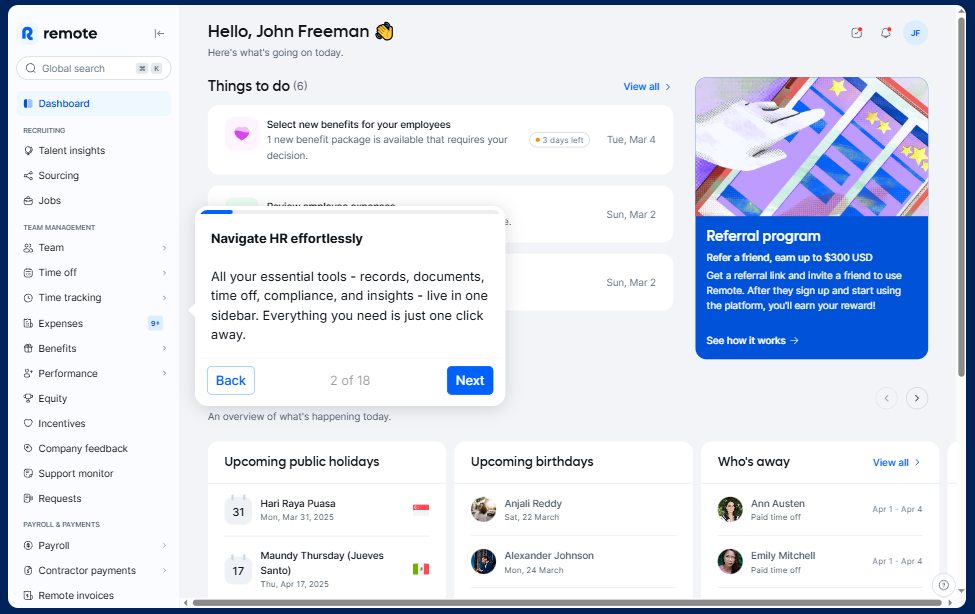
Remote lets you manage all workers in a single dashboard, whether regular employees, EOR hires, or contractors. Also, your payroll, contracts, and compliance stay connected no matter how your team is employed.
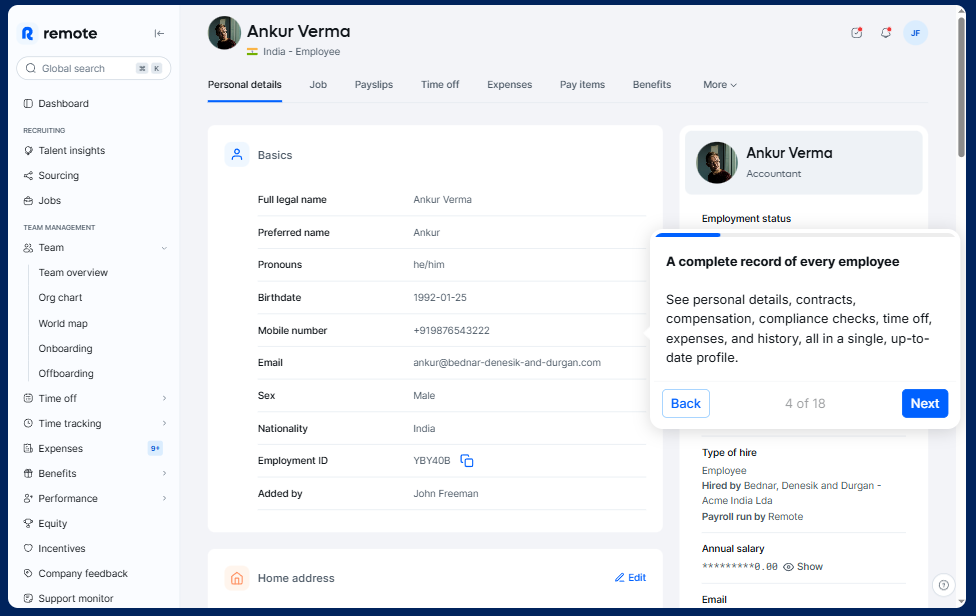
When you click on each profile, you get in-depth information about each employee, including compliance checks, time-off, expenses, history, and more in a single profile.
Similar to most other global HR solutions, Remote also offers visibility into reporting lines, departments, and management ratios via its visual org structure.
You can even manage leave, track time, and process expenses (from submission to reimbursement) in the same dashboard to support planning, decision-making, and clarity for employees.
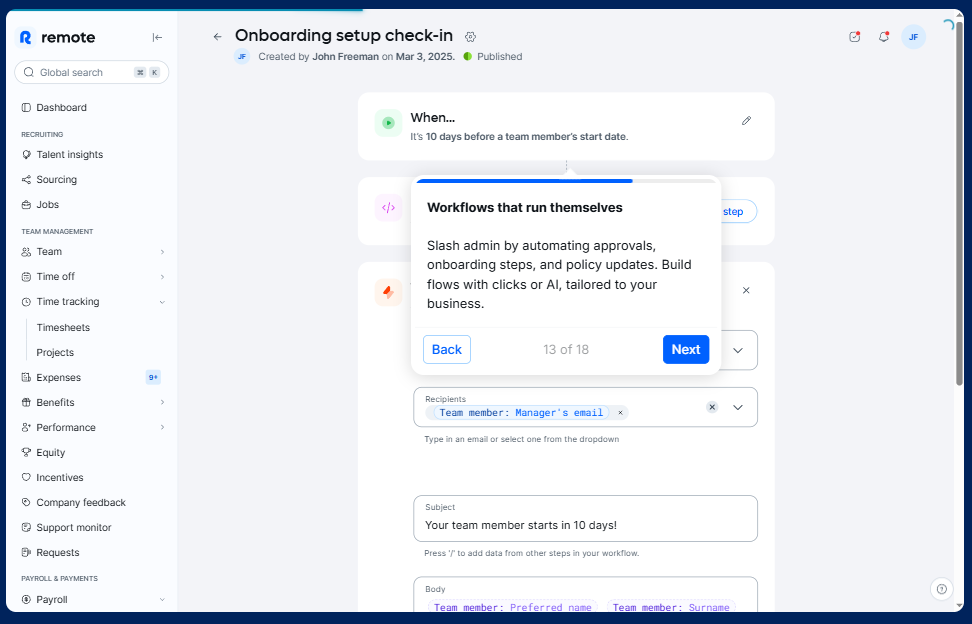
I liked how easy Remote makes it to create automated workflows. Within a few clicks, it lets you create an onboarding workflow that triggers when a specific action happens, saving you admin time.
For instance, you can automatically send policies and welcome emails when ”it’s 10 days before an employee’s joining date.”
Employees can easily update details, request time-off, submit expenses, and access documents. And managers can instantly make approvals.
Deel
Deel’s HRIS is a suite of multiple tools i that lets you manage your global teams efficiently, while ensuring compliance.
You can choose from multiple templates and create customizable automated workflows. It lets you trigger an automated welcome email or message via Slack 3 days after someone joins.
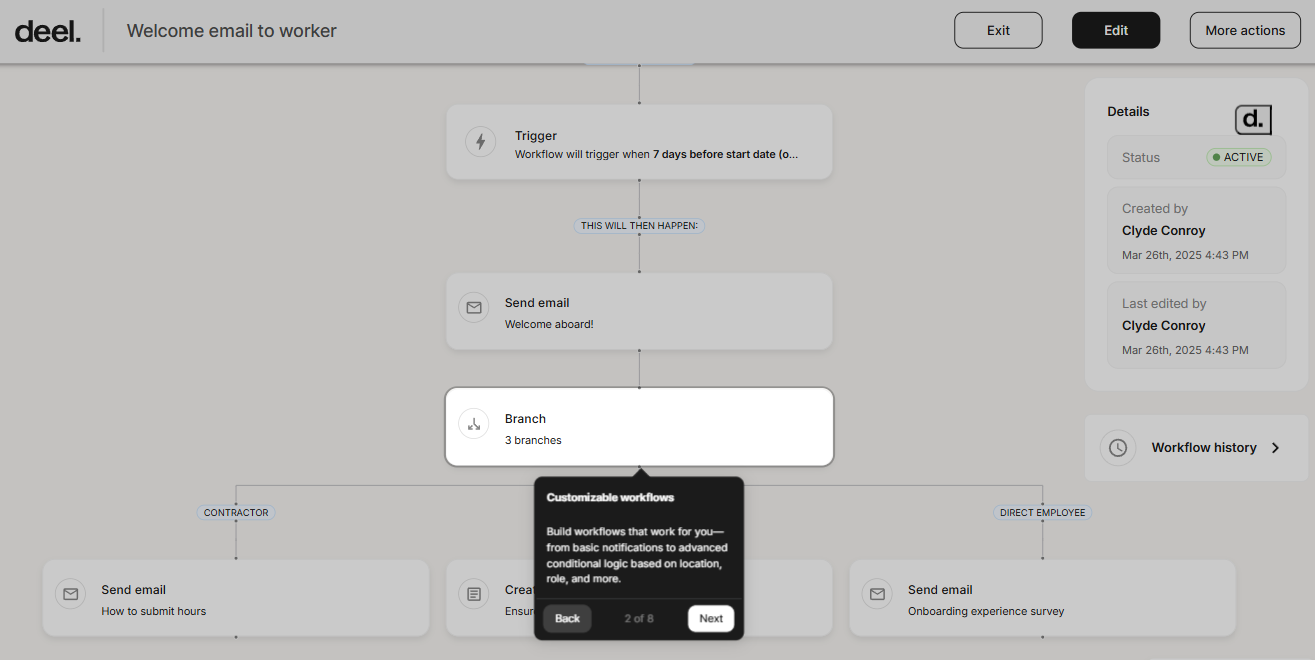
In addition, users can provision apps or even automate onboarding. Just set the country and worker type, and let Deel create a tailored onboarding flow with follow-up tasks:
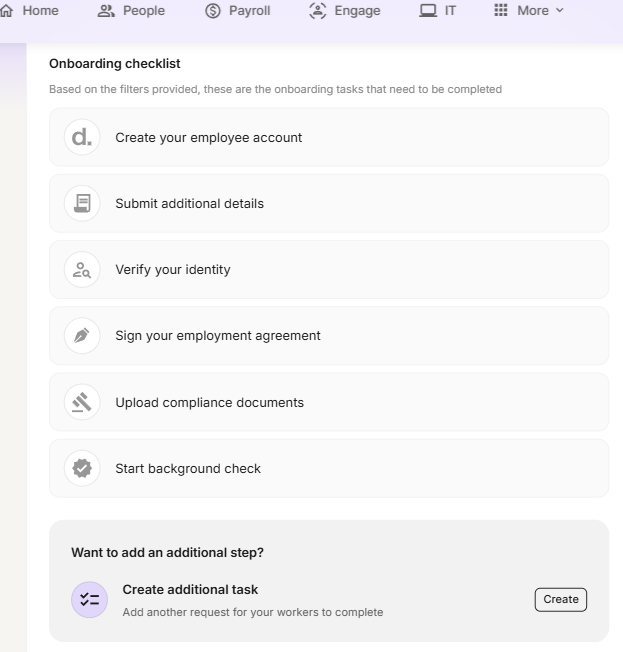
You can also manage people, documents, time off, and more from a single dashboard.
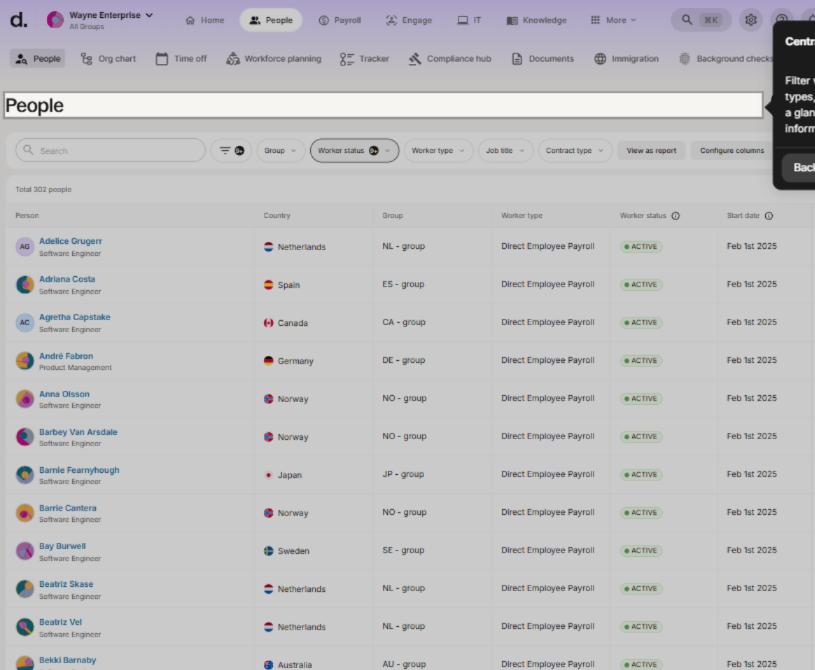
For each user, Deel lets you check granular details like documents, compensation, department information, and more. You can also check time-off details and use pre-built time-off policies for different regions, and stay compliant.
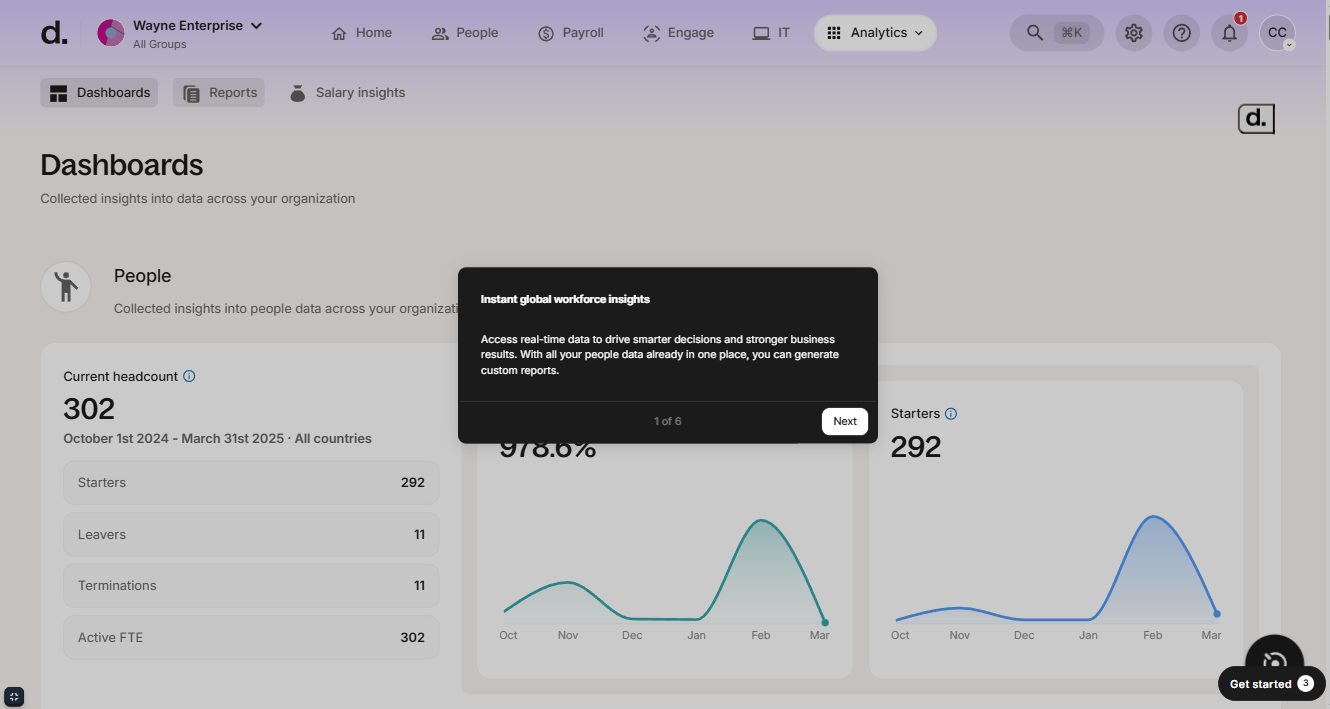
Users can dive deeper with 35+ default reports and even create their own or customize the existing reports according to their needs.
Performance Management
Remote
Remote has a dedicated Team Performance module that lets you run structured reviews, build a culture of continuous growth, and make informed decisions.
Here’s what the team performance dashboard looks like.
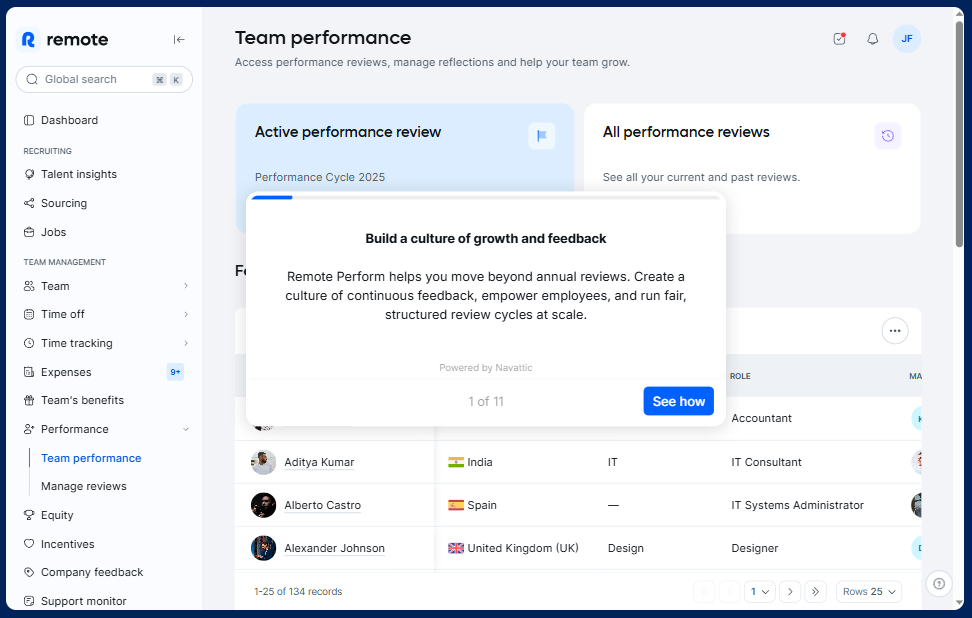
Employees can give feedback to peers and managers, or request it themselves. This help youcreate a culture of open communication and continuous development.
One feature I liked is the smart goal-setting.
Remote’s AI uses insights from previous reviews and peer feedback to create smarter goals.
For example, if repeated feedback highlights that an employee should start mentoring junior team members, the platform may suggest mentorship-related goals during goal setup.Managers then review, edit, approve, or discard these suggestions before assigning them.
Once goals are finalized, employees can track progress over time, giving individuals clarity on expectations while helping managers monitor development consistently.
Users can even customize the review questions, decide who participates, and calibrate reviews to best meet your needs:
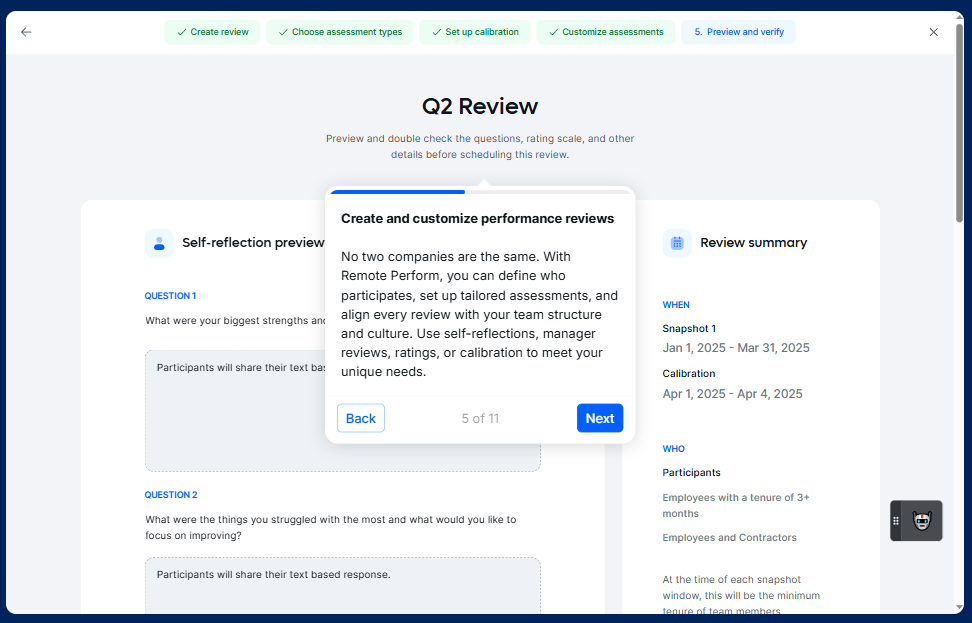
Employees can tap into Remote’s AI to provide detailed self-performance reviews. Just add some basic information, and it’ll expand accordingly.
From the same dashboard, managers track review progress, monitor submissions, reopen assessments if required, and nudge participants to complete their feedback.
Another great thing is the calibration tools. They help you compare evaluations across departments and adjust scores when needed, and ensure consistency in how performance is assessed.
Deel
Deel has a performance management module within Deel Engage. It helps align your team on goals, review performance, identify high-potential talent, and reward top achievers.
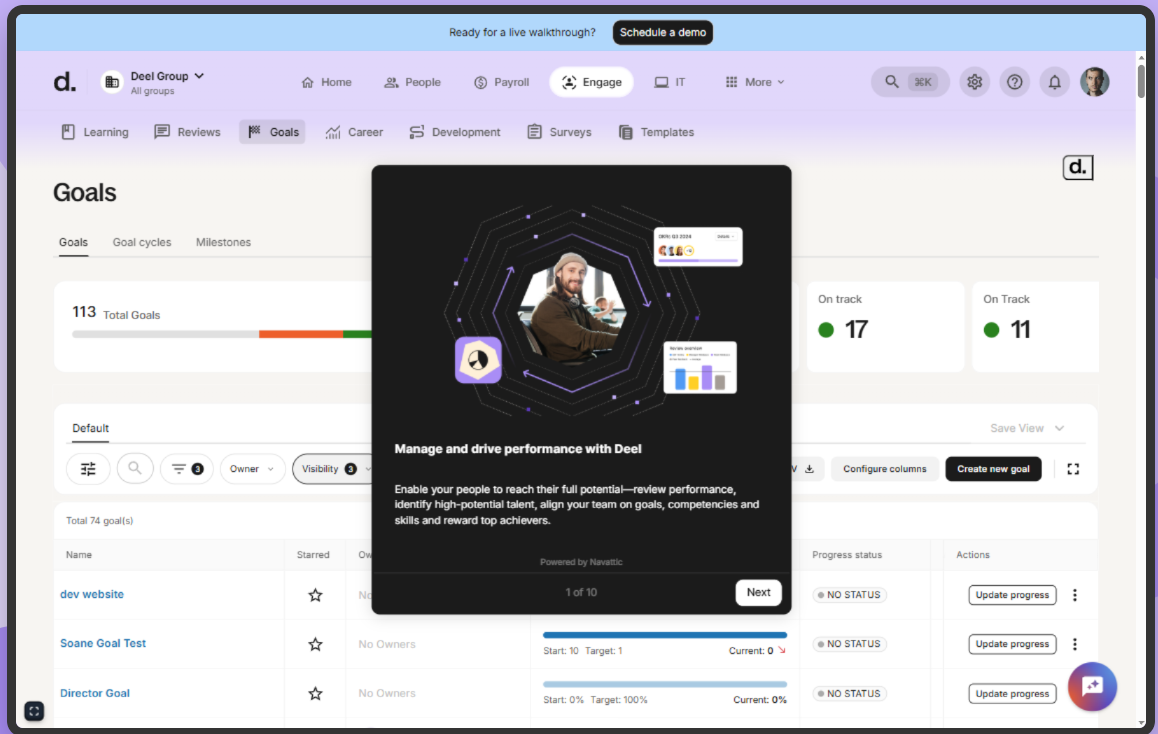
Deel’s Performance Management module also has Goals, similar to Remote, but it’s more detailed.
It lets you define goals, assign owners, define relationships with other goals, and even create individual OKRs and ladder them up to the department or company level.
Teams are able to create company-wide goal cycles (at fixed periods) that define when goals are set, when they’re worked on, and when they’re reviewed.
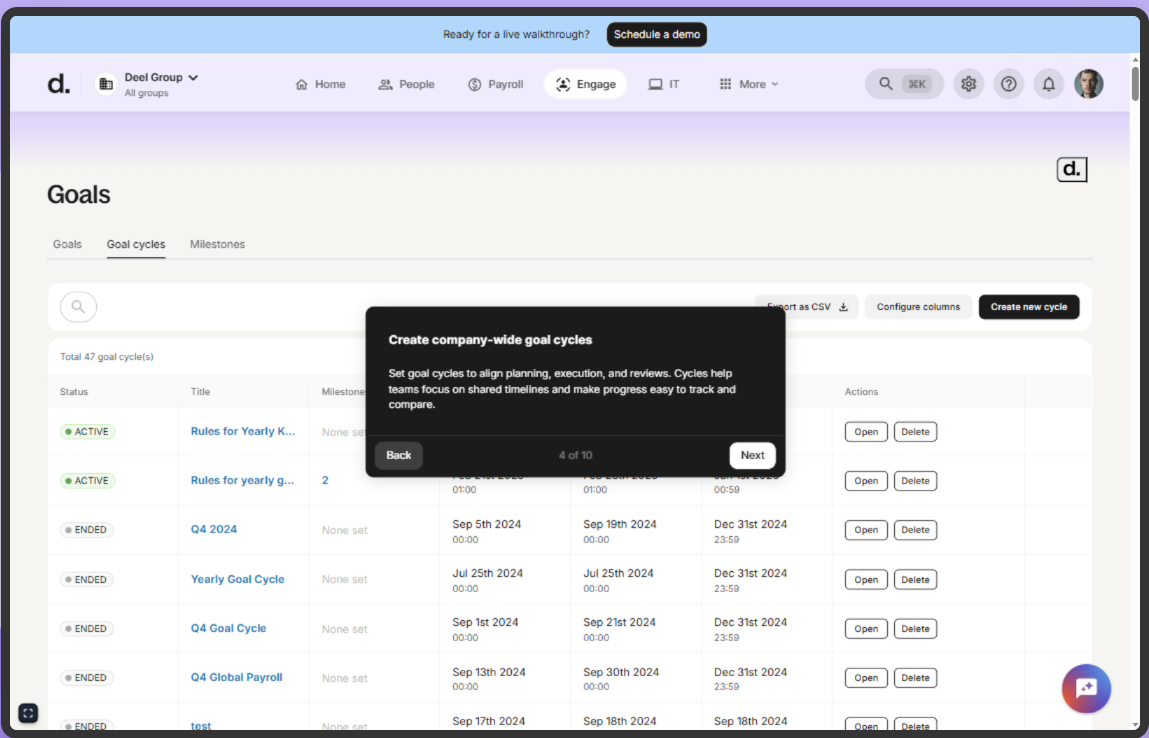
Because everyone knows when goals start and end, teams move in sync instead of at different speeds, and no one is working on outdated goals.
You can run fully customized 360° Reviews, classic performance reviews, or anything in between, based on your company’s culture.
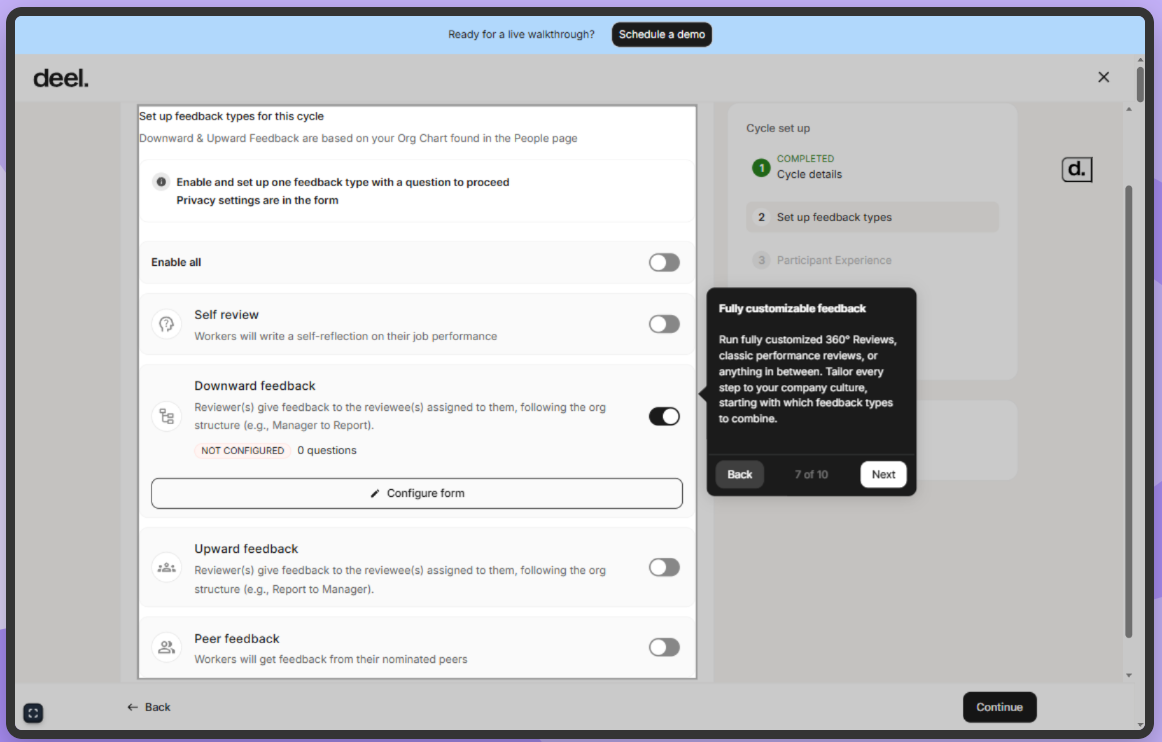
Deel lets teams automate performance reviews by setting rules that trigger feedback cycles based on dates, start events, or team membership. This reduces manual HR work and ensures consistent reviews.
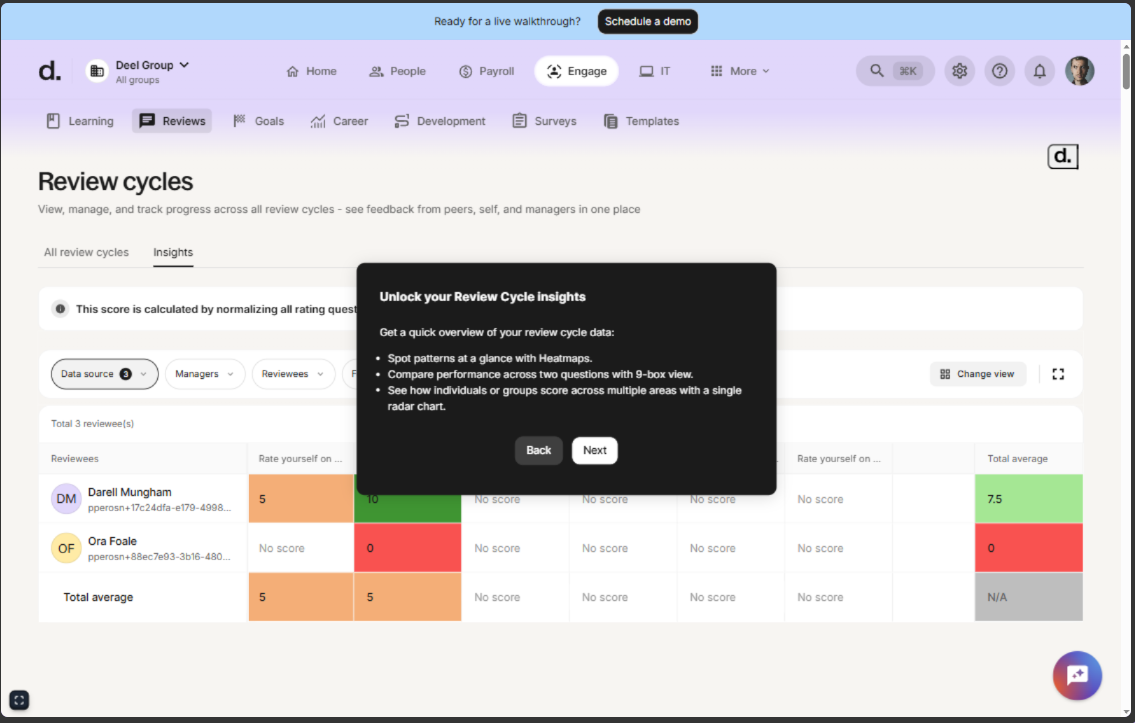
Finally, Deel provides next-level insights into performance reviews, using normalized scores and visual tools like heatmaps and 9-box grids. This helps HR and managers spot trends and make informed decisions:
Compensation and Benefits
Remote
A major differentiator here is that Remote is planning to offer the Compensation feature, as its website displays a “Coming Soon” message. However, they do have a dedicated Benefits module.
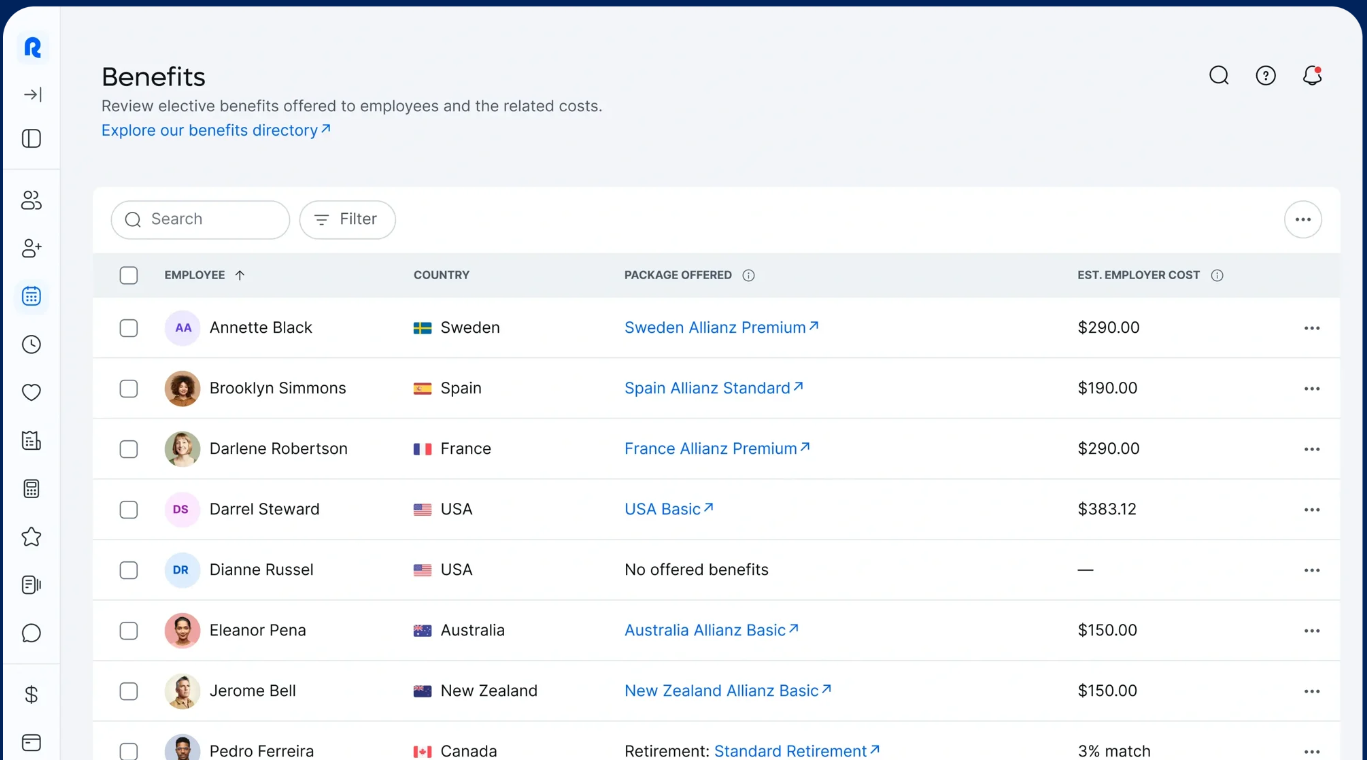
Remote focuses on offering localised benefits that appeal to a global audience. They have benefits specialists who search local markets to identify the best local benefits plans for your new hires.
Users can choose the right plans for employees within the onboarding workflow or at competitive prices, and contact Remote for a specialized request.
With Remote, companies can offer:
- Health insurance plans
- Pension, and 401 (K) plans
- Mental health support
- Life & Disability Insurance
- Dental Insurance
- Vision Insurance
Deel
Deel has a clear edge here, just because it has a live Compensation feature, and Remote doesn’t.
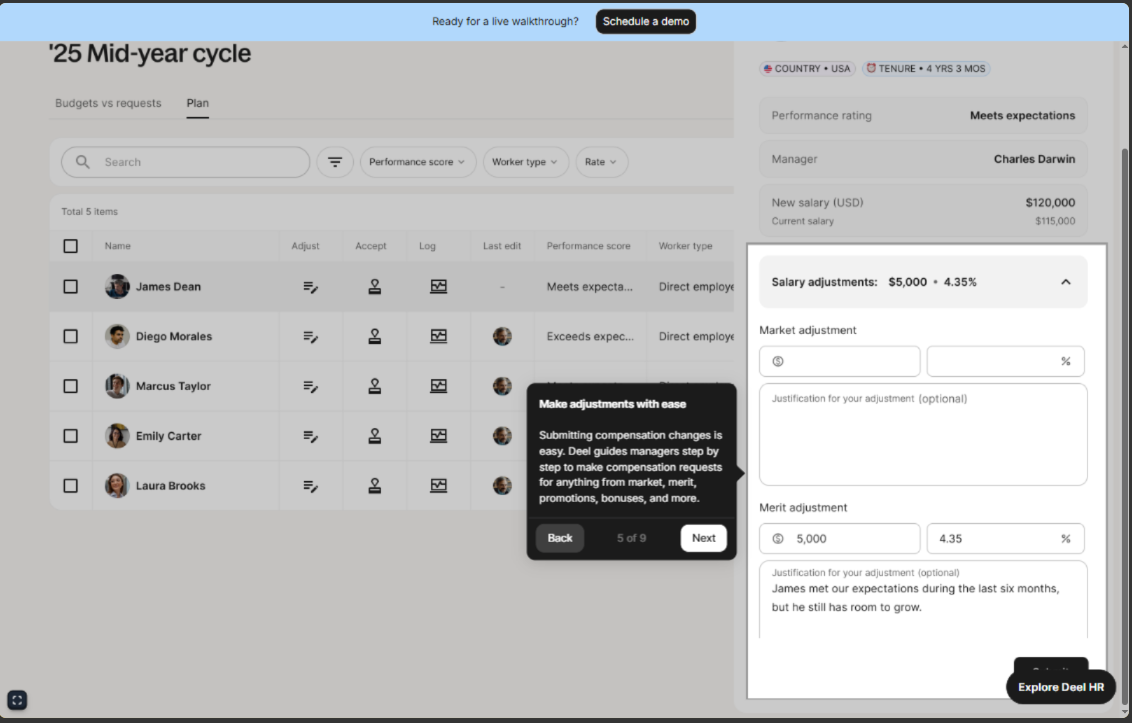
With Deel, users can customize your compensation cycles and manage compensation reviews based on your needs. For instance, Deel lets you create a mid-year and an annual cycle, during which you can review and decide who gets a merit-based hike, promotion, or who gets nothing.
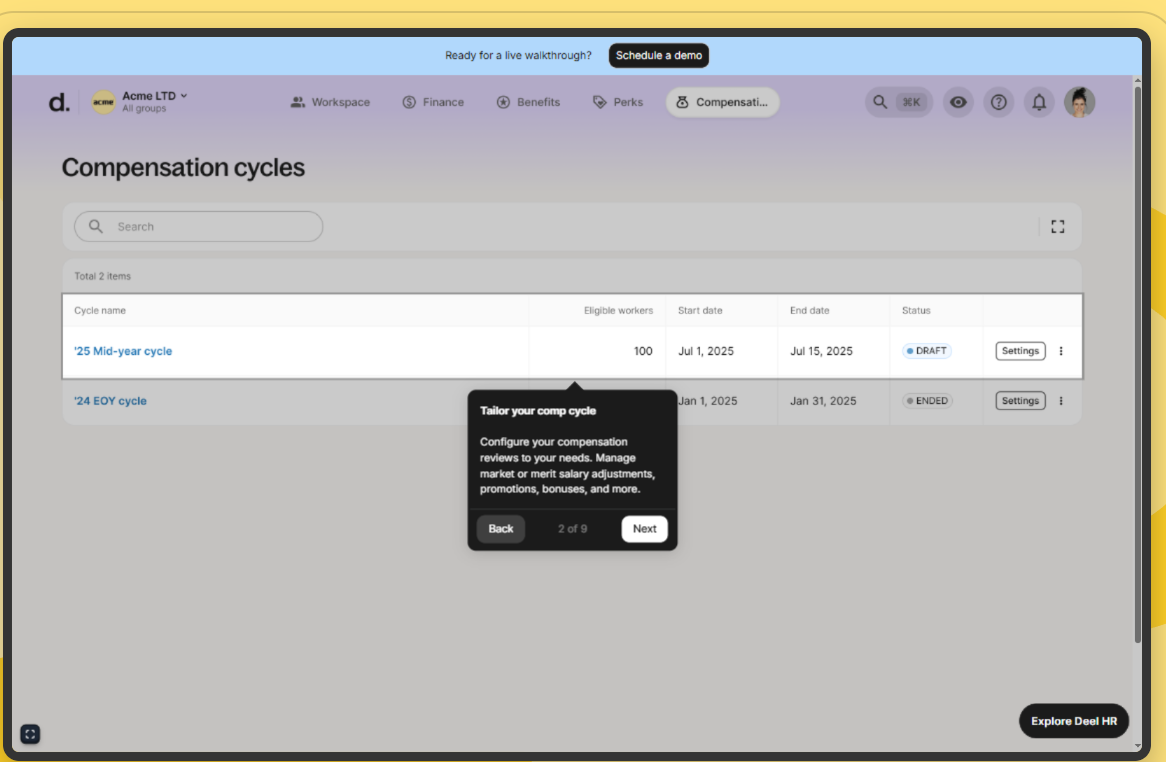
The biggest advantage here is that you don’t have to struggle with spreadsheets (meaning no version control or error margins) anymore. Managers can view the employee’s job title, pay history, current compensation, and more in one place.
Remember the performance module? The performance rating given to your employees syncs in the compensation module, enabling you to link pay to performance.
If a manager feels a compensation change is required, they can do it easily through a self-explanatory process:
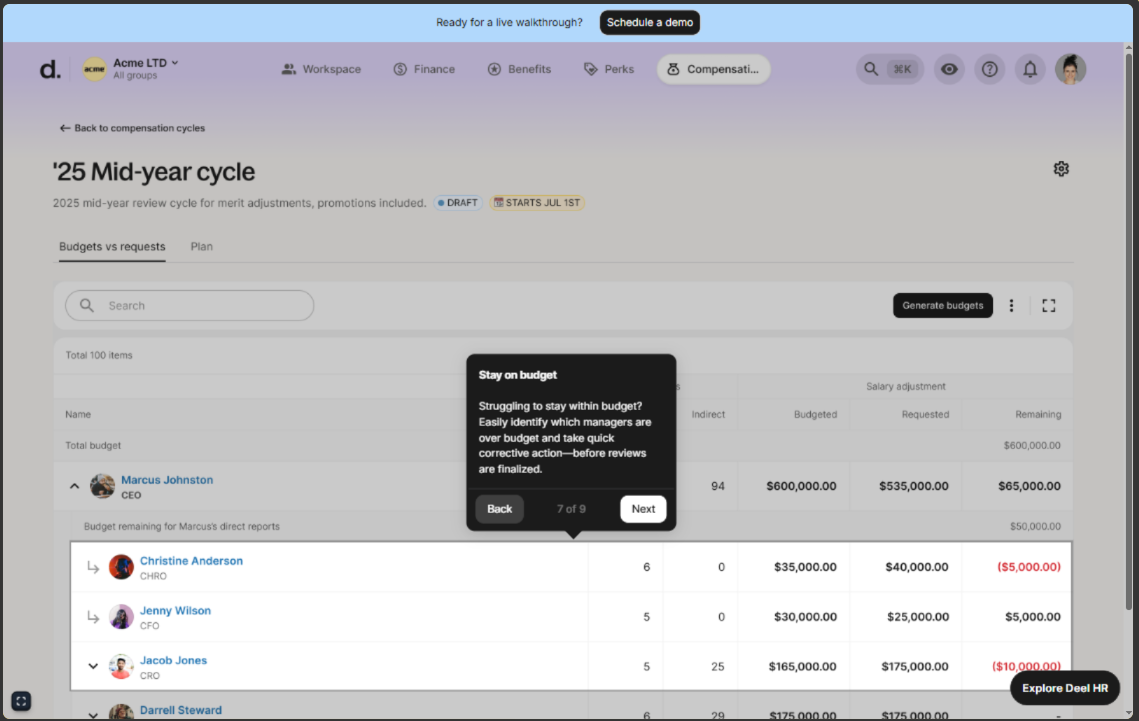
Moreover, managers can view salary adjustments (requested vs budgeted) and point out errors before reviews are finalized.
Another feature I find impressive is that whatever changes you make here are synced automatically to the payroll.
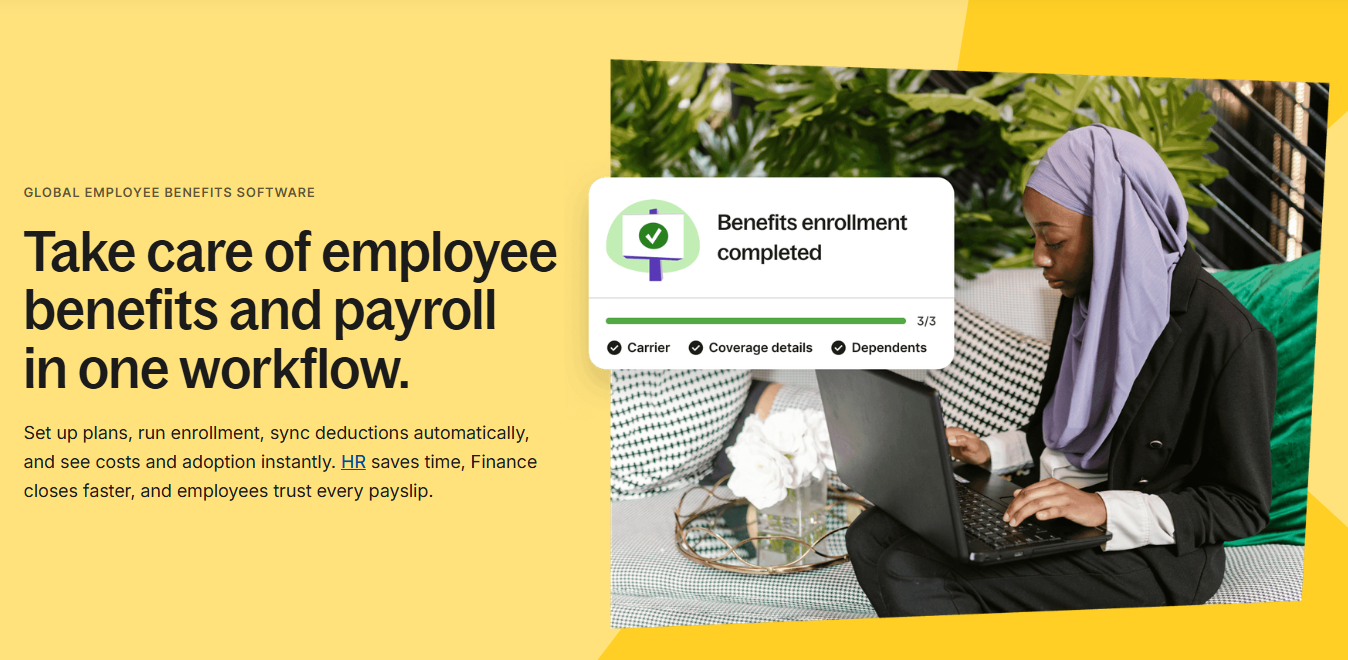
Deel’s benefits administration is integrated with payroll, making benefits setup, enrollment, and deductions part of a single workflow. This reduces manual work for HR and minimizes payroll errors by automatically syncing benefit deductions with each pay run.
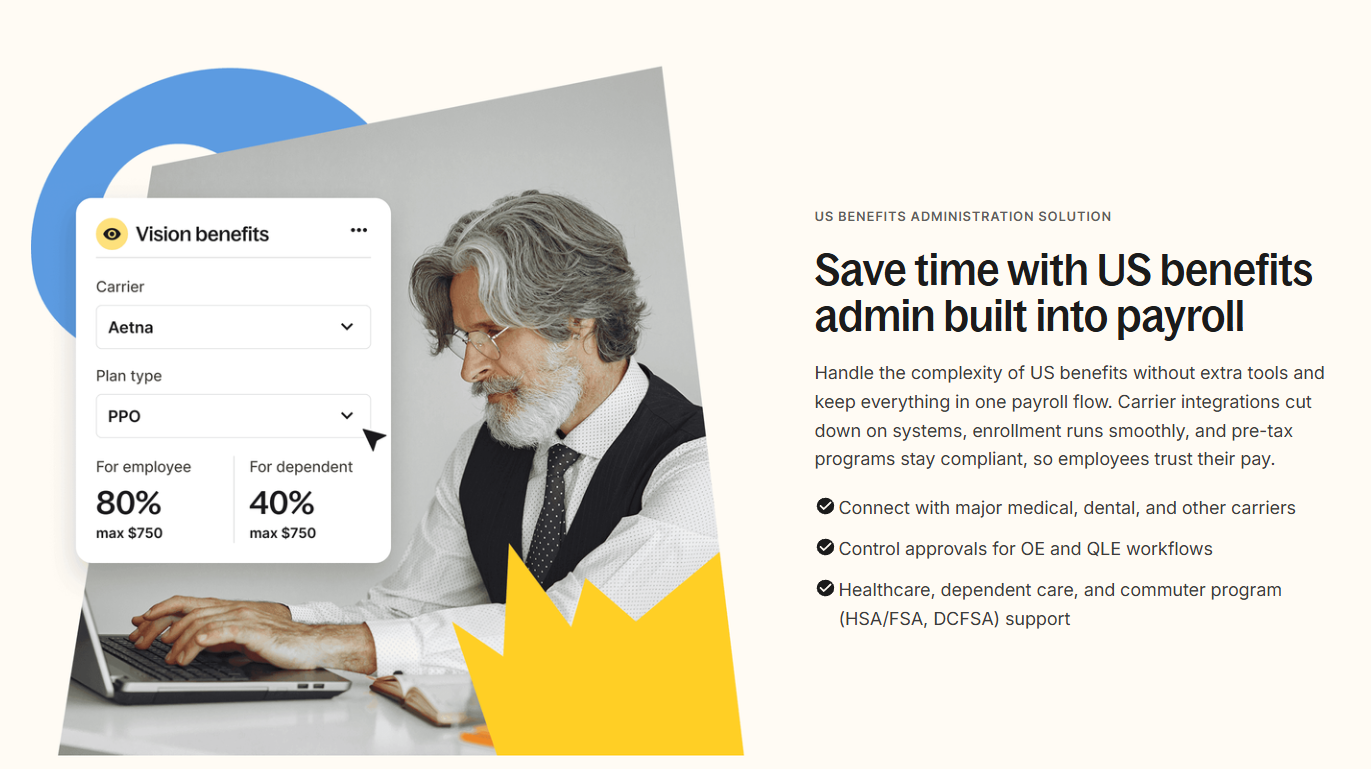
A key strength of Deel is its depth in US benefits administration. It supports medical, dental, vision, and pre-tax programs, including HSA, FSA, and commuter benefits, with direct carrier integrations. This simplifies enrollment, life events, and compliance tracking within the platform.
Recruitment
Remote
Remote’s Recruit module includes 3 major offerings: Recruit, Talent, and Sourcing., Users can post a job, run a search, or browse matches, enabling you to hire high-quality candidates.
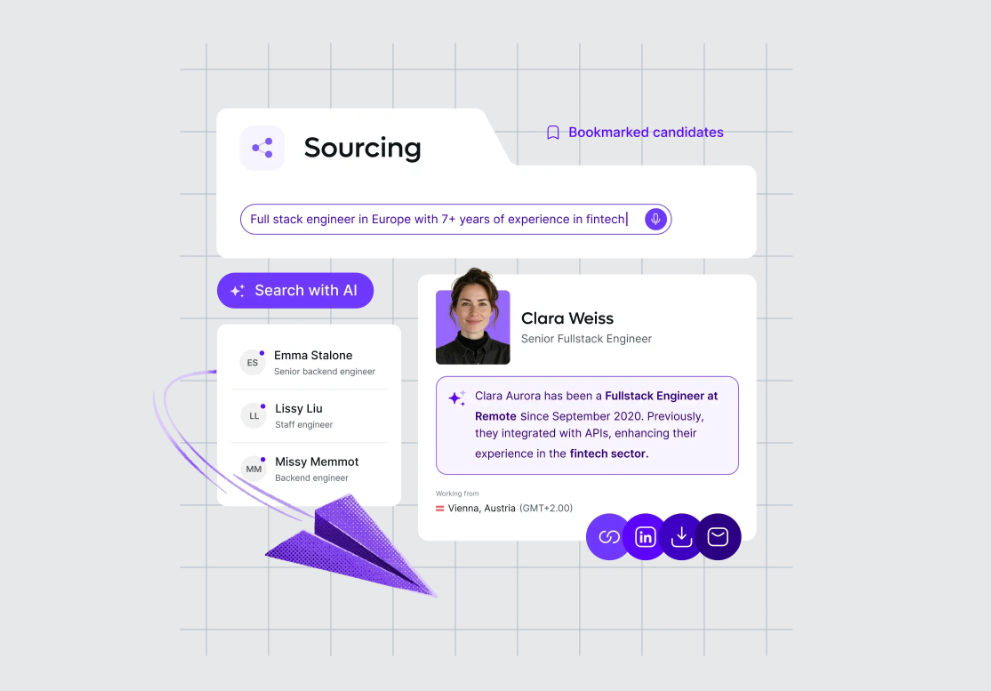
Just describe the role using plain language, and Recruit will search 800M+ public profiles (or your ATS) across 245+ countries and regions to instantly create a shortlist. You can view key details like skills, right-to-work, availability, and pay expectations, and reach out within seconds.
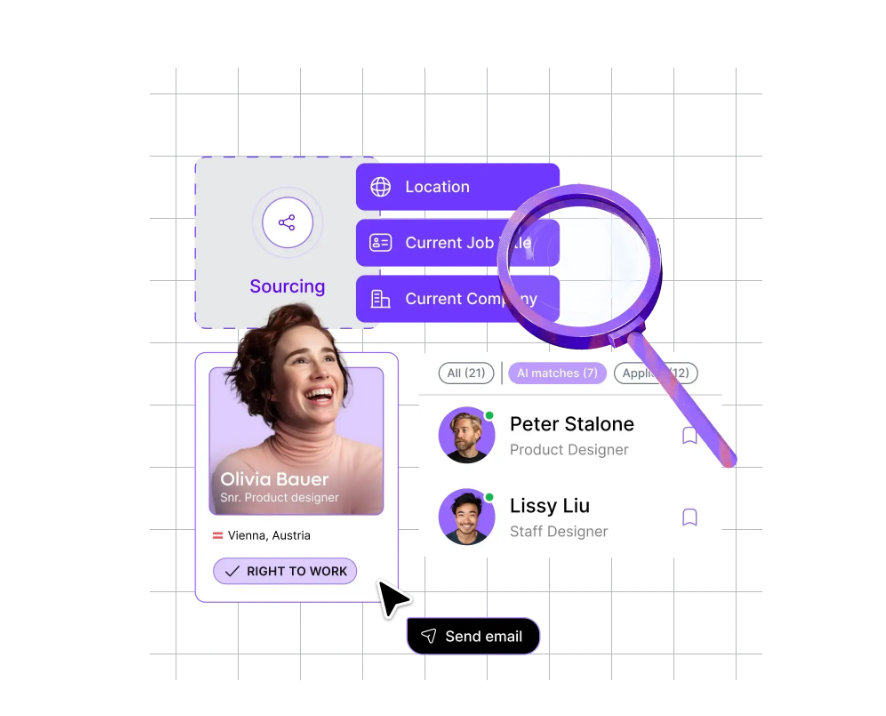
I like how Remote automatically filters out employees who don’t fulfil the right-to-work criteria. This helps you save time and hire only the best.
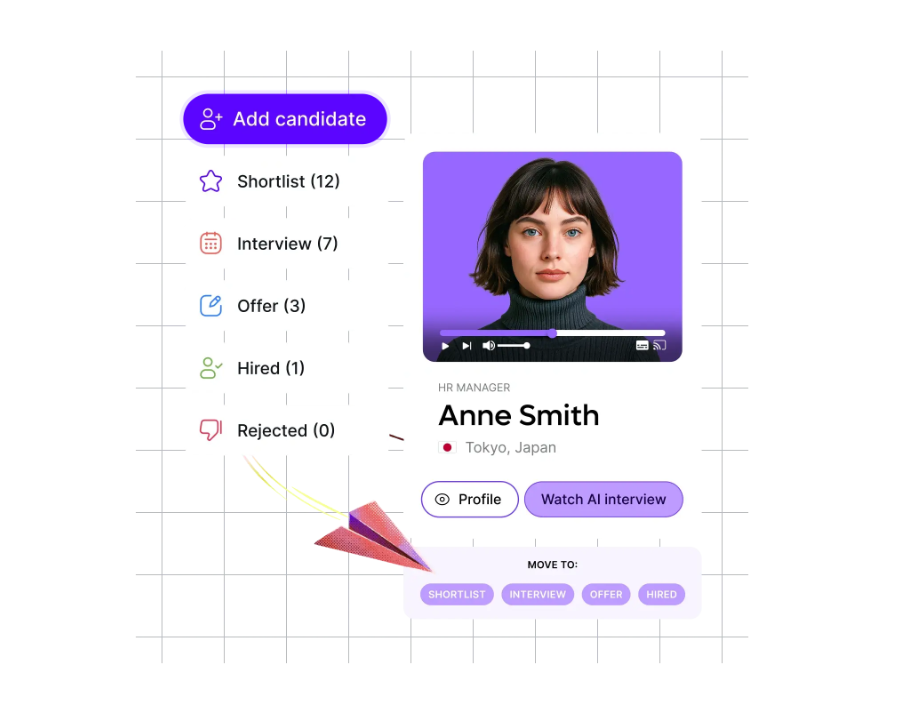
Remote also lets you track candidates throughout the pipeline, screen them using AI-based interviews, and initiate the onboarding workflow within Recruit.
Deel
Deel offers a dedicated Deel Talent module to help you find and hire top talent worldwide.
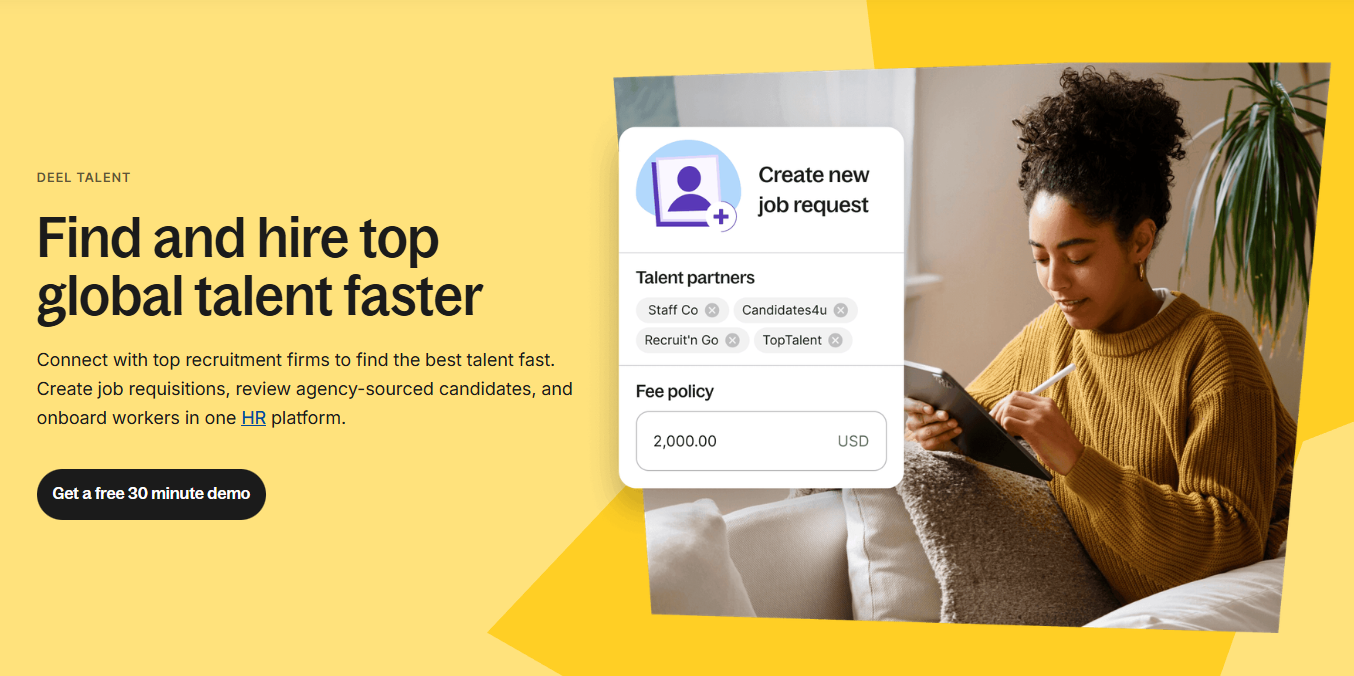
The dashboard gives you an overview of talent across your organization: live job requests, pending tasks, talent partners, and more.
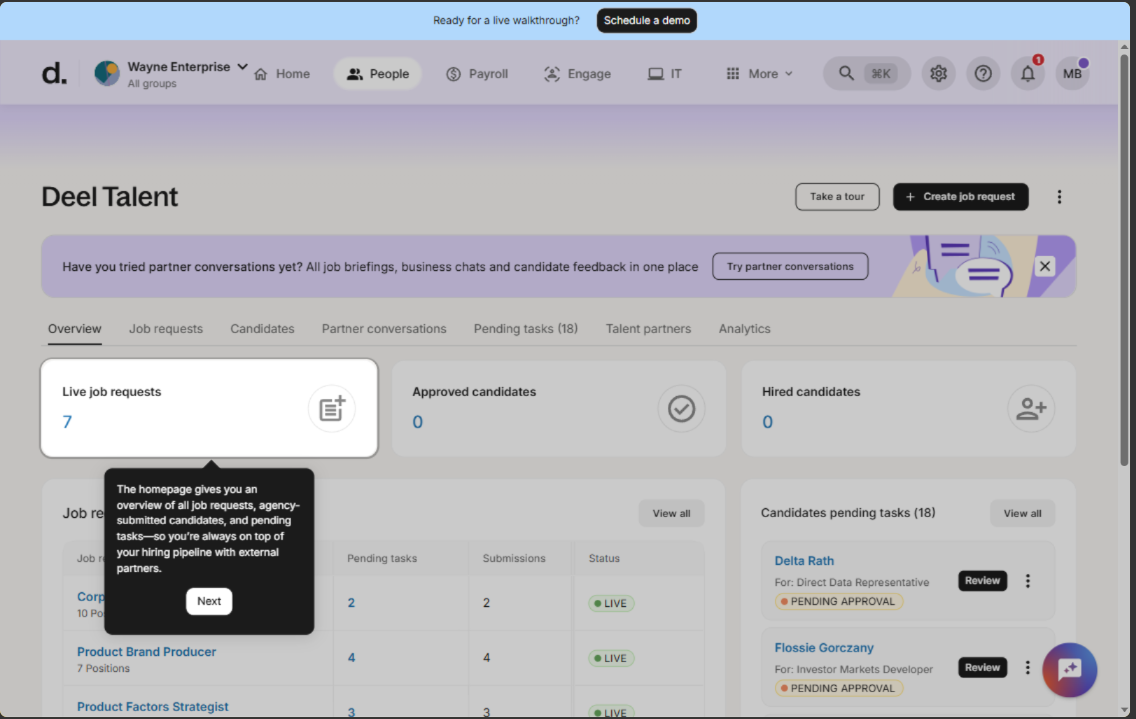
From the same dashboard, users are able to create job requests, and Deel Talent will automatically recommend talent partners that meet requirements. You just need to confirm the fee, select the partner, and share briefing questions to help the talent partners find the right candidates.
You’ll then see a list of all the candidates the talent partners have submitted for shortlisting.
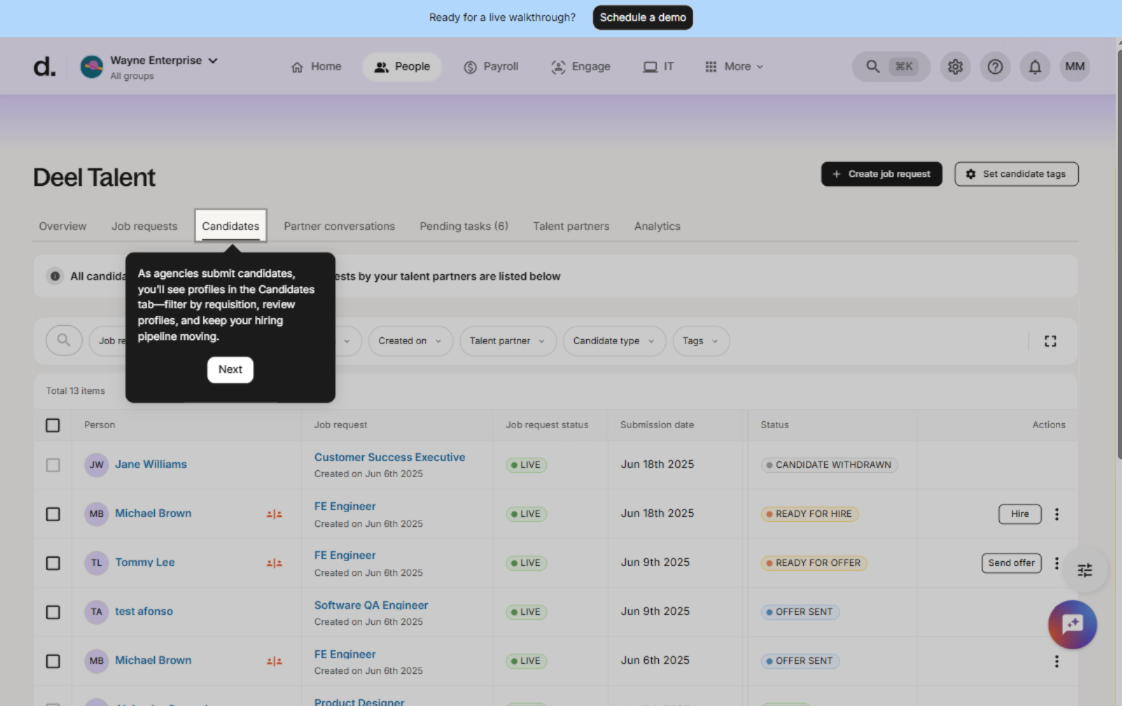
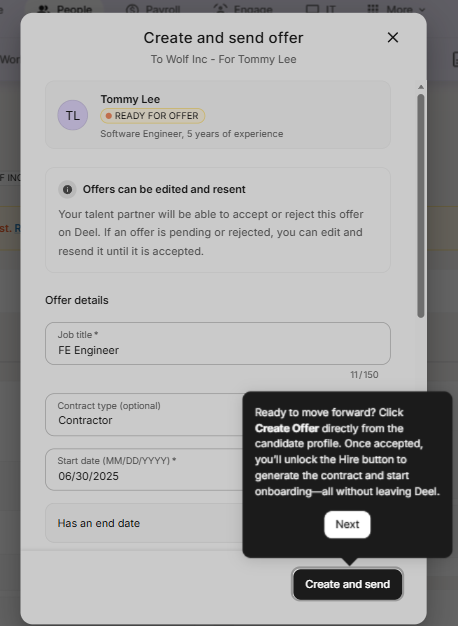
After you’ve selected the right candidate, Deel lets you create and send the offer letter.
HRIS Verdict
Deel’s HRIS module is more comprehensive than Remote.
Beyond core employee records and workflows, Deel extends into structured performance management, compensation cycles, reporting, and analytics. This makes it better suited for organizations that want to manage the full employee lifecycle in one system.
Remote’s HRIS is simpler and more focused, covering essential HR operations, payroll-linked records, and compliance for global teams. However, it currently lacks native compensation management and offers less depth in performance and reporting.
Payroll
Global and Local Payroll
Remote
Remote offers an all-in-one global payroll hub that lets you manage payroll, benefits, time off, taxes, and HR data across 100+ countries from a single dashboard.
The dashboard shows you all the payroll runs organized by country, with a progress indicator bar that tells you where you are:
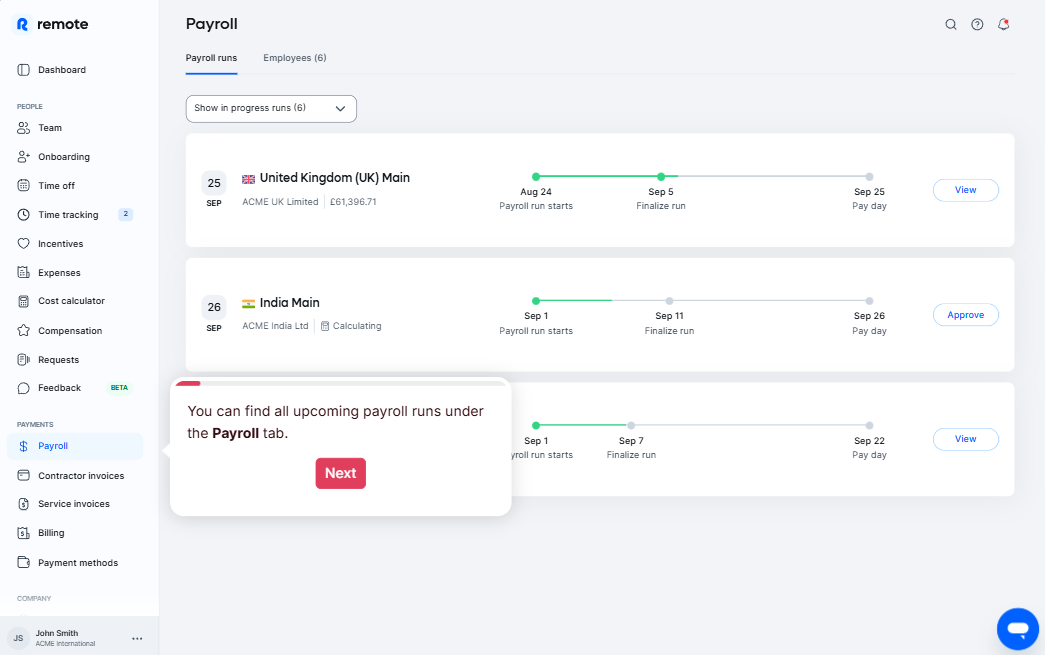
Users can select a payroll run and view details such as salary, benefits, incentives, and the total payroll amount. Remote’s team coordinates with you during implementation to understand the benefits and tax rules, to ensure everyone pays the right amount, and you stay compliant.
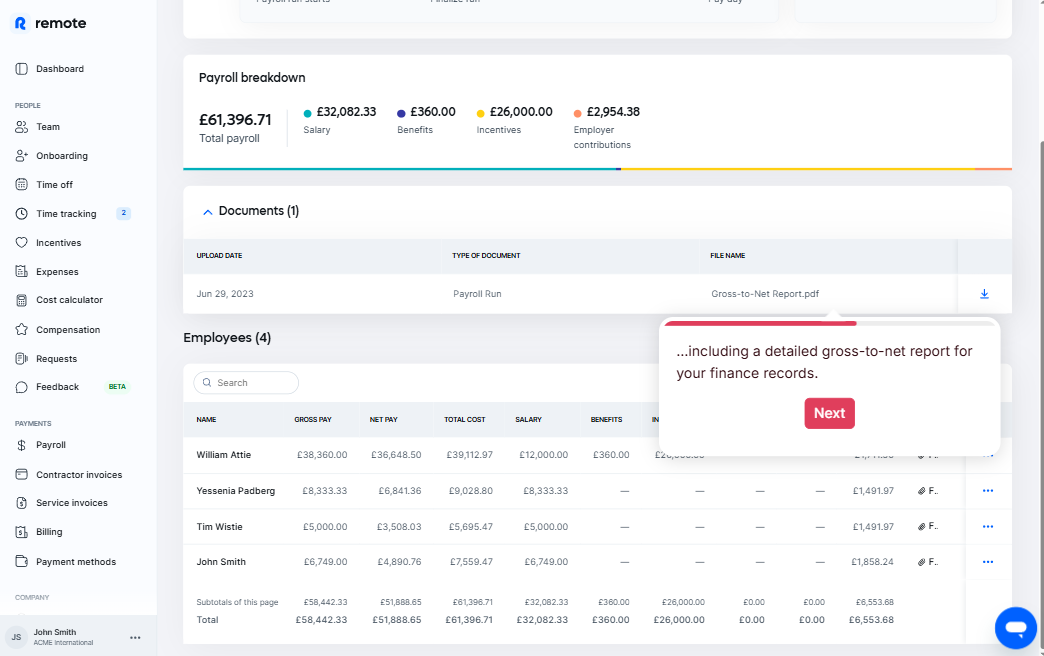
The same dashboard also lets you view time-off and expenses and download a gross-to-net report for financial records.
In addition to global payroll, Remote also helps you with local payroll. But they don’t market it separately as Deel does.
Remote supports countries like the UK, the US, the Netherlands, Spain, Portugal, Mexico, Ireland, South Africa, Indonesia, India, and has local experts to ensure compliance:
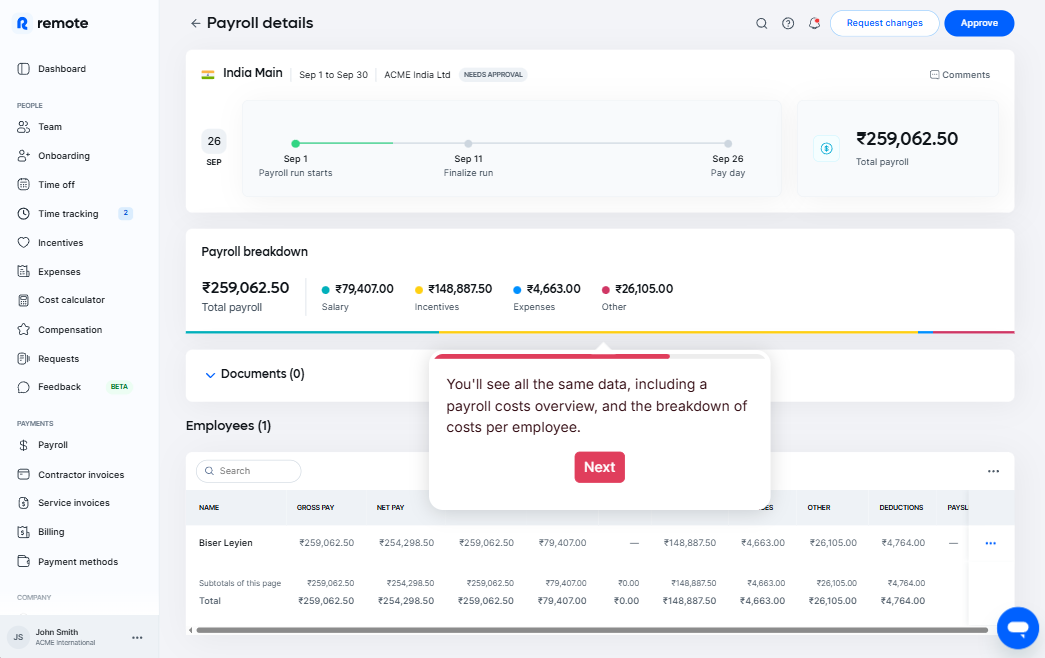
If you think something is wrong, click “Request Changes” and mention the details. You can even add a comment if you have a question, and Remote’s experts will help you out, which is great.
Once you’ve confirmed everything, click approve, and the funds will be available to your employees on payday.
Deel
Deel is one of the fastest fully managed payroll providers that offers in-house, local compliance in 130+ countries, more than Remote’s 100+.
Also, Deel integrates with multiple HR ERP and HCM tools to enable secure, flexible, and complete data flow across HR and Payroll.
Here’s what the interface looks like. It gives you an overview of all your global entities, enabling you to review, and submit payroll for approval from one place.
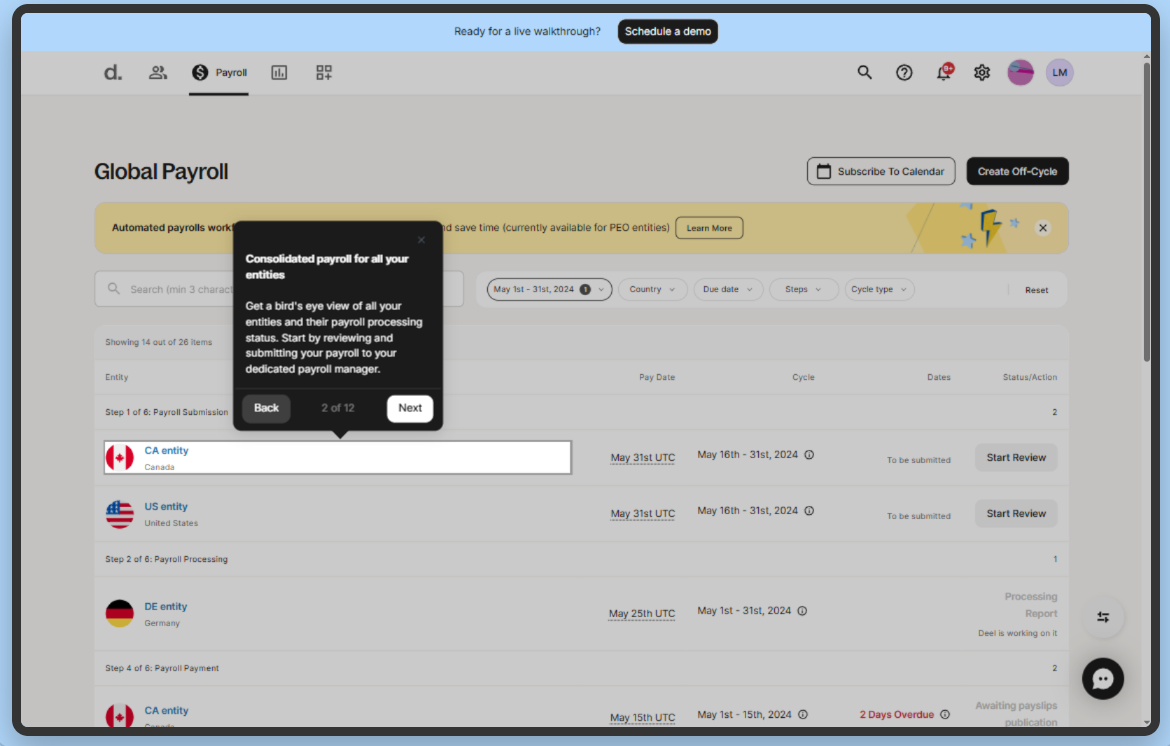
If you find something (like sales commission, bonus, transaction fee and more) that needs to be changed, it lets you make the changes directly in the report:
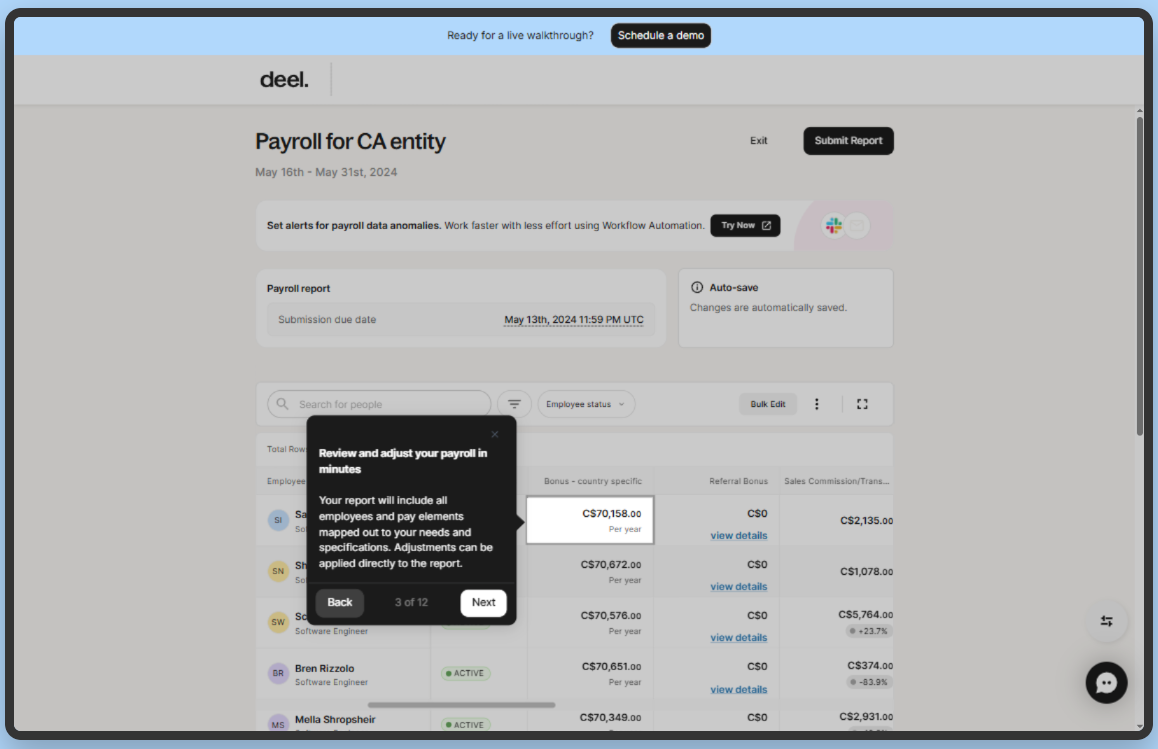
After approval, proceed with the payment using your preferred payment method.
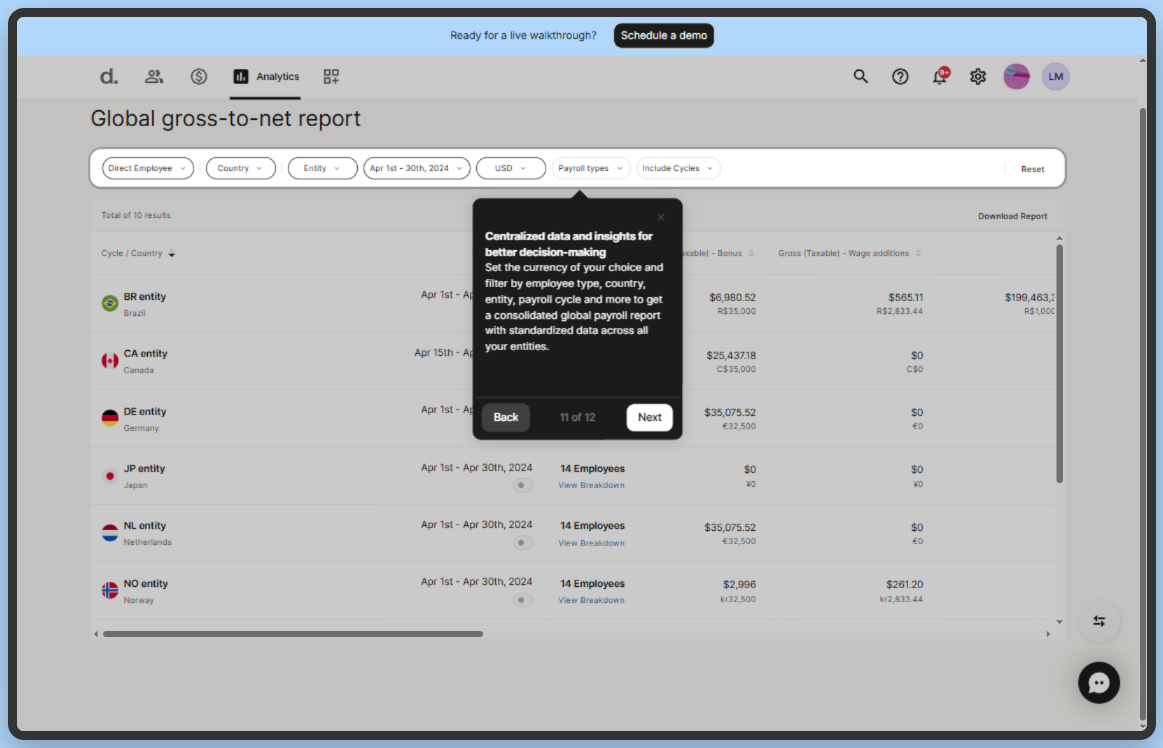
One thing that stood out was the reporting features. From the analytics section, Deel lets users access real-time, global reports on payments, employee contributions, deductions, payment history, and more.
For instance, the global gross-to-net report provides a view of your total payroll operations and can be customized to your reporting needs. With these centralized insights, Deel lets you accurately reconcile payroll and forecast spend:
US Payroll is complex because every state and some cities within the United States have different tax laws to consider in addition to the federal regulations. But Deel has a dedicated US payroll offering with two modes:
- Self-Run: Choose this if you’re a US-based organization with established payroll expertise and need a fast and automated way to handle calculations, taxes, and filings yourself without adding complexity.
- Premium Support: Choose this if you’re a global team or a company that lacks US payroll expertise. You get premium support for hiring across multiple states, paying hourly workers, or managing more complex payroll inputs.
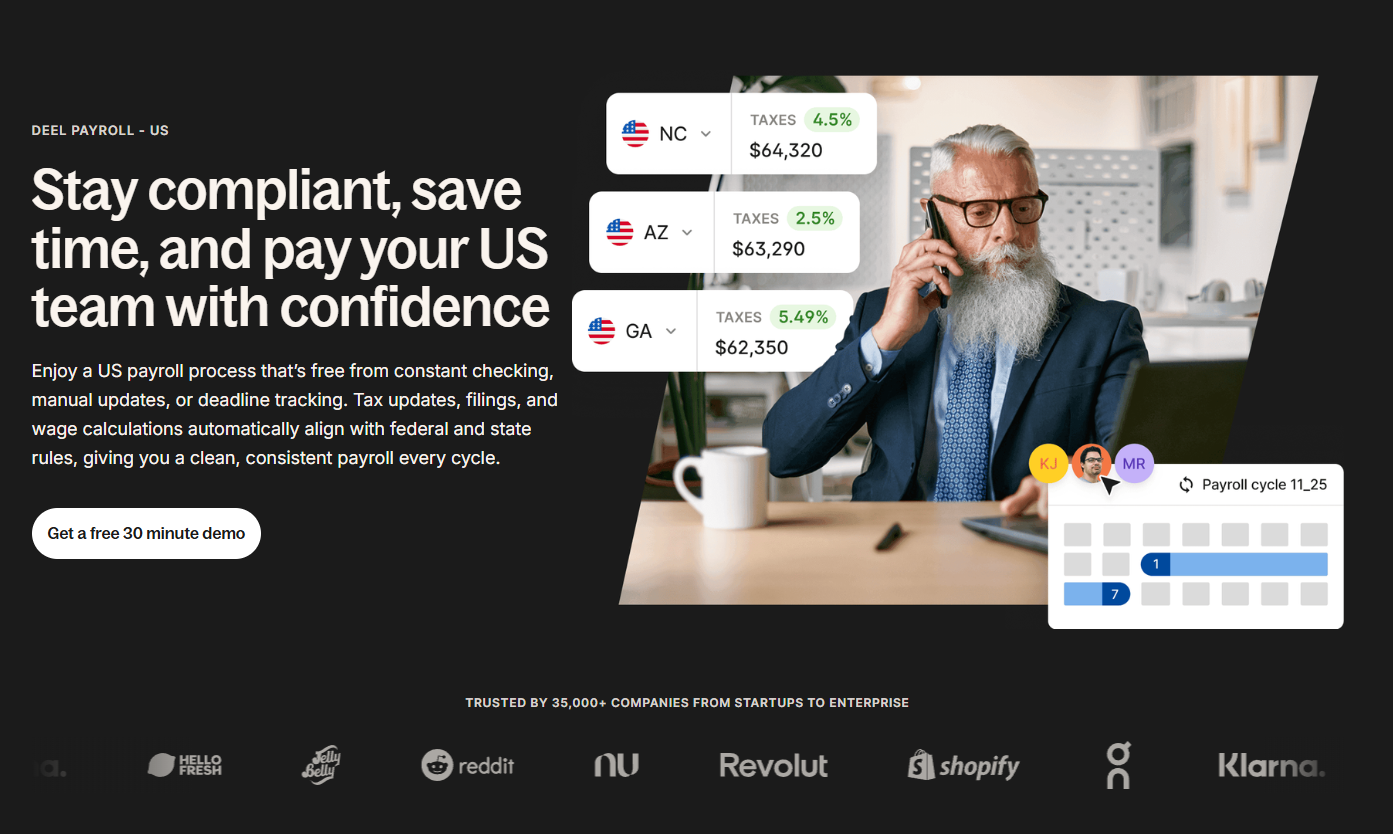
Here’s what Deel helps you with when it comes to US payroll:
- Collecting employee and tax setup information
- Calculating gross wages
- Deducting federal, state, and local taxes
- Withholding benefits and other deductions
- Paying employees
- Filing payroll taxes and submitting employer liabilities
- Producing reports and employee tax forms (e.g., W-2s)
Major Difference:
Deel explicitly lists a dedicated US payroll offering alongside its global payroll and PEO services, signalling a more structured and mature payroll portfolio.
In contrast, Remote presents payroll within its broader global employment platform without a separately named US payroll product. And this makes it less clear to buyers looking specifically for standalone US-entity payroll solutions.
Note. Deel goes a step further by letting you run your own payroll in 44+ African countries, the UK, and Brazil.
Employee of Record (EOR)
EOR is when you hire a 3rd party to hire and onboard employees on your behalf, and manage everything from payroll and taxes to compliance.
Remote
Remote’s EOR service lets you hire employees compliantly and quickly, without opening a local entity in 90+ countries.
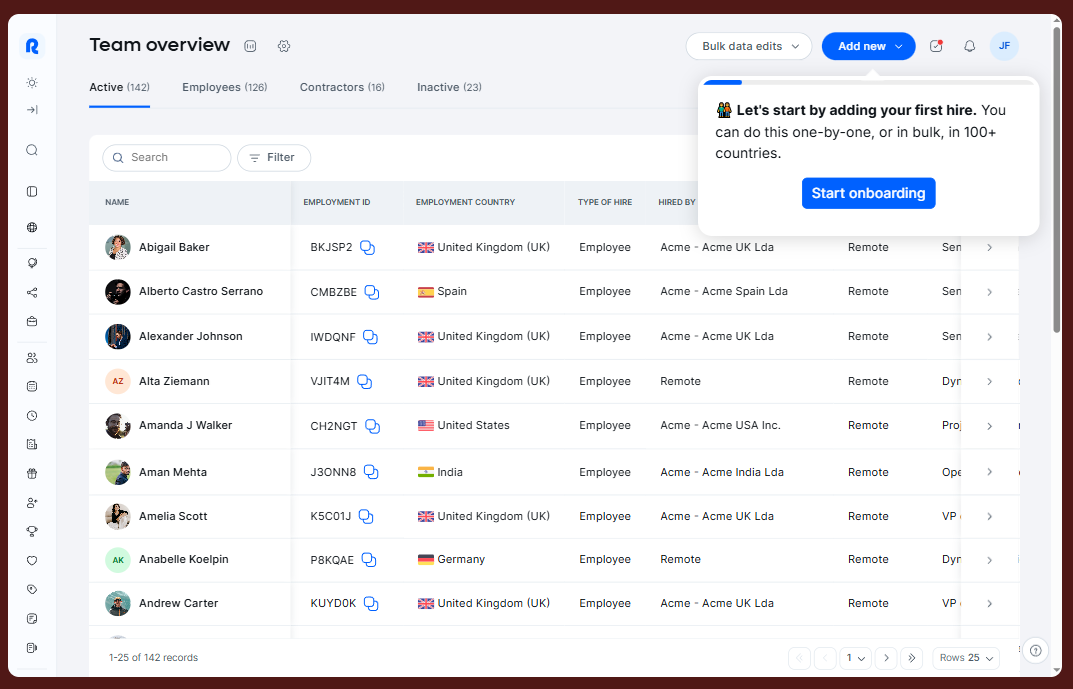
You can instantly add an employee by following simple steps, including employment eligibility checks, role requirements, benefits, and background checks, and adding bonuses or commissions, and the like.
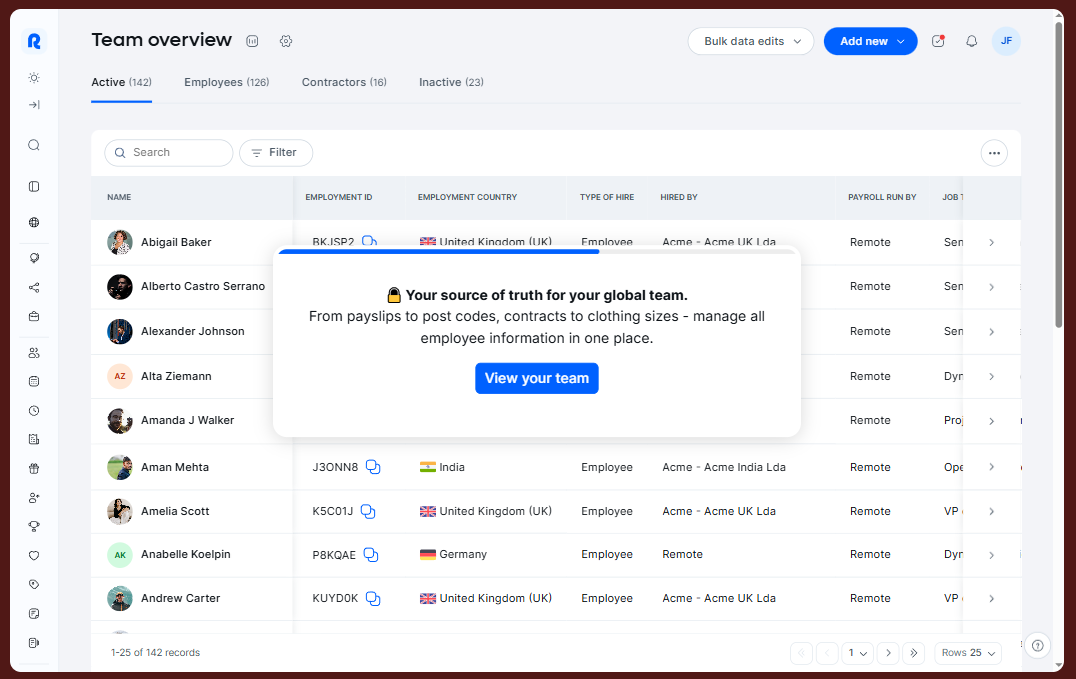
Remote gives you visibility into your global team’s payslips, postcodes, contracts, etc., all in the same dashboard. It even maintains a version history of all the changes.
For instance, if someone changes an employee’s salary, PTOs, pension percentage, Remote logs all this information, enabling complete transparency.
With Remote, there are no handoffs to third parties, since it has own entities across the countries it supports. This ensures better accountability, faster onboarding, and stronger IP protection in every country.
Remote also has strong compliance monitoring features, which are essential when you’re operating globally.
Their team monitors country-specific updates and flags what you need to know,
One feature I like in particular is “Ask an Expert.” So, you get access to Remote’s in-house expert via a 1:1 video call to get answers to your global employment queries.
Deel
Deel lets you hire and onboard employees in 150+ countries without opening an entity, while ensuring compliance and minimizing tax, benefits, and labor-law risks. Now that’s a massive win for Deel, since Remote supports only 90+ countries.
I accessed their interactive demo and found the UI intuitive and easy to use. Simply add people (for example, an EOR employee), enter their compensation and the necessary details, and you’re good to go.
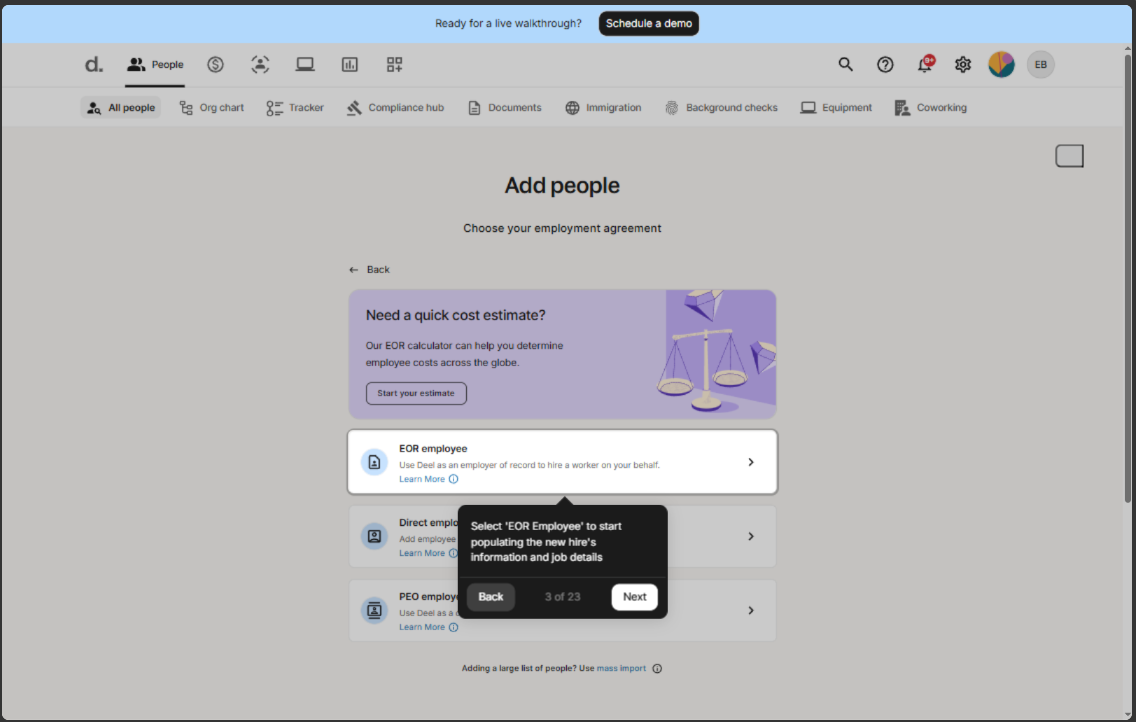
Deel has compliance built in. If you enter a gross salary lower than the region’s minimum gross salary, it won’t let you proceed further.
Also, Deel’s compliance monitor helps you stay up to date on evolving regulations, ensuring that new changes are reflected in agreements, payroll, and employee practices.
Another feature I liked was the self-service facility that allows employees to submit their time off and expenses, view payslips, request documents, and access support. This saves HRs a lot of time.
Lastly, I explored Deel’s AI chatbot. It lets you ask any compliance-related query, and it’ll scan through 12,000 articles to provide a credible answer.
Contractor Management
Remote
Remote lets you hire contractors from 190+ countries, which is higher than Deel’s 150+. You can hire contractors, enable automations, and ensure lightning-fast payments with Remote.
Some features that I liked right off the bat include built-in misclassification and tax tools. This ensures no contractor is misclassified or denied benefits, and you stay compliant. Also, Remote checks which contractors are active and charges you only for those, keeping bills low.
That’s what the contractor onboarding screen looks like:
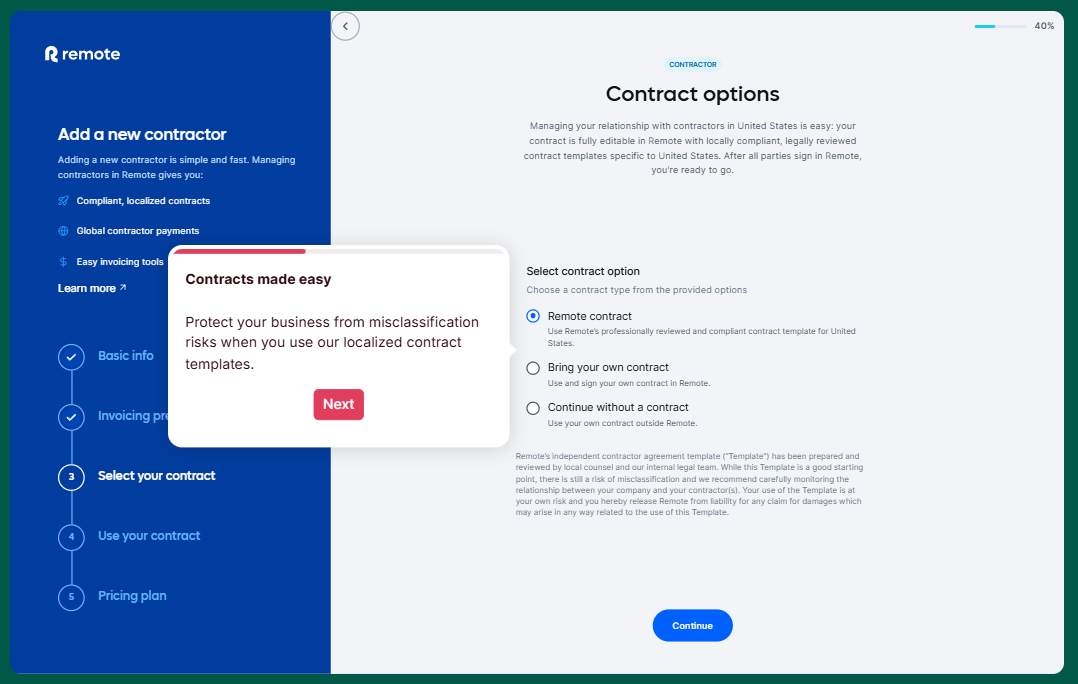
Add some basic information, and choose contracts (localized contracts from Remote or your own),
Remote lets you schedule invoices, which ensures on-time payments without fail:
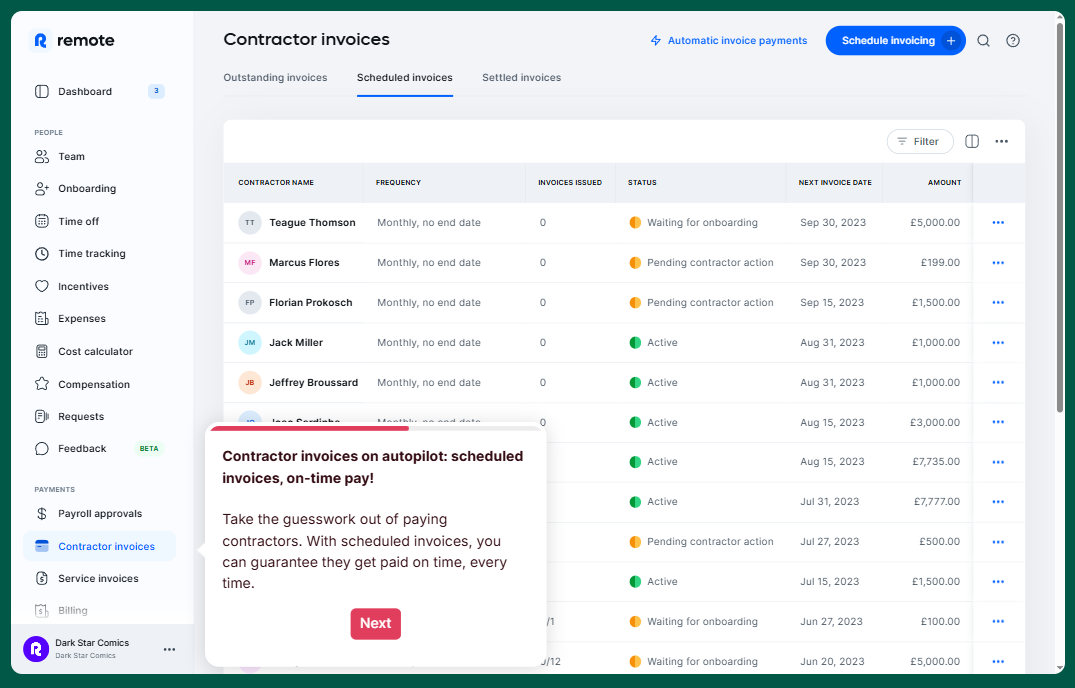
Once you have approved the invoices, choose the payment method, and all your contractors will be paid on time:
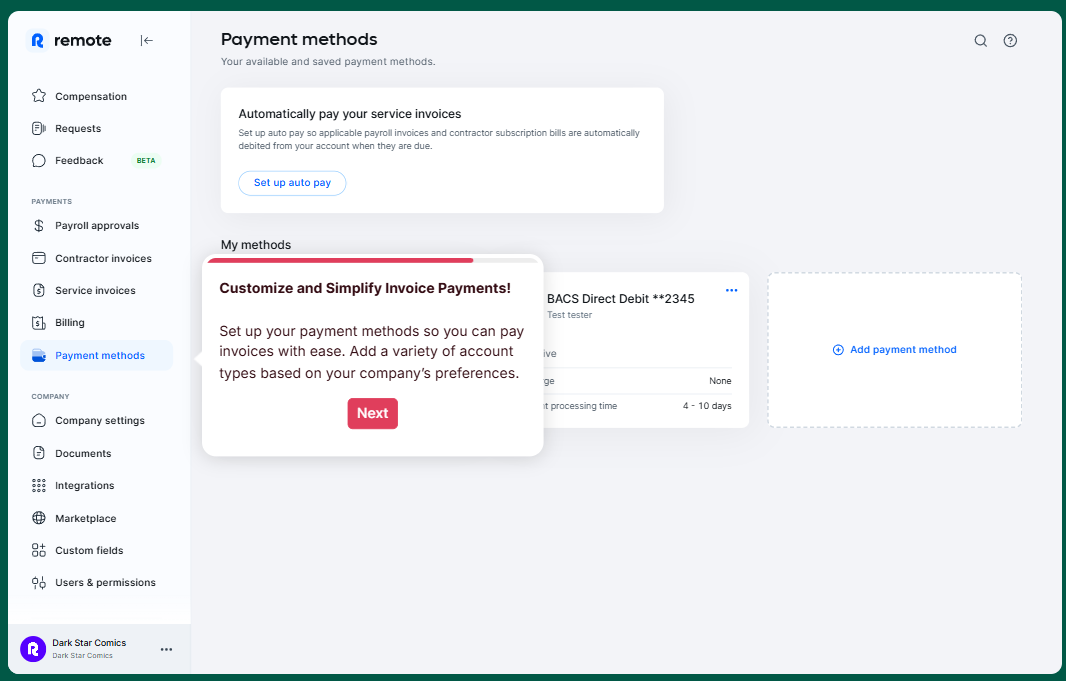
Deel
Deel makes hiring and managing contractors/freelancers from 150+ countries easy and efficient. The interface is very similar to Remote's.
Just:
- Click “Add a contractor.”
- Select the contractor payment agreement.
- Add role details
- Decide on the compensation and frequency (weekly or monthly)
- Choose addons like background checks or coworking passes
- Review, sign, and send the contract
That’s how you onboard a new contractor via Deel.
Once you’ve hired or onboarded a contractor, you can manage each one of them using the same centralized dashboard:
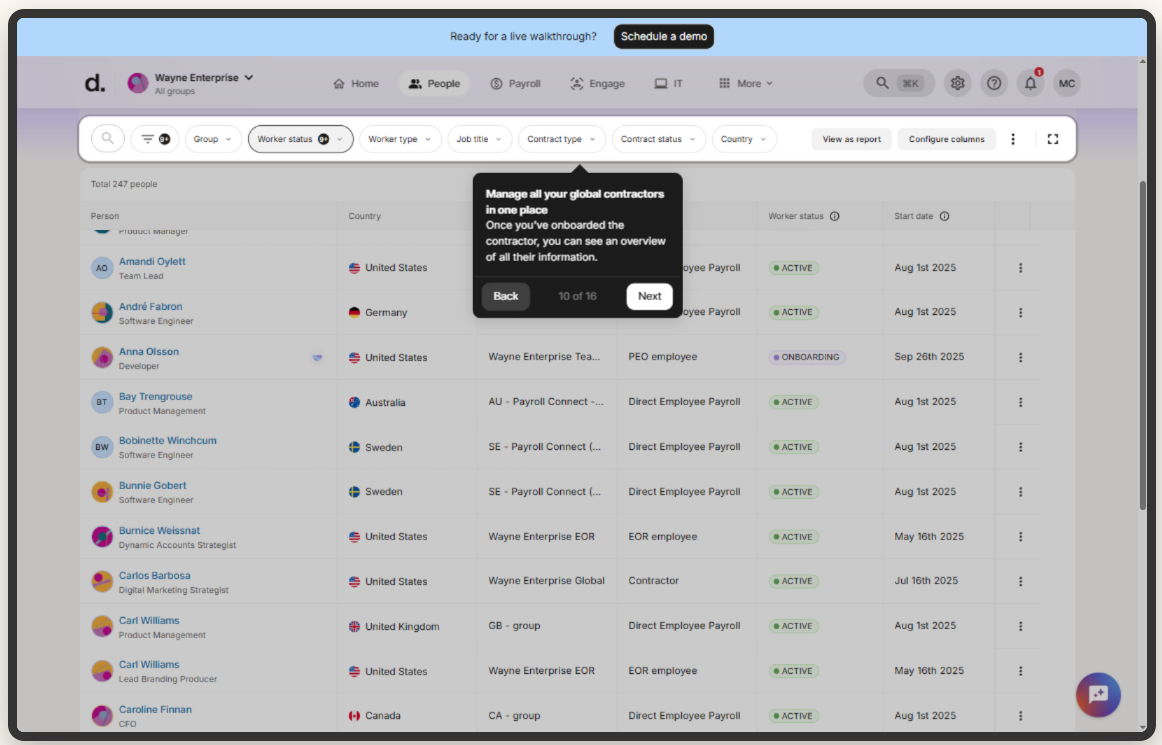
Another great thing is that Deel lets you instantly bulk pay all your contractors. Select the contractors, review the invoices, choose your preferred payment method, and make the payment.
Contractor of Record
Contractor of Record (COR) is when Remote or Deel acts as the legal entity on your behalf and handles even the legal implications and compliance, in addition to handling the onboarding, payments, and offboarding. It’s similar to EOR but for contractors.
Remote
Remote’s Contractor of Record (COR) is a compliance-first service that lets you engage international contractors without becoming the legal contracting party.
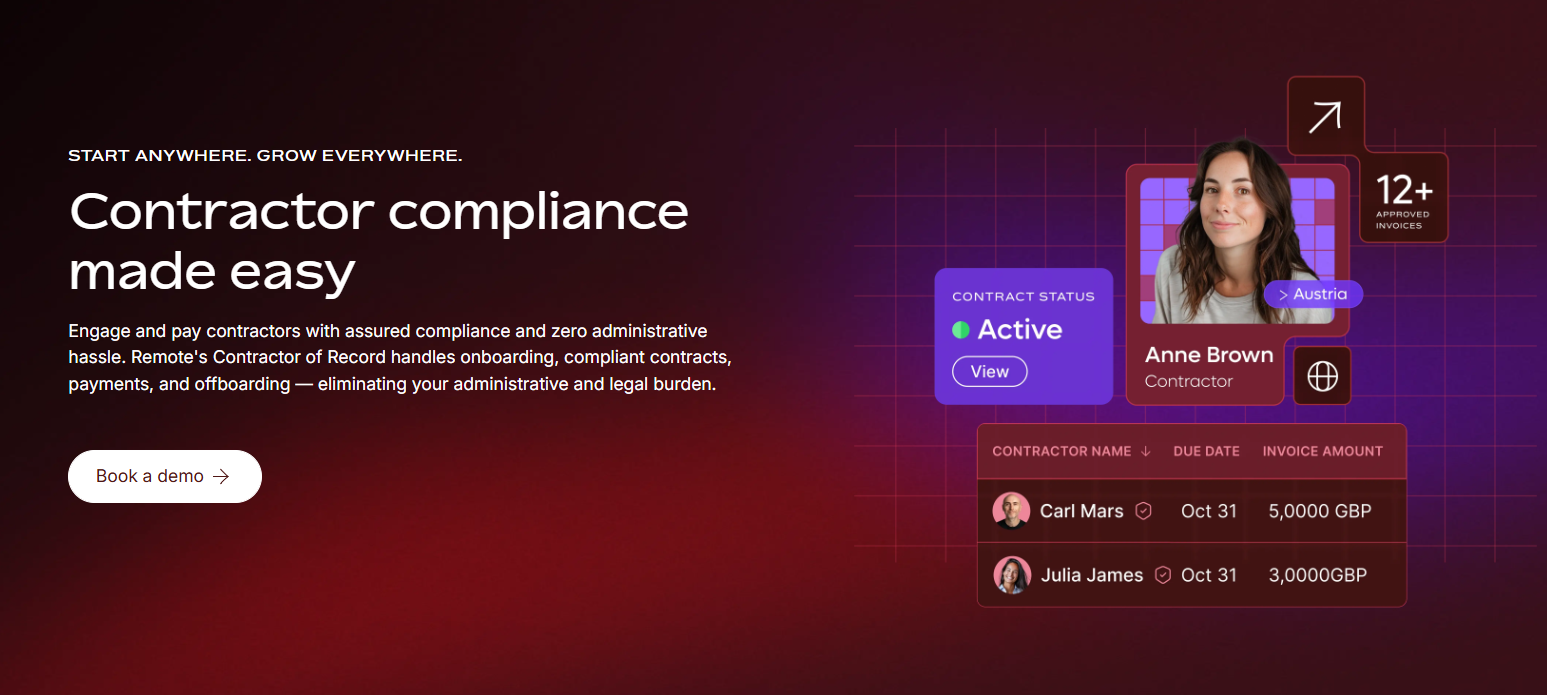
Remote directly creates a contract with the contractor, handles compliant agreements, manages payments, and oversees offboarding. This removes legal and administrative burden from your team.
A feature I liked is their risk protection. Remote emphasizes uncapped indemnity, proactive classification guidance, and IP protection through Remote IP Guard.
This is designed for companies that want strong legal safeguards and confidence when hiring contractors in unfamiliar or high-risk jurisdictions.
Deel
Deel also handles localized contracts, onboarding, global payments, and ongoing administration, allowing companies to hire contractors worldwide with reduced legal exposure.
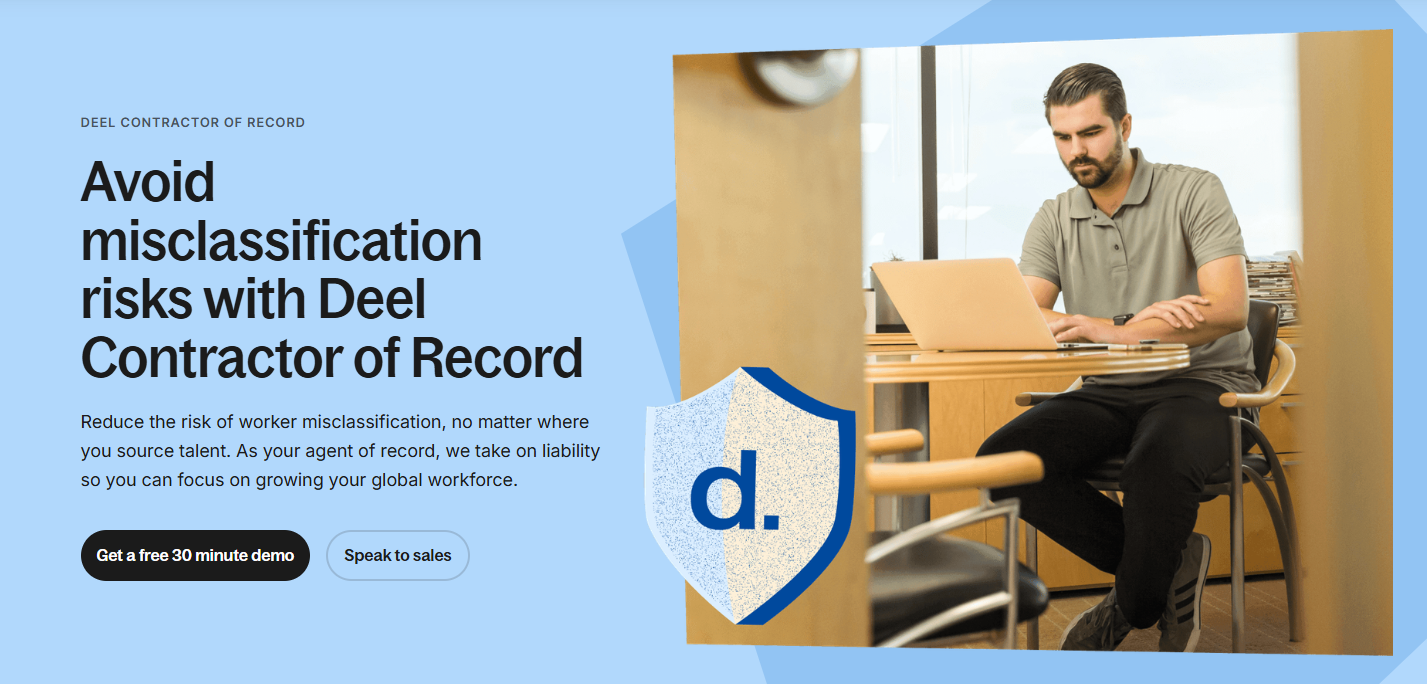
Deel positions COR as part of a broader workforce operating system, tightly integrated with Deel HR, payroll, IT, and reporting. Contractors and clients share a single platform to manage documents, approvals, time off, and payments, with fast setup often measured in days.
Payroll Verdict
Deel is the stronger payroll platform overall, offering broader country coverage, deeper reporting, clearer US payroll workflows, and more control for HR and finance teams.
Remote excels at compliance-first, managed payroll with strong human support. Still, its payroll experience is more opaque and less configurable, especially for teams that need standalone or US-centric payroll depth.
IT Management
Remote
One thing I noticed instantly was that Remote did not position IT management as a central offering like Payroll, HR, and Recruitment. It was mentioned under the services tab, along with background checks, compliance watchtower, and entity setup.
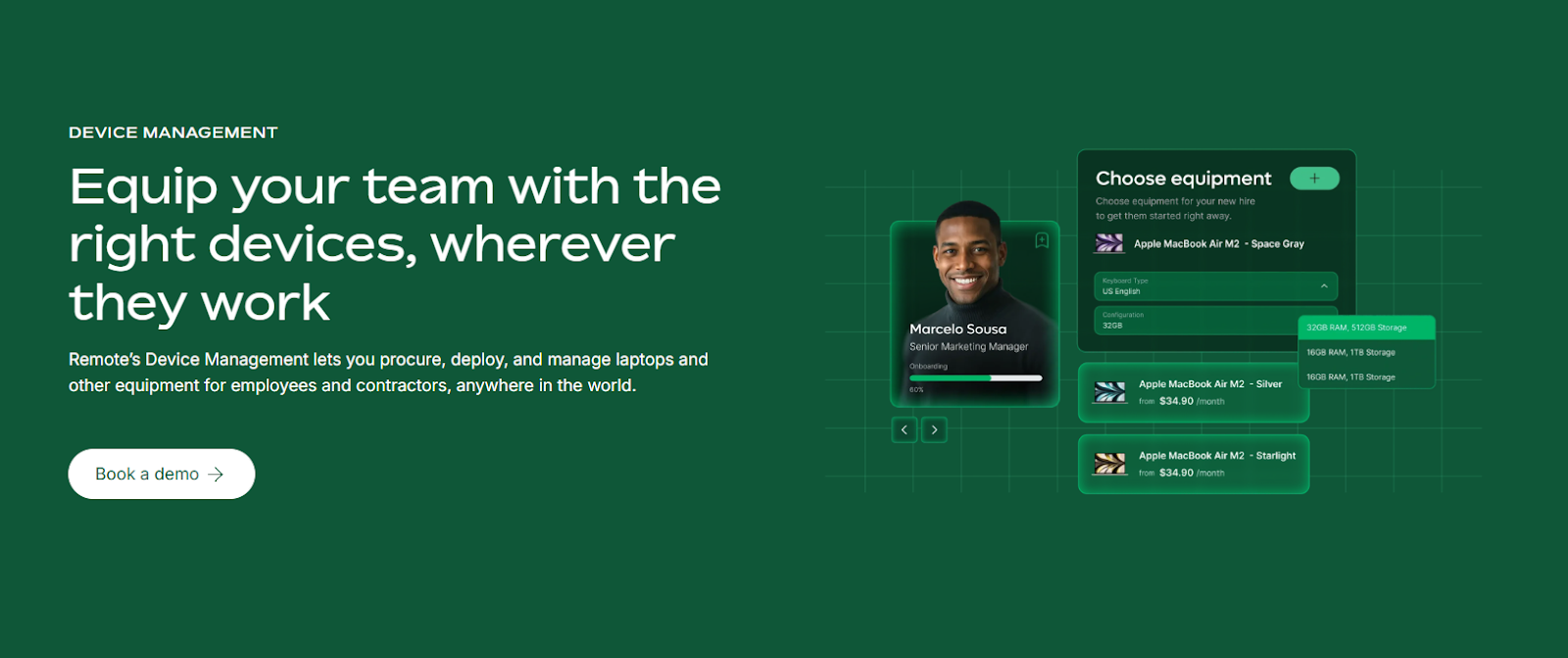
With Remote’s Device Management, teams procure, deploy, and manage laptops and other equipment for employees and contractors, anywhere in the world.
Because I could not find an interactive demo, unlike other modules, I thought IT might have been added later or wasn’t their primary offering.
And I was right, as Remote does not offer IT management in-house. They have partnered with Fleet to provide remote device management. However, I must say that it gets the job done:
For instance, it lets you
- Order laptops and other equipment (during onboarding) in just a few clicks, and Remote handles global delivery, returns, and replacements.
- Assign devices during onboarding and trigger collection during offboarding using Remote’s integrated workflows.
- Enable MDM to enforce security policies, remotely manage settings, and meet certification requirements such as ISO 27001.
Deel
Deel, on the other hand, has a robust IT management offering. It acquired Hofy (an IT management solution) and offers in-house IT management under Deel IT.
For instance, after adding a new worker to the platform and selecting their employment type (contractor or employee), you can see multiple equipment to order (selected MacBook for this example):
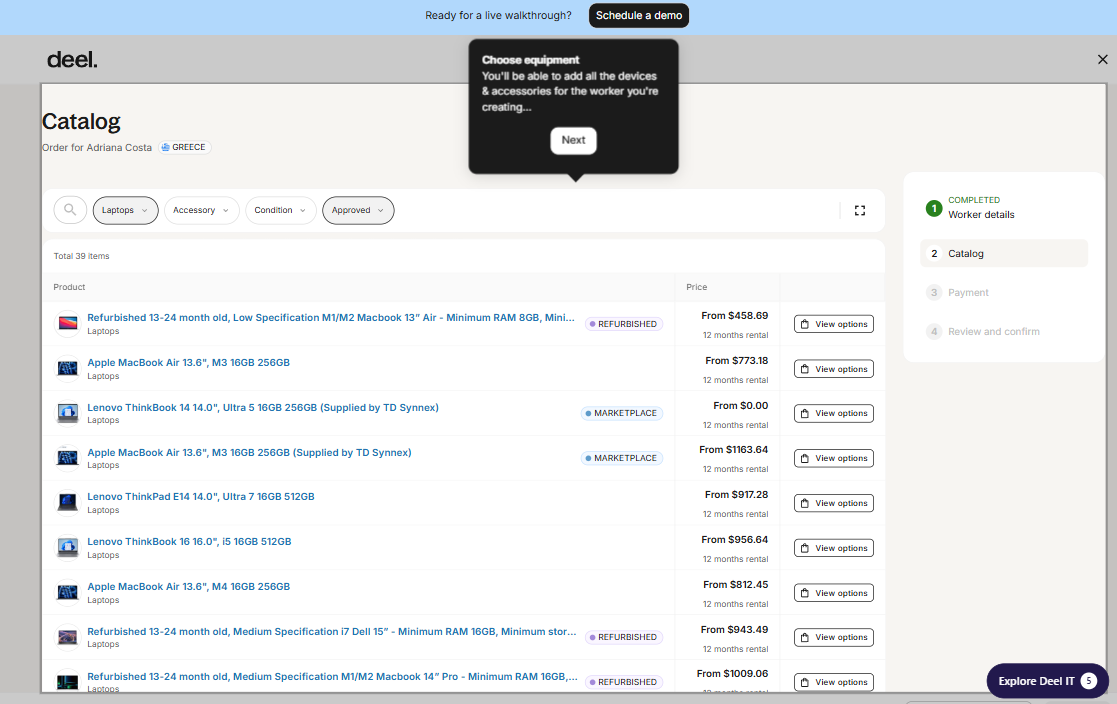
I liked how Deel let me customize configurations based on the region, add hardware support, or choose a warranty.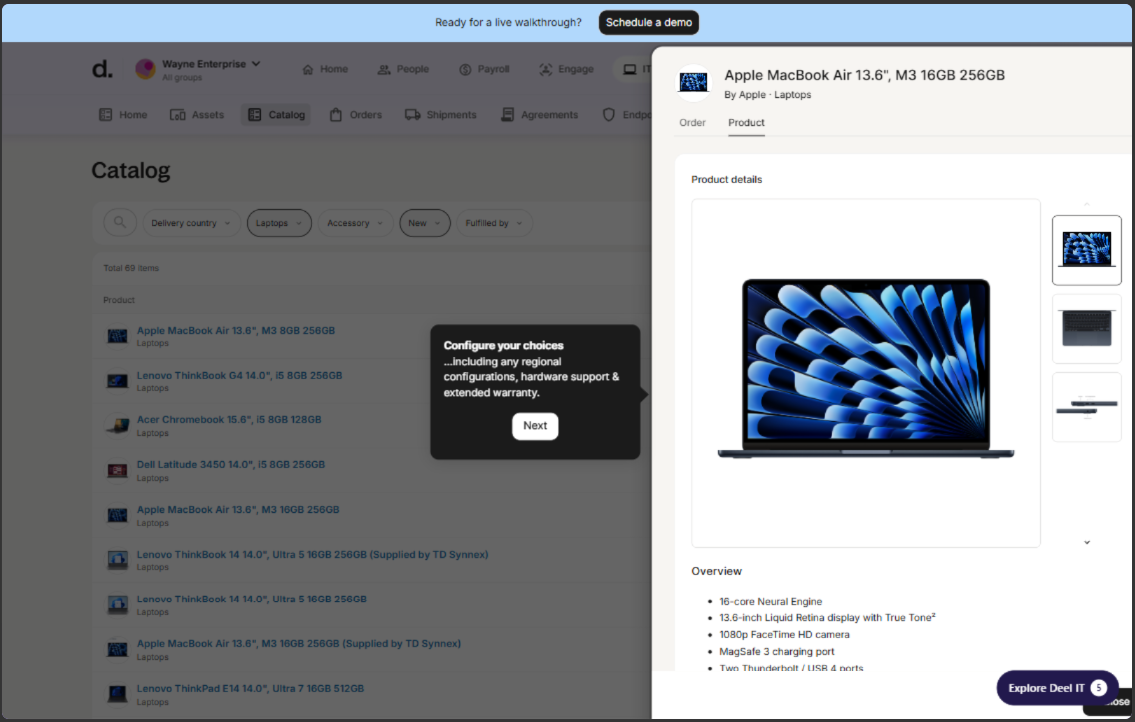
It also lets you review the items you added to the cart, and finally, place the order:
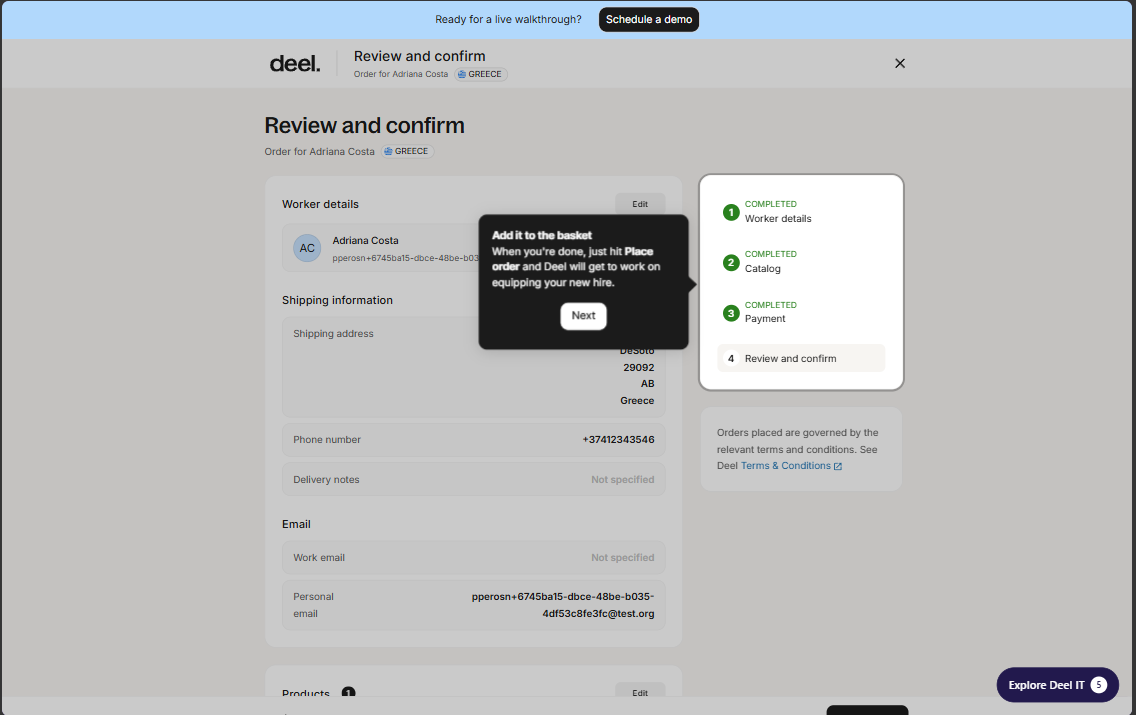
And once the order is placed, Deel IT will send pre-configured equipment to your employees in 130+ countries, without juggling vendors or dealing with the stress.
Deel lets you store your devices in its warehouses and reassign them to your employees as needed.
Deel IT’s dashboard gives you a straightforward view of all your assets. It lets you see the number of assets you currently have, where they are, who they’re assigned to, their MDM status, and Model, among other details.
Using the same dashboard, users can add new devices to the inventory:
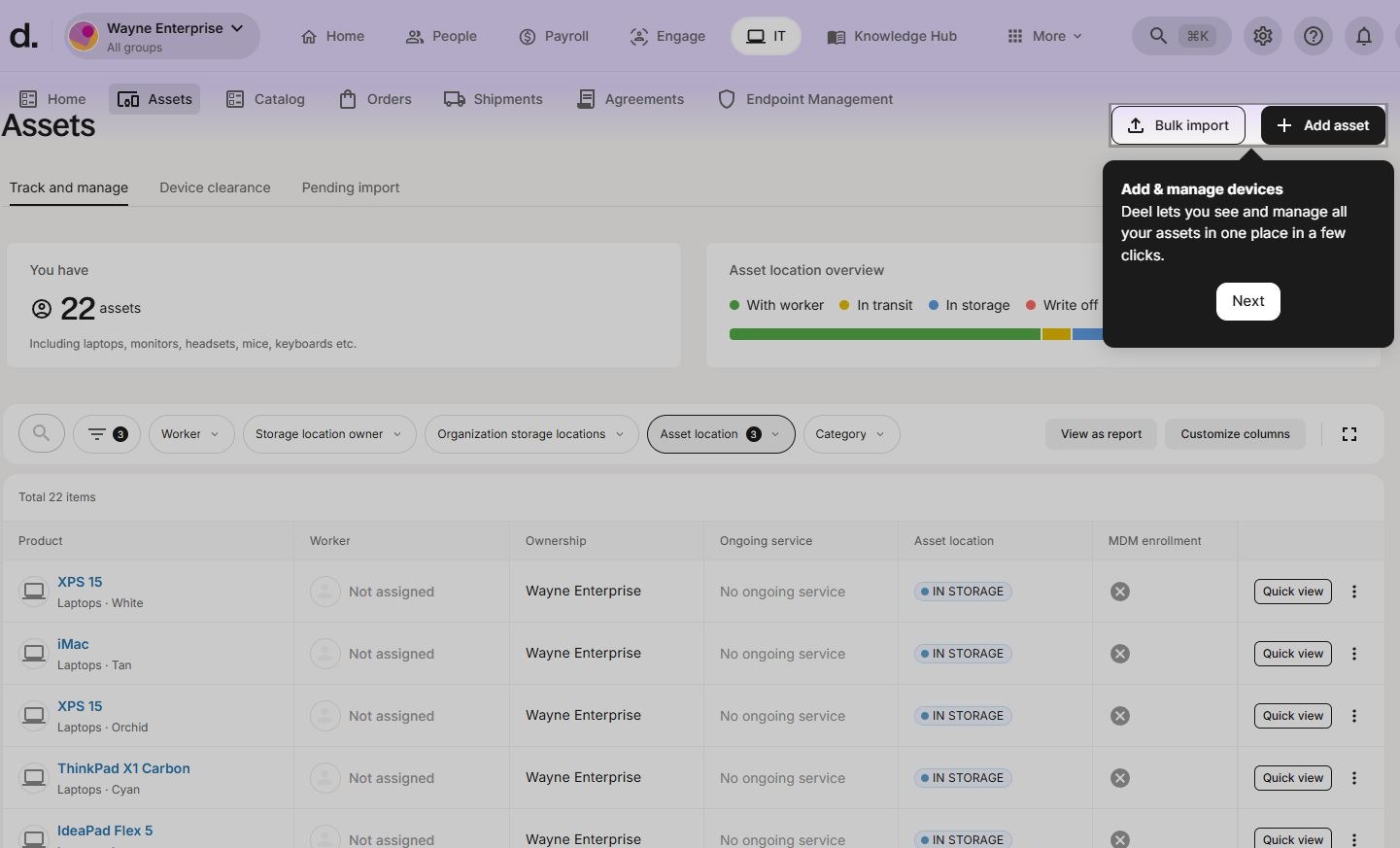
Source: Deel
Simply click the device you want more information for, and Deel IT will take you there. As you can see in this screenshot, it lets you check the asset health, associated documents, service packages, and location.
From the same dashboard, users can request hardware support, reassign it to storage, or even sell it for its residual cash value:
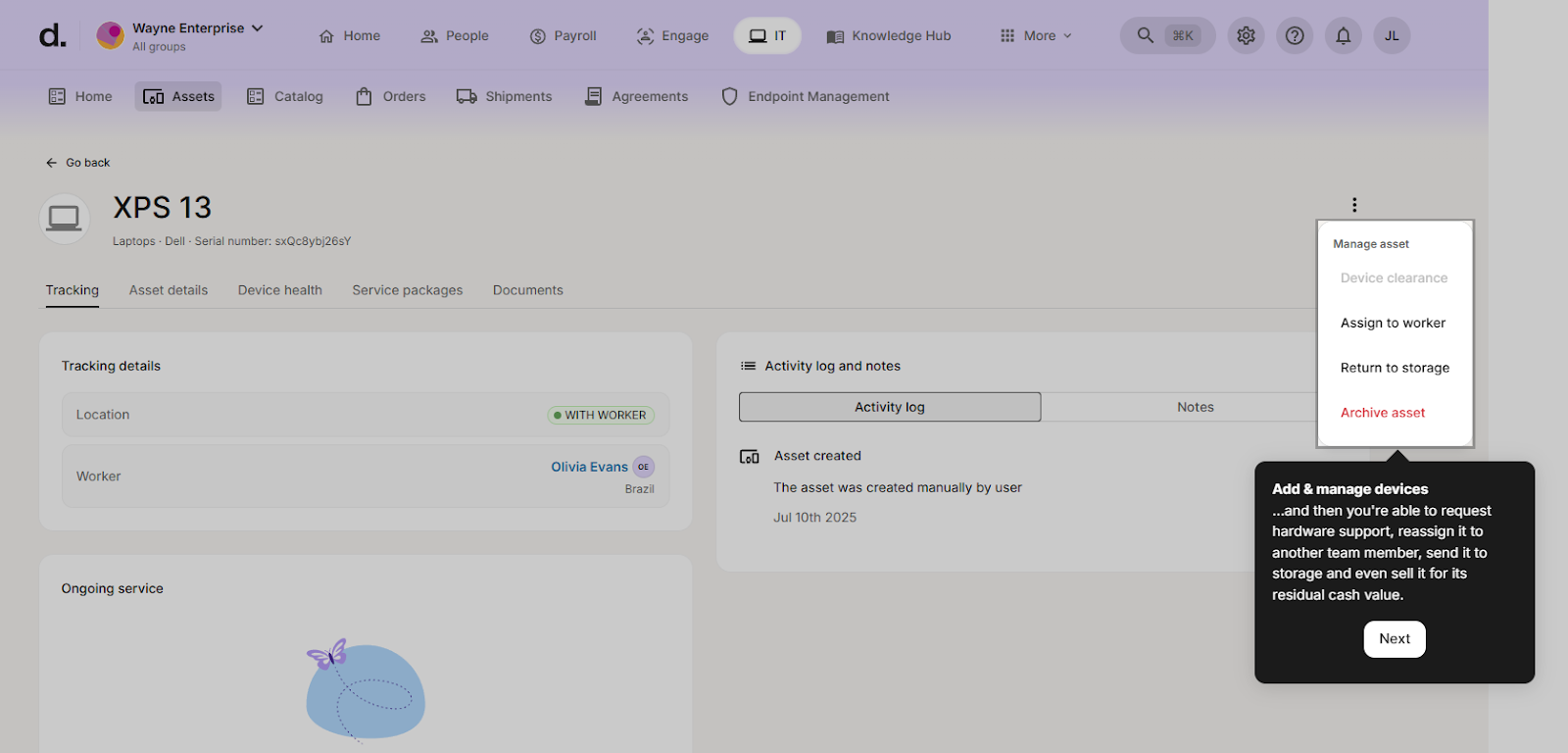
In a nutshell, Deel lets you track all your assets in a single dashboard and gives enough visibility into your infrastructure. For a solution that was not built around IT asset management, this functionality is appreciable.
Deel also has a mobile device management module where you can add an MDM that suits youe need, including Remote.
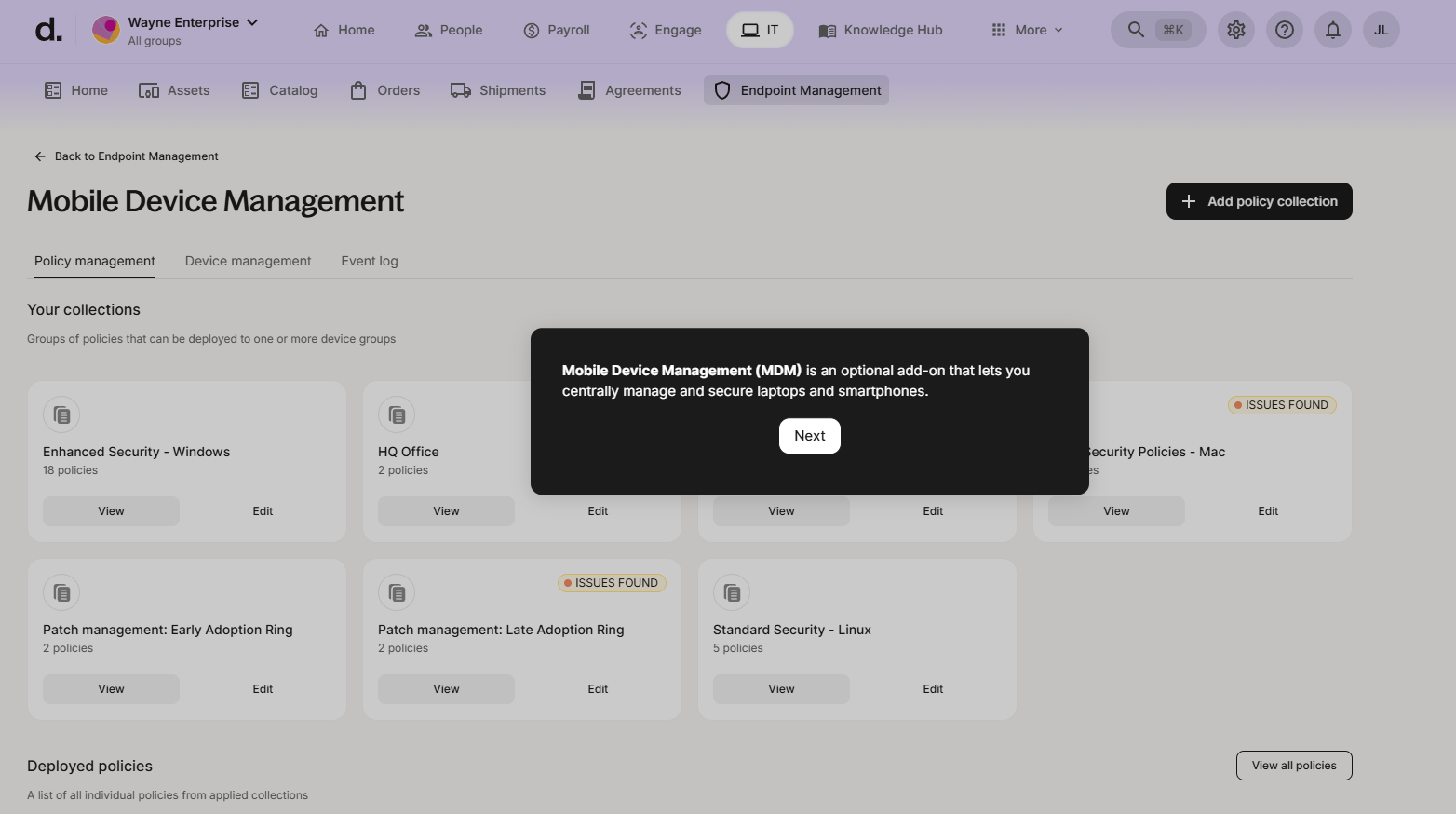
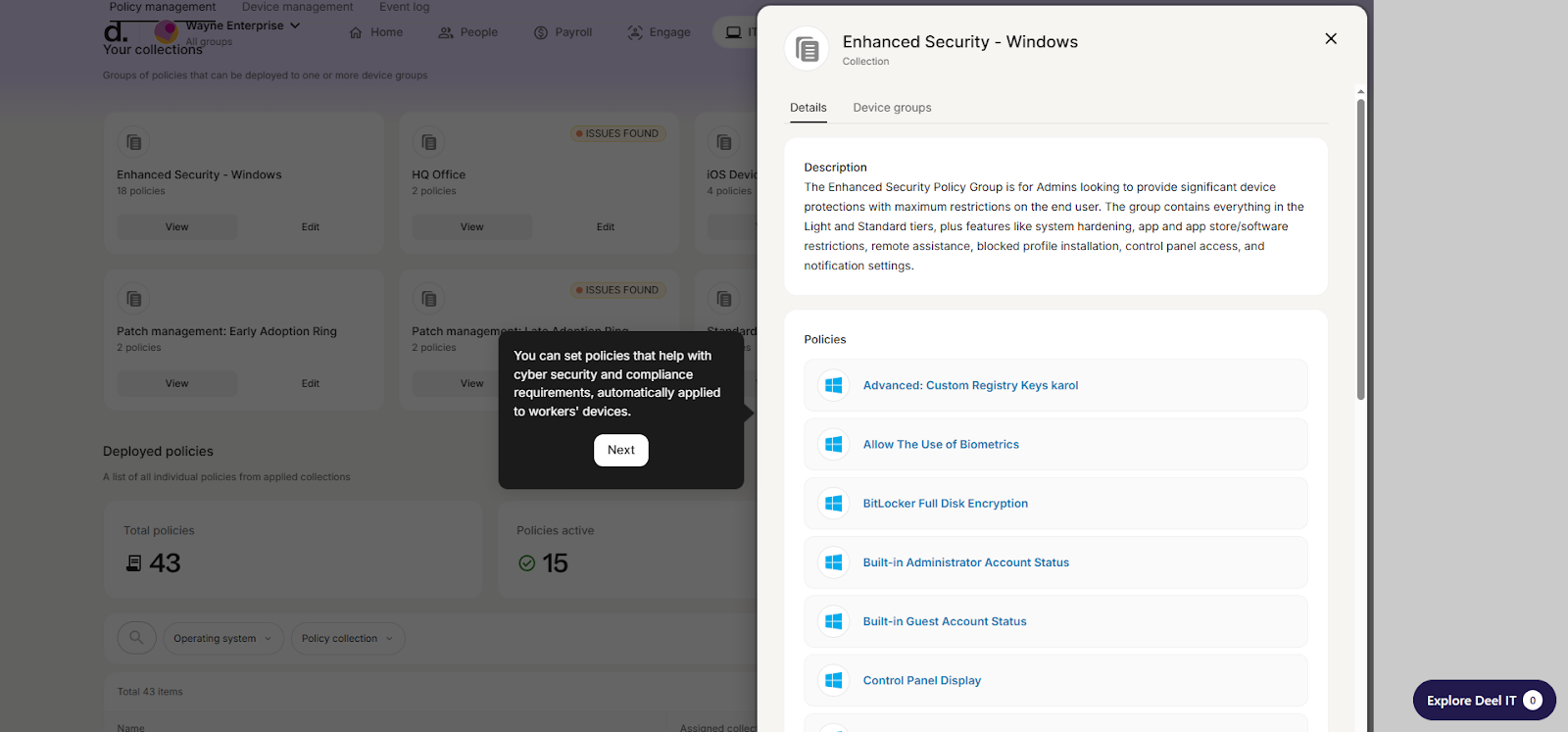
Once you add the MDM of your choice, Deel lets you apply security policies to enable biometrics, set built-in admin or guest status, enable BitLocker encryption, etc. These policies help you enforce security features across all devices in your infrastructure:
Verdict
While Remote claims to offer everything Deel does on paper, there aren’t many user reviews to support that claim.
On the other hand, Deel IT (previously Hofy) is highly mature, with multiple user reviews, which increases its credibility.
So, Deel is a winner for me for enterprise-level IT management solutions.
Pro Tip: IT management is not something to be taken for granted. After all, a few delayed deliveries and just one lost asset can lead to a poor onboarding experience and an increased risk of a data breach, respectively.
Therefore, you should rely on dedicated global IT hardware management platforms like Workwize. Workwize is an end-to-end hardware management platform that automates your entire asset management lifecycle. You can:
- Integrate Workwize with Deel, and trigger procurement when an employee enters your organization.
- Order the required assets and have them delivered to your employees pre-configured (100+ locations).
- Integrate your favorite MDM (Jamf, Intune, etc) and remotely track and control the asset (wipe or lock the device remotely)
- Order repairs and ship replacement devices
- Automatically trigger offboarding workflows to ensure safe and compliant asset retrievals.
- Perform disposals or even resell the devices to retrieve residual value.
The wrong solution drains your bank account, while the right one plugs the gaps. No wonder HighLevel saves $1.4 million annually by using Workwize to automate its asset management lifecycle.
Whatever payroll or global HR solution you choose, integrate Workwize and automate asset management. Book a free demo now.
Compliance
Remote
Here’s what Remote’s compliance posture looks like:
- Proactive legal monitoring (Compliance Watchtower): Remote continuously tracks labor law changes across countries and surfaces only what’s relevant to your workforce.
- Clear visibility and plan of action: Remote explains the impact and the required action in plain language, reducing interpretation errors by HR or finance teams.
- Strong coverage of employment law fundamentals: Tracks changes across wages, overtime, leave entitlements, benefits, pensions, and more.
- Compliance is tightly linked to EOR operations: When you hire through Remote EOR, they proactively update contracts, payroll rules, benefits, and policies as laws change.
- Centralized visibility across countries: Shows upcoming compliance risks by country, making it easier to manage multi-country teams without fragmented legal knowledge.
- Expansion-ready compliance research: HR teams can explore country-specific employment laws and requirements before hiring to reduce surprises during market entry.
- Human expertise when automation isn’t enough: Remote complements automation with in-house compliance and payroll experts.
- Lower operational burden for lean teams: Designed for companies that don’t want to build internal legal ops.
Deel
With Deel, users can make compliance when hiring around the globe a breeze. Here’s how:
- Localized contracts by default: Deel auto-generates country-specific contracts for employees and contractors, updated continuously as local labor laws change.
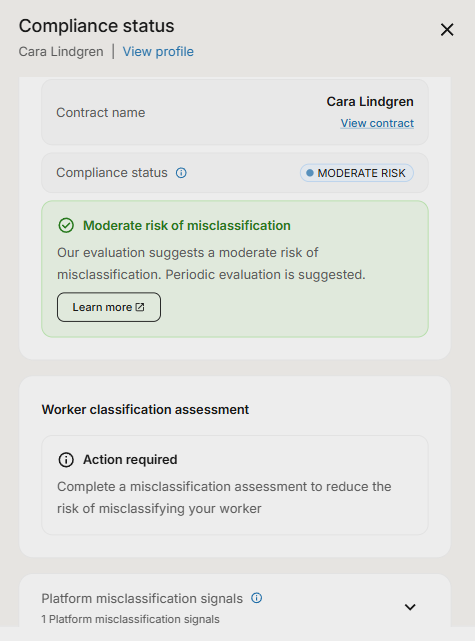
- Built-in worker classification safeguards: Deel flags misclassification risks upfront using country-specific rules and court-case-trained logic.
- Compliance baked into payroll, not bolted on: Payroll calculations automatically include statutory taxes, social contributions, and mandatory deductions.
- Clear ownership under EOR: When using Deel EOR, Deel takes responsibility for local labor law compliance, filings, and statutory benefits, not you.
- Strong US compliance workflows: Automated W-9/W-8 collection, one-click 1099 filing, and state-aware payroll flows make Deel particularly reliable for US contractor and multi-state compliance.
- Ongoing regulatory monitoring: Deel continuously updates policies, contracts, and payroll logic as regulations change.
- Audit-ready documentation: Contracts, DPAs, tax forms, payslips, and compliance records are stored centrally, making audits and internal reviews far less painful.
- Enterprise-grade data protection: ISO 27001-aligned security, GDPR compliance, SSO, and signed DPAs ensure workforce data handling meets global privacy standards.
Verdict
I didn’t find any distinction in their ability to handle compliance, as both have decent compliance measures in place.
Platform Experience & Operational Factors
Let’s now compare the user experience, integrations, customer support, scalability, and pricing details of Remote and Deel.
User Experience & Ease of Use
Remote
I analyzed several demo videos and YouTube walkthroughs of Remote’s platform, and I love how intuitive, clean, and modern Remote’s UI is.
It looks easy to navigate and features a search option for finding options that might be buried deep:
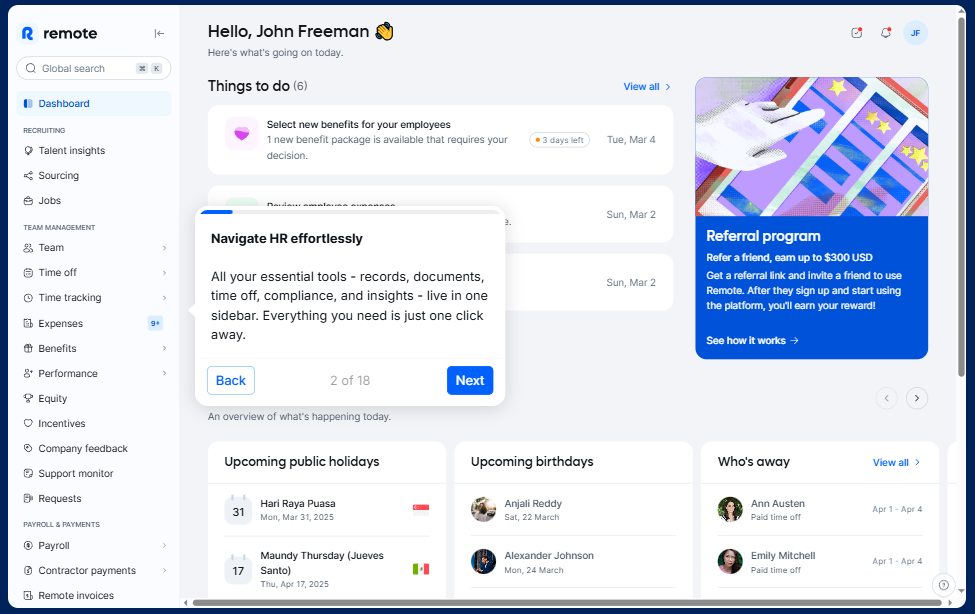
And based on multiple G2 reviews, Remote’s platform is very easy to use and implement. Even non-technical folks can get started with the platform with minimal training.
Deel
Based on the multiple interactive demos that I viewed and analyzed, I found Deel’s interface to be very straightforward and uncluttered. I viewed numerous dashboards and even tried adding a contractor, and the entire process was seamless.
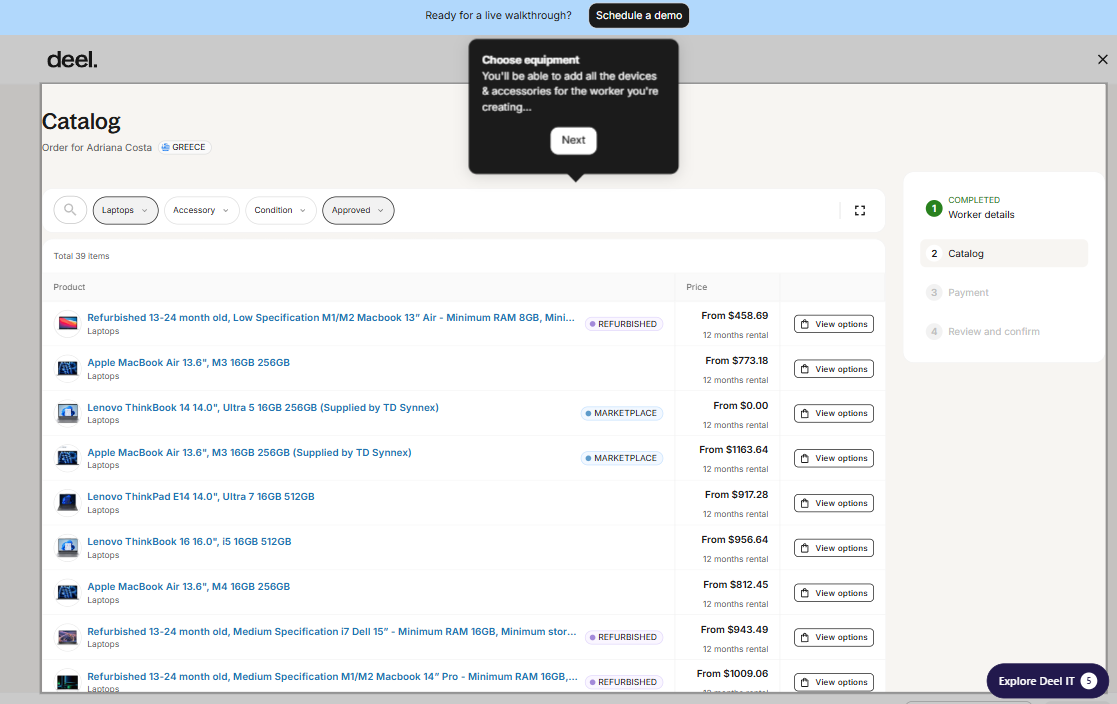
Similar to Remote, Deel is easy to use and implement. While you may require some basic training, that’s normal
Verdict
There’s no winner here. Both Deel and Remote are easy to use and implement.
Integrations
Remote
Remote is far behind Deel in integrations, offering just 20+ integrations, according to their integrations page. Popular integrations include Workday, QuickBooks, NetSuite, Gusto, BambooHR, Greenhouse, Slack, and more.
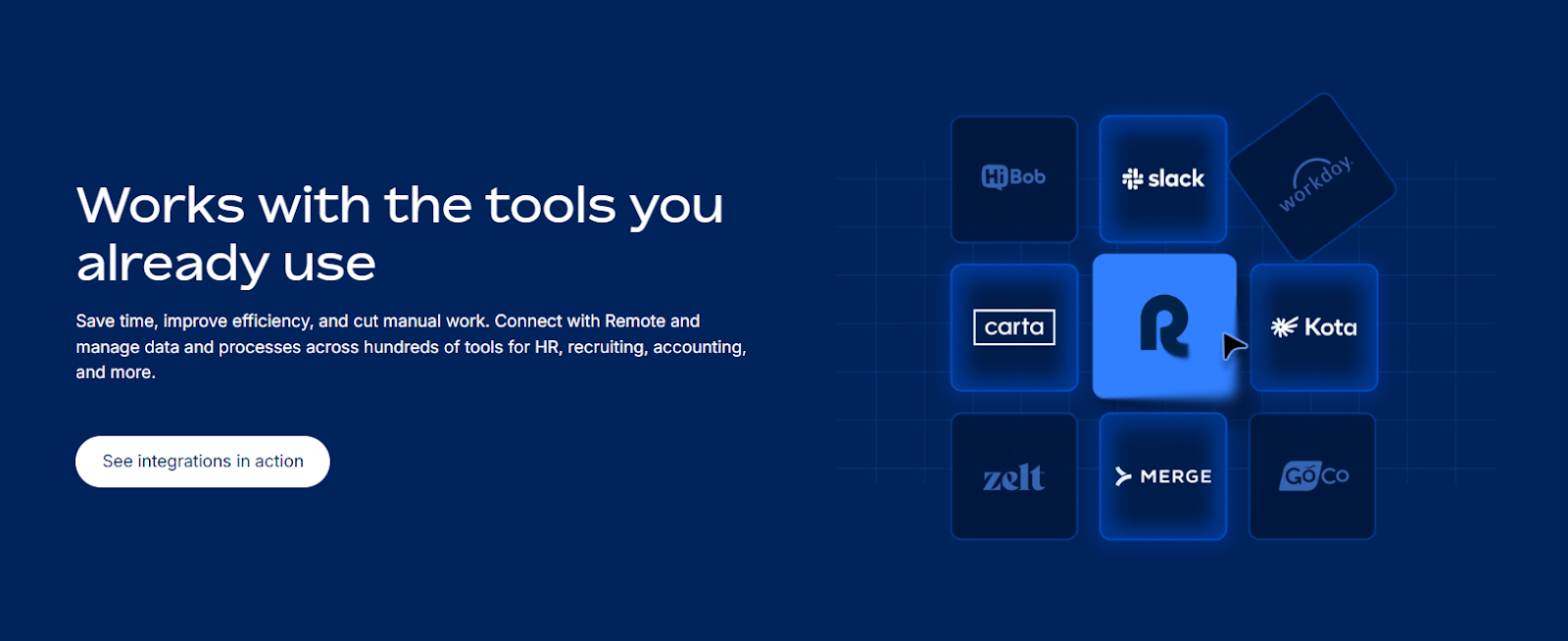
You can also use Remote’s API to integrate it directly into your existing tech stack.
Deel
Based on the integrations mentioned on Deel’s website, it supports somewhere around 140 integrations, which is higher than Remote’s 20+:
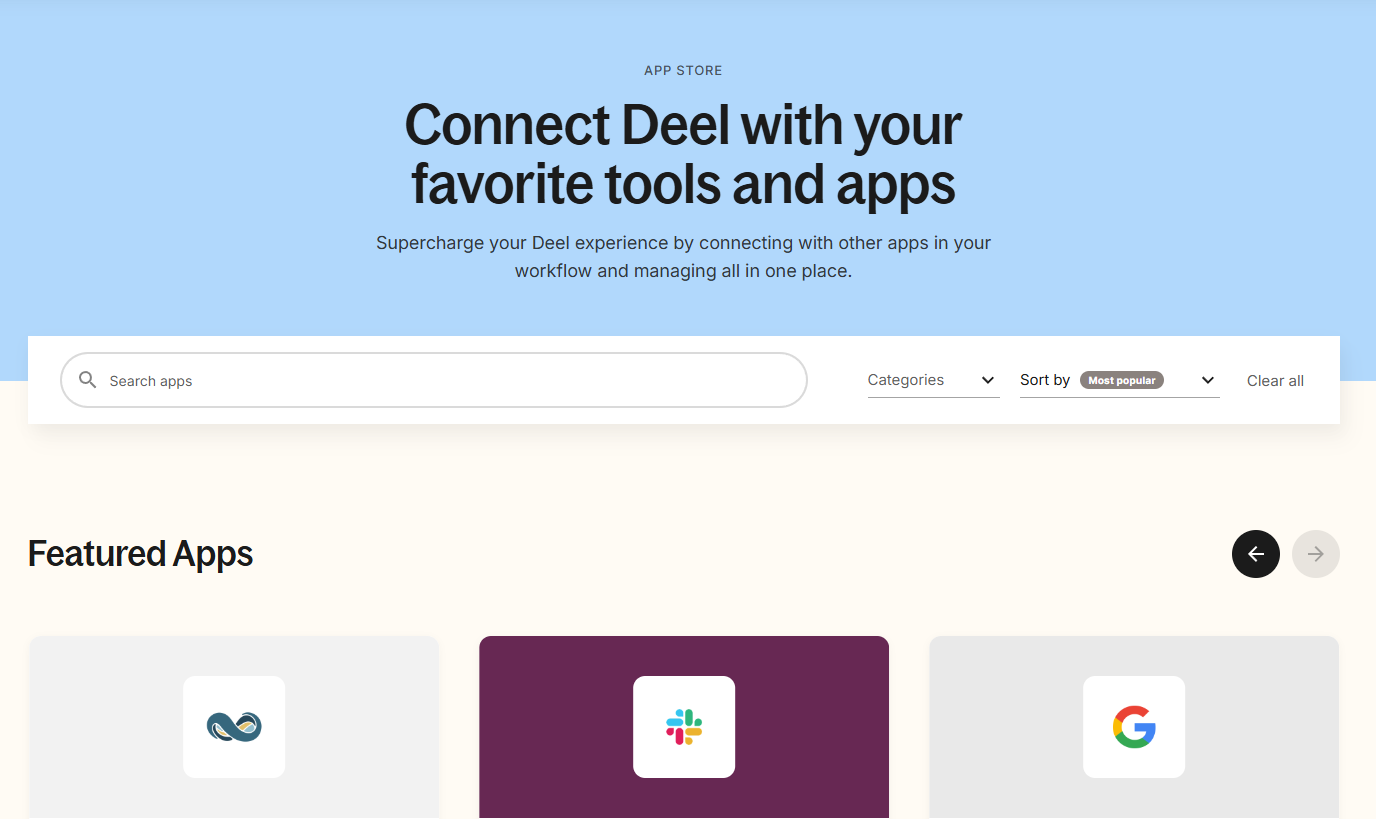
These include popular accounting software such as QuickBooks, Xero, NetSuite, and SAP, as well as HRIS/ATS such as BambooHR, Workday, Lever, Greenhouse, and more.
Also, Deel offers an API that lets you integrate Deel into your enterprise ecosystem. This enables you to use Deel’s features, such as payroll management and global hiring, within your workflows.
Verdict
Based on the sheer number of integrations, Deel is a clear winner. And I firmly believe you’d need more integrations to build automated workflows.
Customer Support
Remote
You can reach Remote's customer support primarily through in-platform live chat and email. The in-platform chat starts with an AI bot, but you can always convert that into a human-agent chat later on:
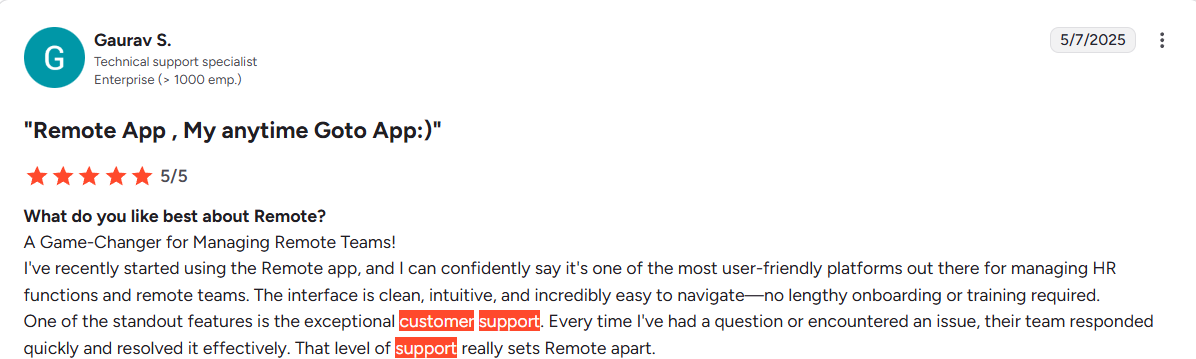
Source: G2
While most reviews appreciated Remoe’s customer support, some users mentioned their response times can be longer, especially during peak hours, similar to Deel.
Deel
You can reach Deel's customer support 24/7 via live chat, email, and even phone, which is impressive. I analyzed 50+ user reviews on G2 around customer support, and they were all positive, appreciating how knowledgeable and responsive the support staff is.
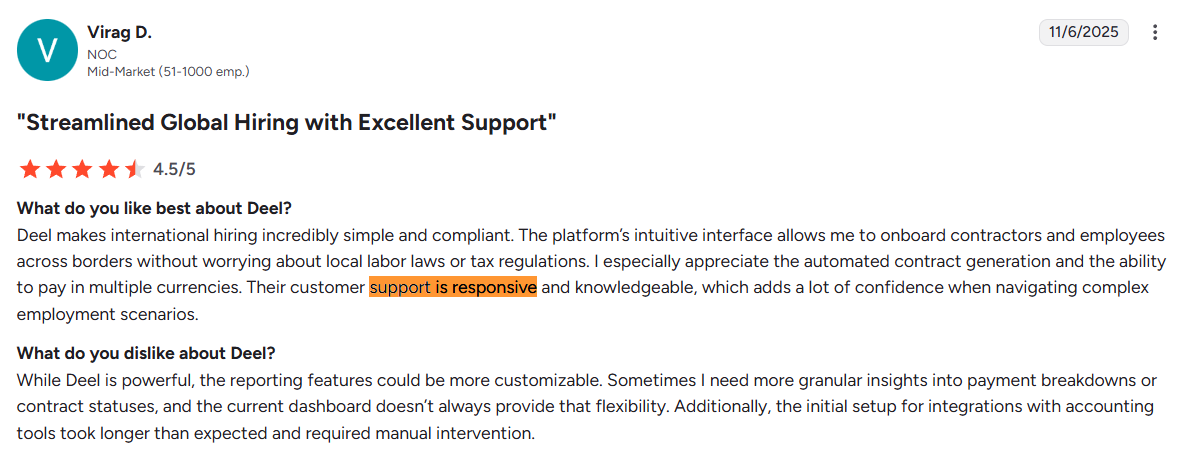
Source: G2
However, I noticed that most of Deel's reviews are left by individual contractors who use it to receive payments. So, I’d recommend that you test the customer support on your own for your specific use case and then decide.
Verdict
Deel wins by a small margin here, since it lets users contact support via call, chat, and email. And Remote, on the other hand, relies solely on chat and email support.
Pricing & Cost Predictability
Remote
Remote’s pricing is transparent. I could see pricing for each of their offering:
- Employer of Record (EOR): $699 per employee/month
- Global Payroll: $29 per employee/month
- Contractor Management: $29 per contractor/month
- Contractor Management Plus: $99 per contractor/month
- Contractor of Record (COR): From $325 per contractor/month
- Professional Employer Organization (PEO – US): From $99 per employee/month
Deel
Deel’s pricing is also almost as transparent as Remote’s. You can see the pricing details for every plan except for the US Payroll (talk to sales):
- Employer of Record (EOR): Starting at $499 per employee/month
- Contractor Management: Starting at $49 per contractor/month
- Contractor of Record (COR): Starting at $325 per contractor/month
- Professional Employer Organization (PEO): Starting at $95 per employee/month
- US Payroll: Custom pricing (speak to sales)
- Global Payroll: Starting at $29 per employee/month
Verdict
Overall, Deel is the more affordable option for most global teams. Its EOR pricing starts at $499 per employee/month, compared to Remote's $699 per employee/month. This amounts to almost 30% savings per employee, which compounds significantly as headcount grows.
Deel also pairs lower pricing with broader country coverage (150+ countries) at the same or lower price points, especially for EOR and contractor management.
Over a year, teams hiring internationally can save thousands to tens of thousands of dollars with Deel, without sacrificing core payroll or compliance capabilities.
Deel Vs Remote: Pros and Cons Based on Real User Reviews
Here are some major pros and cons for Deel and Remote, as reported by real users on G2:
Deel Pros
- Users repeatedly mention simplicity and ease of navigation. This appears prominently in hundreds/thousands of reviews on G2 (Source)
- Many users report that Deel makes international payments smooth and organized. (Source)
- Customer support is knowledgeable and helpful in resolving issues (Source)
- Multiple reviewers highlight that onboarding and employee setup are straightforward and quick. (Source)
- Users love how Deel helps them comply with local and global regulations (Source)
Deel Cons
- While the response is generally good, it can be slow and take some time, as per users (Source)
- Users find Deel expensive due to high fees for international transactions and crypto wallet withdrawals, impacting overall convenience (Source)
Remote Pros
- Users appreciate the ease of use of Remote, finding the interface intuitive and the setup process quick and simple (Source)
- Reviewers value the fast and detailed customer support of Remote, enhancing their overall experience with the platform (Source)
- Makes it easy for users to handle taxes, deductions, and expense reimbursements seamlessly (Source)
- Highly effective solution for global payments (Source)
Remote Cons
- Multiple users express frustration with delays in onboarding and payment processing, affecting their overall experience with Remote (Source)
- Several users mention missing features. I even noticed that Remote doesn’t yet offer the compensation module, while Deel does (Source)
- Limited country support might force you to choose another EOR in addition to Remote, if you hire employees from regions beyond Remote’s reach (Source)
Deel Vs. Remote: What to Choose?
If I have to choose between Deel and Remote, I’m picking Deel. Here’s why:
- Because it covers more of the “global ops” surface area in one stack, for instance, Deel’s EOR reach is 150+ countries, compared to Remote’s 90+, so I’m less likely to hit a coverage wall as we expand.
- On top of that, Deel has a dedicated IT layer (device ordering/repairs/recovery) across 130+ countries, while Remote remains HR + payroll-focused (though it does offer device management and supports the asset lifecycle, similar to Deel).
- Additionally, if I need compensation management and learning development on the same platform, Deel already offers them. While Remote is set to provide these services in 2026, it doesn’t offer them now, making the choice clearer.
- Lastly, I find Deel more cost-effective as I scale, easily helping me save thousands annually as I expand.
Supplement your Global Workforce Management Journey with Workwize
Whatever option you choose (Deel or Remote), you’ll likely end up managing employee devices across borders.
While both platforms support device provisioning as part of onboarding and offboarding, hardware operations aren’t their primary focus.
As you scale across regions, the real friction typically shows up in execution: coordinating multiple vendors, managing inventory across locations, handling retrievals, and keeping deployments consistent and secure.
That’s where a dedicated hardware operations layer fits.
Workwize is built to manage the physical asset lifecycle end-to-end, from procurement, deployment, and repairs to retrieval and disposal, across 100+ countries.
Say you choose Deel as your Workforce management platform. Now, you can:
- Integrate Workwize with Deel, and trigger procurement when an employee enters your organization.
- Order the required assets from verified vendors and have them delivered to your employees pre-configured (100+ locations).
- Integrate your favorite MDM (Jamf, Intune, etc) and remotely track and control the asset (wipe or lock the device remotely)
- Order repairs and ship replacement devices
- Automatically trigger offboarding workflows to ensure safe and compliant asset retrievals.
- Reassign older devices, perform disposals or even resell the devices to retrieve residual value.
In a nutshell, while Deel handles the digital aspect of workforce management, Workwize takes care of the physical (or logistical) aspect, ensuring:
- Zero logistical issues.
- On-time deliveries and retrievals
- Maximum savings
And we have numbers to support our claim. HighLevel saves $1.4 million annually by using Workwize to manage the hardware portion of its asset lifecycle.
To see Workwize in action, book a free demo now.


Establish a single source of truth for every IT asset across the globe.
.png?width=258&height=318&name=g10%20(5).png)
More related resources to help you stop firefighting hardware operations.


Get monthly insights into how other IT leaders are improving their ops.



.png?width=2880&height=1232&name=Group%202147262874%20(1).png)
Stop coordinating
hardware like it's 2012.
.svg)
.png?width=172&height=68&name=apple%20business%20patner%20(1).png)
.svg)
.svg)
.svg)
.svg)