TABLE OF CONTENTS
 Edited & Reviewed
What is an IT Procurement Service?
An IT procurement service is a third-party provider that buys, installs, and in many cases, manages a company's information technology (IT) assets.
IT assets here is the umbrella term for computers, smartphones, tablets, data center hardware, networking gear, software products, and cloud services, among others.
Organizations of any kind, public or private, from healthcare to embassies, can pay third-party providers to handle their purchases and setups. They enter into these agreements because they lack the manpower to handle the process.
They may also decide that using a procurement service is cheaper after considering everything from compliance and security to healthcare and risk management.
IT procurement services can do the following:
- Technology assessment
- Sourcing
- Vendor and supplier management
- Real-time updates (procurement tracking)
- Contract negotiation and management
- Configuration and deployment
- Asset lifecycle management
Outsourcing procurement services to a provider addresses numerous purchasing and asset management challenges for companies, including a lack of visibility into purchases and assets, security vulnerabilities, compliance pitfalls, and out-of-control spending, among others.
How Do Providers Handle IT Procurement?
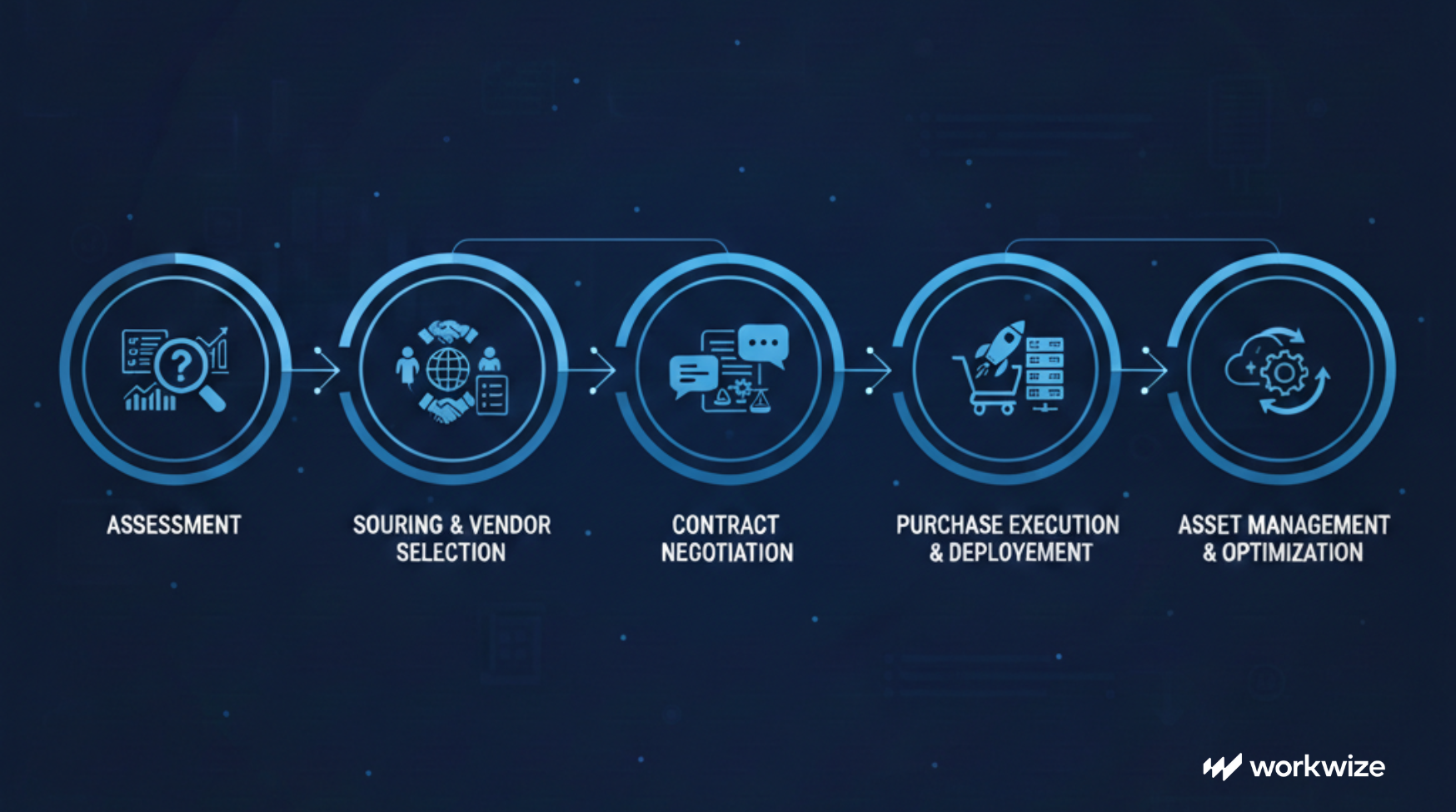
By using a procurement process that involves the following phases:
1. Assessment
A provider that knows its onions familiarizes itself with your current tech stack. That way, it can ensure your new purchases slot into your existing infrastructure seamlessly, and you don't have to run extensive training.
The assessment establishes:
- The business's budget,
- The specific tech to purchase,
- Who needs what and when,
- Ideal security measures
- Compliance requirements
Gathering this information requires pooling details from stakeholders, that is, the departments that need the products.
For example, if a company intends to procure PaaS (Platform as a Service) tools for developers, the procurement team must consult those developers to understand their core needs, assess what they currently have and use, and confirm ideal deployment and configuration timelines.
2. Sourcing and Vendor Selection
With the assessment complete, the provider can begin to source hardware, software solutions, and cloud services that meet the company's specifications, pricing, and compliance requirements.
Service providers typically maintain networks of ready-to-go suppliers they can tap to meet most sourcing demands.
But they can also use smart market-exploration techniques, such as RFx (RFIs, RFPs, and RFQs), to compare vendors when customers ask for custom purchases.
3. Contract Negotiations
This phase of the procurement process covers discount negotiations for bulk orders, warranty agreements, and SLAs (which define expected performance, return policies, and penalties for vendor underperformance).
Capable IT procurement service providers already have working contract frameworks that adequately protect their clients. That means ironclad contracts with little to no wiggle-room for failed delivery standards and last-minute backouts.
4. Purchase Execution and Deployment
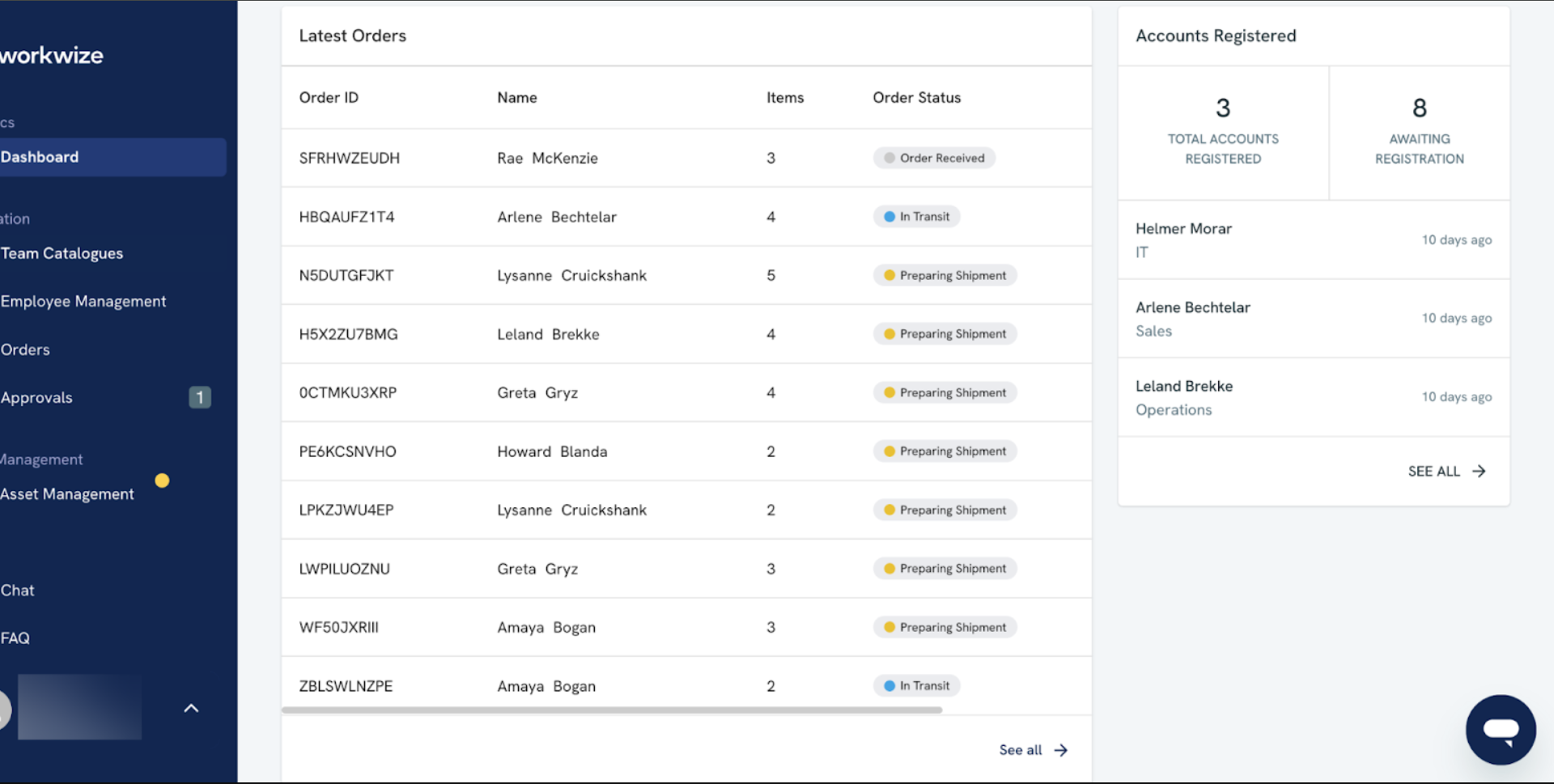
After reaching agreements and signing contracts, the next step is to place the order and deliver devices to users or to the company infrastructure (such as data centers).
But it goes beyond solving logistics challenges.
Service providers also handle deployment and installation where needed.
This includes:
- Imaging and provisioning (installing operating systems),
- Software distribution (pushing applications to devices via the cloud),
- Security configurations (setting up firewalls and enabling encryption),
- Asset tagging, among others.
For example, providers like Workwize offer manual device configuration with MDM logging, tailored to a client's specific requirements.
5. Asset Management and Optimization
Some procurement services are also IT asset lifecycle management vendors. They manage every asset to provide visibility and prevent cost leakage and security risks.
The model involves
- Using asset tracking systems to make hardware and software licenses visible throughout their lifespan,
- Conducting regular vendor reviews for seamless renewals or replacements,
- Maintaining hardware devices, and handling returns, replacements, and sustainable disposal.

Types of Procurement Services
The mainstream IT procurement categories are hardware, software, cloud, and services.
But I'll be grouping procurement services by how long their involvements last during (and after) the procurement cycle.
I'll discuss the kind of providers you'll have to deal with, how their services work, and the limitations you should expect.
Note: Some companies offer services that may span multiple categories. For example, Amazon Business' IT procurement services cover delivering configured eligible devices and advising teams that want to scale.
Procurement-Only Service Providers
These include traditional resellers and consultants that do not participate beyond the purchase phase. Using these providers is ideal if you're only experiencing purchase problems.
Traditional IT Resellers
Traditional resellers, also called value-added resellers (VARs), are OEM and vendor channel partners that sell IT products to end customers after buying at discounted rates (mostly due to bulk purchases).
How it works
- Resellers buy from OEMs or software vendors at discounted prices and sell to companies at retail prices, sometimes with small discounts.
- In some cases, the reseller buys from a distributor with a regional sales license and then sells to companies
- Includes hardware and software products
- You typically interact with the reseller for quotes, purchase orders, and in some cases, logistics
Best for
- Smaller IT teams dealing with non-complex tech stacks
- Companies that want to bypass the complexities of cross-border shipments
Limitations
- Resellers don't manage a product's full lifecycle, as they are limited to warranties
- Limited help with compliance, governance, or end-to-end control
- VARs almost always recommend what they have
IT Procurement Consultants
Procurement consultants are also called technology advisors. They help companies find the best products and suppliers, formulate procurement strategies, endorse vendors, and facilitate contract negotiations during the purchase process.
How it works:
- Consultants assess your needs, research available market options, and recommend a strategy
- They tell you which vendors to use, often sourced from their extensive vendor networks, and how to deal with them
- They guide you through the contract and agreement process
- You place the order once SLAs are signed
Best for:
- Complex, high-value procurements, especially for inexperienced procurement teams
- Organizations seeking unbiased vendor recommendations
- Smaller teams without the budget to hire full-service providers
Limitations:
- They don't execute procurement themselves, and expertise gaps may show despite advice
- No post-procurement involvement (may be arranged separately but at extra cost)
- Using IT consulting services for procurement means no visibility into assets
End-to-end procurement providers are outsourced IT procurement services that typically begin with needs identification and end with deployment and configuration.
How it works:
- You provide device specifications and configuration requirements
- The service provider purchases equipment and stages it in their depot facility
- Devices are branded, configured, delivered to company locations, or shipped direct-to-employee, depending on the hardware involved
Best for:
- Companies deploying large caches of IT hardware and infrastructure
- Companies without dedicated IT staff for device configuration and a minimal budget for full IT asset lifecycle management services
- Businesses that need rapid deployment
Limitations
- Lacks asset tracking, maintenance, inventory management, and optimization provisions.
Managed Lifecycle Services
Managed lifecycle services is an umbrella term for software and hardware asset management providers.
These services procure technology and assume ongoing responsibility throughout each asset's operational lifespan. There are different service models to choose from, from mobile asset management to Managed Service Providers.
IT Asset Management (ITAM) Services
Gartner defines ITAM as a process that "provides an accurate account of technology asset lifecycle costs and risks." Its main aim is to "maximize the business value of technology strategy, architecture, funding, contractual, and sourcing decisions."
ITAM or IT Asset Lifecycle Management providers help companies buy and configure assets, manage those assets (optimization, maintenance, redeployments, and returns), and sustainably retire (dispose of, recycle, or resell) outdated, end-of-life, or end-of-support assets.
Certain providers, notably Workwize, specialize in IT hardware procurement services, while others can provide cloud asset management alongside other services.
How it works:
- The ITAM platform integrates with your procurement, finance, and HR systems
- The platform discovers existing IT assets, evaluates your company's needs, and allows you to kickstart procurement
- Once procurement requests are sent, the service handles planning, sourcing, vendor selection, compliance, contract agreements, purchase orders, and deployment
- Your team can track every process of the procurement process and receive real-time updates in the provider's asset management system
- Assets are usually delivered preconfigured
- The ITAM provider continues to monitor the asset and fulfil replacement, return, repairs, and disposal requests with the same level of real-time updates
Best for:
- Globally distributed teams and organizations with complex hardware procurement and software licensing needs
- Companies in need of audit-readiness
- Enterprises seeking financial accuracy for IT asset purchases, budgeting, management, and depreciation
- Businesses seeking to eliminate security vulnerabilities caused by shadow IT
- Teams that want to leverage device lifecycle management tools alongside procurement services
Limitations:
- Not the best option for small organizations
- You'll hardly find a single ITAM provider that supports every country
- MDLS (Managed Lifecycle Service) providers do not handle software and cloud assets
Managed Services Providers
MSPs are third-party IT management companies that offer procurement, deployment, and asset management, among many other services. These services, which they provide onsite or remotely through data centers, also include application, network, license management, administration, and security.
They are essentially outsourced IT departments.
Customers can choose the specific services they want and how far into their asset lifecycles these providers can stay.
How it works:
- MSPs provide the standard procurement process, from needs assessment (including compliance) to deployment and configuration.
- A company's subscription can cover post-procurement management, including full asset lifecycle management
- They can handle every other IT operation, from support to internal server administration.
Best for:
- Small to mid-sized businesses that lack the capability, financial or logistical, to maintain in-house IT departments
- Companies that need procurement bundled with enterprise IT asset management
DaaS (Device as a Service) Providers
Device (not Desktop) as a Service providers lease devices to customers and handle the support required to run and maintain those devices.
This model is also called Hardware as a Service.
How it works:
- You specify the devices you need and negotiate a lease-based SLA with the provider
- The provider procures, configures, and deploys the devices as requested after you fulfil payment obligations
- You do not own the devices
- The DaaS company will provide ongoing support and maintenance
Best for:
- Companies that want to avoid the huge capital expenditure of building an IT department from the ground up, without losing out on critical capabilities
- Organizations that need IT capabilities temporarily (for specific short-term projects)
- Businesses looking to offload device management, support, and maintenance at a predictable running subscription
Limitations:
- Longer contracts may be required, which may price out certain small companies
- Customers have limited customization options
- Device selection is somewhat rigid, and upgrade cycles are usually up to the provider

Benefits of Using Procurement Services
When hardware, software, and cloud services run well, companies can fulfil business-side operations efficiently.
But there are more benefits of using a reliable procurement service:
Reduces Shadow IT
Employees engage in Shadow IT when they use unauthorized technology (hardware or software) for official work. It's a serious security concern because a personal computer or external hard drive could open your company to all sorts of security risks when connected to your network.
Per IBM's 2025 Cost of a Data Breach Report, Shadow IT-related data breaches, specifically Shadow AI, cost $670,000 more on average than other security incidents.
It's also becoming widespread.
Gartner says, "75% of employees will acquire, modify, or create technology outside IT’s visibility by 2027." That's up from 41% reported for 2022.
Workers usually turn to these alternatives when they can't get their hands on new (or replacement) hardware or software fast enough to do their duties.
Fix this issue, and you're significantly cutting the risk associated with Shadow IT. A reliable procurement service provider can fulfil hardware and software purchases in record time, deploy assets as intended, and meet configuration demands.
Protects Companies from Supply Chain Volatility
Even when products are available, sudden shipping lane blockages, port congestion, customs delays, and tariff policies can prevent purchases from proceeding or drive prices sky-high.
Suzie Petrusic, a Senior Director Analyst at Gartner, says large organizations should view tariff volatility as a "multiyear, dynamic event," and stakeholders who recognize this trend must strengthen operations to prepare for the future.
Signing up with an IT asset management provider offering procurement services is one way to prepare for that future.
Providers with global supply networks can easily source products from the cheapest available, or tariff-insulated, vendor. To bypass logistics-related uncertainties, services like Workwize rely on local suppliers and warehouses to help clients set up buffer stock and move assets fast to end users.
Risk Management
Procurement risks are many, and they can hit you at any time.
If it's not delayed deliveries or defective hardware, it could be vendors taking shortcuts that set off compliance alarms.
Leading procurement services know all the nuts and bolts of the IT market. Using their expertise and experience, they can put strategies in place to prepare for and avert your most likely risks, from potential security issues to vendor noncompliance and the financial losses that will follow.
For example, a leading IT provider's hardware procurement services will include extra protections for devices, including encryption, vendor compliance verification, extended warranties, and ongoing maintenance and updates.

Enhanced Compliance
Companies spend about $5 million on average to stay on the right side of regulations, laws, and other policies. Yet, 64% still fall short of at least one compliance requirement annually.
It's hard to blame organizations that can't keep up because a typical compliance list goes on and on, especially for firms with multinational presence.
Procurement services are experts in this area, as they have compliance teams dedicated to IT procurement and management for diverse industries and jurisdictions.
Most IT services procurement processes involve assessing compliance requirements to mitigate potential non-compliance risks by engaging suppliers and vendors that meet those requirements.
If your new provider manages your IT lifecycle, it will ensure you're audit-ready by reducing the prospect of shadow IT, keeping every asset visible, and efficiently handling replacement, return, and repair requests in real time.
Access to a Wider Network of IT-Capable Suppliers
Using an established provider for the procurement of IT services, hardware, or software means you can plug into a vast supplier ecosystem, one that you'll struggle to build and maintain on your own.
It offers these advantages:
- An Economist Impact global survey reported that 90% of participating executives enjoyed benefits from increased supplier partnerships, especially in supplier innovation and sustainability
- Access to enterprise-level prices, even for retail-level purchases
- Options to source the best available products
- Faster deliveries since you have options to choose local or nearby suppliers
Improved Cost Efficiency
A case study published in The University of Edinburgh's Annual Procurement Report for 2023 to 2024 showed how a firm saved £189,033 by mitigating anticipated cost increases using its procurement network.
Additionally, HighLevel, a growing marketing platform with more than 900 employees, reported annual savings of up to $1.4 million after streamlining its IT procurement and lifecycle management with Workwize.
These savings are thanks to vast supplier networks, access to enterprise-level pricing, risk mitigation, and fulfilled compliance obligations.
Better Quality Assurance
Providers source products directly from OEMs whenever possible. That means you get the best possible quality for any given product model. On top of that, SLAs and warranty agreements mean you can get replacements for product failures within an agreed, often longer-than-usual, period.
Ongoing Support and Maintenance
Depending on the procurement service you use, your provider can manage the full lifecycle of your devices, especially assets that require ongoing support.
Among many other activities, you should expect the provider to handle:
- Firmware updates
- Critical security patches
- Physical servicing
- Repairs
- Remote troubleshooting and
- Regular safety drills
Improved Focus on Core Business Operations
Businesses that outsource IT procurement can reroute resources to core operations to boost productivity. With quality, delivery speed, and IT asset management sorted by the provider, those operations will run even more smoothly, yield better revenues, and the brand can meet its ESG goals.
Procurement Services vs. Software: Key Differences
I've mentioned that you can either choose a software platform to optimize your procurement process or turn to a reliable IT procurement service provider to handle your tech purchasing.
Now that you know how IT procurement services work, here’s how they compare against procurement software.
CTA: A procurement application is different from asset management software. One helps you purchase technology while the other helps you track and manage it. You can sign up to Workwize for comprehensive IT asset tracking and management.
I'll lay all the pieces on this table:
|
Category |
Procurement services |
Procurement software |
|
Core idea |
A third-party platform runs your procurement process using its people and platform |
You buy or subscribe to a software platform, often cloud-based, to automate your team's procurement workflows |
|
How it works |
You place requests through the provider's platform, and its people handle everything |
Your internal team does the work but uses the software platform's controls and automations to manage vendors, assign workflows, generate purchasing orders and financial statements, and track shipments |
|
What you can buy |
Hardware, software, cloud infrastructure, and IT services through established global supply networks |
Software, cloud infrastructure, and IT services from your in-house vendor portfolio or through the software program's marketplace, if it has one |
|
Why you should use it |
Your team can't handle your immediate procurement needs You need to scale IT procurement without hiring more staff You have offices across different countries You need asset lifecycle management |
You prefer to keep procurement in-house but want to automate your workflows, visualize spending, and track shipments |
|
Pricing Structure |
Ongoing fees (per-transaction, retainer, spend percentage, or tier-based bundles) Some providers offer subscription fees |
Annual or monthly subscriptions/licensing fees |
|
Pros |
Access to proven expertise and experience for complex demands Scales with your business Stronger vendor and supply network Can offer enterprise pricing for retail procurements Insulates you from supply chain and market disruptions Offers lifecycle management |
You get full control over procurement decisions and control You can automate repeatable actions, such as standard approvals Your knowledge and expertise stay in-house |
|
Cons |
Might be too costly for small businesses You'll lack control over certain procurement processes Your equipment will be handled by a third party |
Your team still handles the complexities of procurement Sudden spikes in procurement needs may overwhelm your current structure Weaker vendor options and management Your budget may buckle under the pressures of market fluctuations without access to a supply network |
Top IT Procurement Service Companies in 2026
If you're positive that IT procurement services, not software, offer the best solutions to your procurement and asset management issues, it's time to choose the right provider.
But before asking for "IT procurement services near me," look through this table and consider that most of these providers offer services worldwide.
|
Company |
Service Type |
Best For |
Geographic Coverage |
Services Offered |
Pricing Model |
|
ITAM |
Global teams that want one place to request, approve, buy, and track devices |
Global (100+ countries) |
Centralized purchasing workflow Vendor coordination Device lifecycle tracking and management (from purchase to disposal) Inventory management |
Tier-based pricing options (Basic, Professional, and Enterprise) |
|
|
Procurement consulting |
Enterprises seeking strategic procurement guidance and unbiased vendor selection |
Global |
Technology assessment Vendor evaluation RFP management Contract negotiation consulting Market research/peer benchmarking |
Subscription-based consulting fees |
|
|
VAR |
Teams that need software asset management combined with hardware procurement and licensing expertise |
Global (strong US presence, expanding internationally) |
Hardware/software procurement Software licensing optimization, cloud services, deployment planning, and vendor relationship management Hardware lifecycle management |
Transaction-based with markup. |
|
|
Device as a Service |
Organizations wanting to shift devices to an OpEx model with predictable costs and guaranteed modern equipment |
Global |
Device ownership and procurement Deployment/imaging Ongoing support Hardware replacement, scheduled refresh, end-of-life management |
Monthly subscription per device with long-term commitments |
|
|
GPO |
Organizations that need retail-level volume for enterprise-level prices |
Global |
Access to global suppliers through its OPUS platform Contract offerings Data and spend analytics |
Membership is free Charges administrative fees (percentage of orders) to supplier partners |
|
|
MSP |
Large global organizations |
Global |
End-to-end procurement Options for source-to-pay (S2P), source-to-contract (S2C), procure -to-pay (P2P), and strategy-to-operate (S20) Asset management |
Custom (varies by level of service) |
|
|
IT reseller |
Teams that want easier ordering through catalogs, punchout, and integrations |
Global hubs (strongest in the U.S., Canada, U.K., and E.U.) |
eProcurement integrations Custom catalogs Consolidated purchasing |
Available on demand |
|
|
End-to-End Procurement (Staging and Deployment) |
Organizations needing bulk devices deployed with custom imaging and direct-to-user delivery |
Global |
Full procurement management Device staging/imaging, kitting, White-glove deployment Lifecycle Management |
Charges and fees vary by services provided |
|
|
Procurement consulting |
Companies with in-house procurement teams looking to change their buying process |
Global |
Sourcing strategy RFP support Vendor evaluation Negotiation support |
Subscription plans vary according to organization type and consulting services offered |
|
|
RedHelm (formerly 1Path) |
MSP |
SMBs that may want to scale hardware and software procurement in the future |
Primarily North America |
Hardware and software procurement IT Asset Management Other managed services |
Prices are determined by "user base, infrastructure, and service level" |
Top IT Procurement Software Solutions in 2026
A procurement software platform is the best option if you prefer to make your in-house procurement process better. These programs can automate your S2P and P2P processes, manage vendors, and, in some cases, support asset discovery.
The following are leading market options you can consider.
|
Software Platform |
Best For |
Key Features |
Integration Capabilities |
Pricing |
Ratings |
|
Workwize (Hybrid Solution) |
Distributed global teams that need hybrid IT hardware procurement services and software automation |
Asset management dashboard Automated workflows and real-time asset tracking Automated onboarding Centralized, monthly invoices Companies can add existing inventory Self-service employee portal |
HRIS integrations (BambooHR, etc.) MDM tools (Jamf, Kandji, Intune) API available |
Basic: $8/seat + $540 platform fee Professional: $11/seat + $540 platform fee Enterprise: Custom pricing |
4.4/5 (Capterra) 4.5/5 (G2) |
|
Large enterprises with complex global procurement and an existing SAP ecosystem |
Source-to-pay suite Supplier discovery Strategic sourcing and RFx management (also from integrated tools) Supplier discovery (search for suppliers) Supplier collaboration (allows companies to invite out-of-platform suppliers) Purchase order generation |
Seamless SAP ecosystem S/4HANA integration ERP-agnostic capabilities Oracle, JD Edwards, PeopleSoft Connects with other platforms through middleware |
Custom pricing (enterprise-level) |
4.1/5 (Gartner) 4.1/5 (G2) |
|
|
Mid-to-large enterprises seeking AI-driven spend visibility and analytics |
Direct spend management with real-time spend analytics Source to contract Supplier onboarding and automated third-party risk protection Purchase order management Supplier ESG monitoring e-invoicing Virtual card |
SAP ECC, SAP S/4HANA, and other well-known ERP systems Coupa features an app marketplace |
Free tier Verified: $549/year Premium support (6 hours per year): $499+/year Advanced: $4,800/year |
4.0/5(Capterra) 4.8/5 (Gartner) |
|
|
Small to mid-sized businesses needing budget control and ease of use |
AI-powered spend management with analytics Mobile-first procurement Automated approvals and workflows 3-way invoice matching Real-time budget tracking |
Oracle NetSuite Sage Intacct QuickBooks Online/Desktop Microsoft Dynamics 365 Allows custom integrations |
Flexible pricing available on request |
4.6/5 (G2) 4.2/5 (Gartner) |
|
|
Mid-sized to high-growth enterprises seeking direct and indirect unified S2P |
Unified source-to-pay platform AI-based spend analytics (Merlin AI) Savings tracking & optimization Contract and supplier management Real-time procurement visibility Mobile version |
API-enabled to connect to existing ERP and back office systems |
Custom enterprise pricing |
4.4/5 (G2) 4.6/5 (Gartner) |
|
|
Large organizations prioritizing compliance, sustainability, and supplier collaboration |
All-in-one cloud S2P platform Advanced supplier and contract management Spend analytics ESG intelligence Strategic sourcing tools Supplier risk management |
SAP S/4HANA and ECC Provides an API for integration with ERPs and other business systems |
Custom pricing |
4.4/5 (G2) 4.5/5 (Gartner) |
|
|
SaaS procurement and cost optimization |
Software marketplace Pricing benchmarks Contract analysis Stack savings review Expert negotiation support Quick price checks |
Azure Active Directory Google workspace OneLogin Jira Jumpcloud Netsuite Sage Intacct Quickbooks BambooHR Webhooks SAML Okta Gusto |
Free basic usage Pro: $25,000 to $95,000 annually Enterprise: $37,500 to $142,000 annually |
4.0/5 (Capterra) 4.6/5 (G2) |
|
|
Large enterprises requiring flexible, configurable S2P solutions |
Complete source-to-pay suite No-code/low-code customization Direct and indirect materials management Spend analysis External workforce management Intake management ESG compliance tracking Invoicing |
Integrates with all major ERP systems and other cloud solutions |
Custom enterprise pricing |
4.2/5 (G2) 4.7/5 (Gartner) |
|
|
Organizations seeking AI-powered procurement automation across full S2P cycle |
Merlin AI Suite for automation Agentic AI procurement agents Intake-to-outcomes platform Supplier risk management Contract lifecycle management Microsoft Teams/Slack integration |
SAP, Oracle integrations All major ERP systems Built-in Teams/Slack integration API-enabled platform |
Custom subscription pricing Based on modules & users |
3.6/5 (G2) 4.6/5 (Gartner) |
|
|
Mid-to-large enterprises interested in accessing an online marketplace |
Spend insights and management Compliance management Team management Marketplace Also offers limited IT services |
Supports over 300 integrations, including other procurement platforms like SAP Ariba, Coupa, and Jagger. |
Duo: Free Essentials: $179 per year Small: 499 per year Medium: $1,299 per year Enterprise $10,099 per year |
4/5 (G2) 4.4/5 (Gartner) |
How to Evaluate and Choose the Right IT Procurement Solution
According to a Gartner survey, more than 50% of decision makers regret their tech purchases. Choosing the right software platform or IT service for procurement helps you avoid such buyer's remorse.
Let's break down how to identify the right option. I'll provide two guides: one for evaluating IT procurement services and another for choosing the right software solution.
Choosing the Right Procurement Service
To choose the right procurement service, you need to confirm, in practical terms, that your current needs align with the third-party provider's offerings and procurement model.
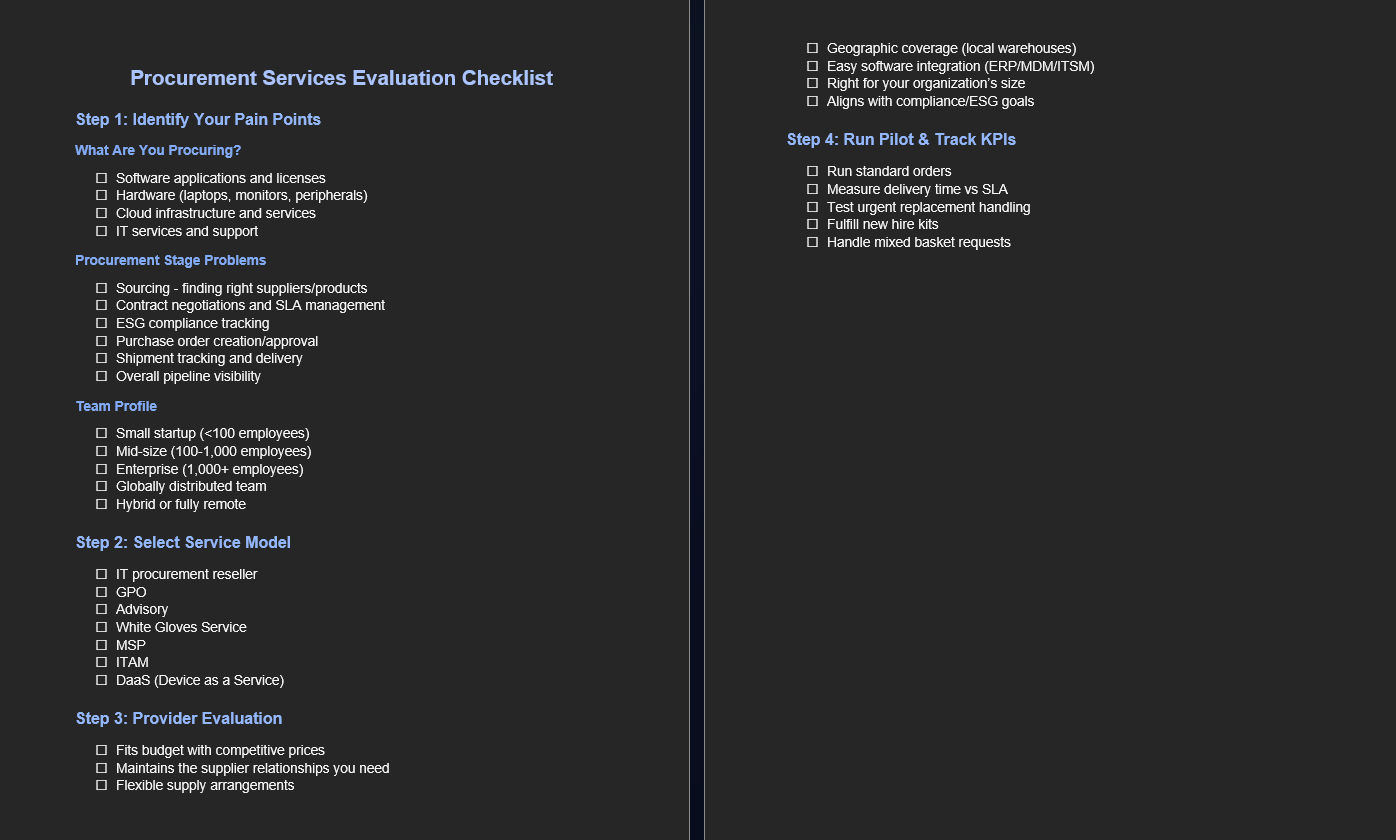
You can download this checklist to get started:
Start with your pain point
Compile all the reasons you need a procurement service. That means evaluating the following:
- What are you procuring? Software, hardware, cloud infrastructure, IT services?
- Which stage of the procurement process do you struggle with? Sourcing, SLAs, ESG compliance tracking, purchasing orders, shipment tracking, visibility?
- Which specific issues are the most frequent across different procurement stages?
- What is your team's make-up? Are you a small brand, a globally distributed team, a hybrid work organization, or a fully remote business?
- Do you struggle with post-purchase issues like a lack of visibility into assets, maintenance problems, and asset management inconsistencies (returns, replacements, disposal)?
- How much are you currently spending vs your budget? To answer this question, check paid manhours, the impact of maverick spend and wrong sourcing, and long-running costs, such as poor hardware quality and unsustainable warranties
Determine the Right Procurement Service Model
Now that you've identified issues you want to fix, it's time to eliminate procurement service models that don't fit. Earlier, I categorized procurement providers according to the level of support they offer.
Here's a checklist that helps:
|
What you need |
Ideal procurement service type |
|
Only quick hardware/software sourcing and delivery |
IT procurement reseller (VAR) and GPOs |
|
Sourcing and contract management advice |
Procurement consultant |
|
Vendor procures, deploys, and configures assets |
White glove services (end-to-end procurement service providers) |
|
IT procurement and hardware asset lifecycle management |
ITAM |
|
IT infrastructure services and procurement |
MSP |
|
Leased devices for temporary projects |
Device as a Service |
Evaluate Specific Procurement Services Against Your Pain Points
Now that you know which service model you want, it's time to assess individual service providers. But there are hundreds of service providers under each category. Many companies even offer services across various categories.
To further shorten your list, select services that:
- Meet your budget (and offer the best prices)
- Maintain suppliers for the devices or software applications you need
- Support flexible supply arrangements (what happens when their supply network can't provide your tools)
- Can handle your geographical coverage (local sourcing and warehouses like Workwize's offering is a plus)
- Use easy-to-use software solutions that integrate with your current system (ERPs, MDM, ITSM, etc.)
- Is ideal for your organization's size (some companies are best for enterprises, while others work well with small to mid-size organizations)
- Aligns with your compliance and ESG goals
Request a Pilot and Track the KPIs
Before you spend thousands of dollars in annual fees, request a practical pilot or test run.
You should be able to run real-world procurement activities, such as, requesting urgent replacements and fulfilling new hire kits, depending on what you need.
Since trying out different services can be time-consuming, it helps to first do a deep dive into the services that best align with your needs and start with the best one.
After that, measure and score the provider based on the pilot process.
How to Evaluate and Choose the Right Procurement Software
Your ideal procurement solution must make your team's current processes more efficient.
Here's a checklist you can download to get started:
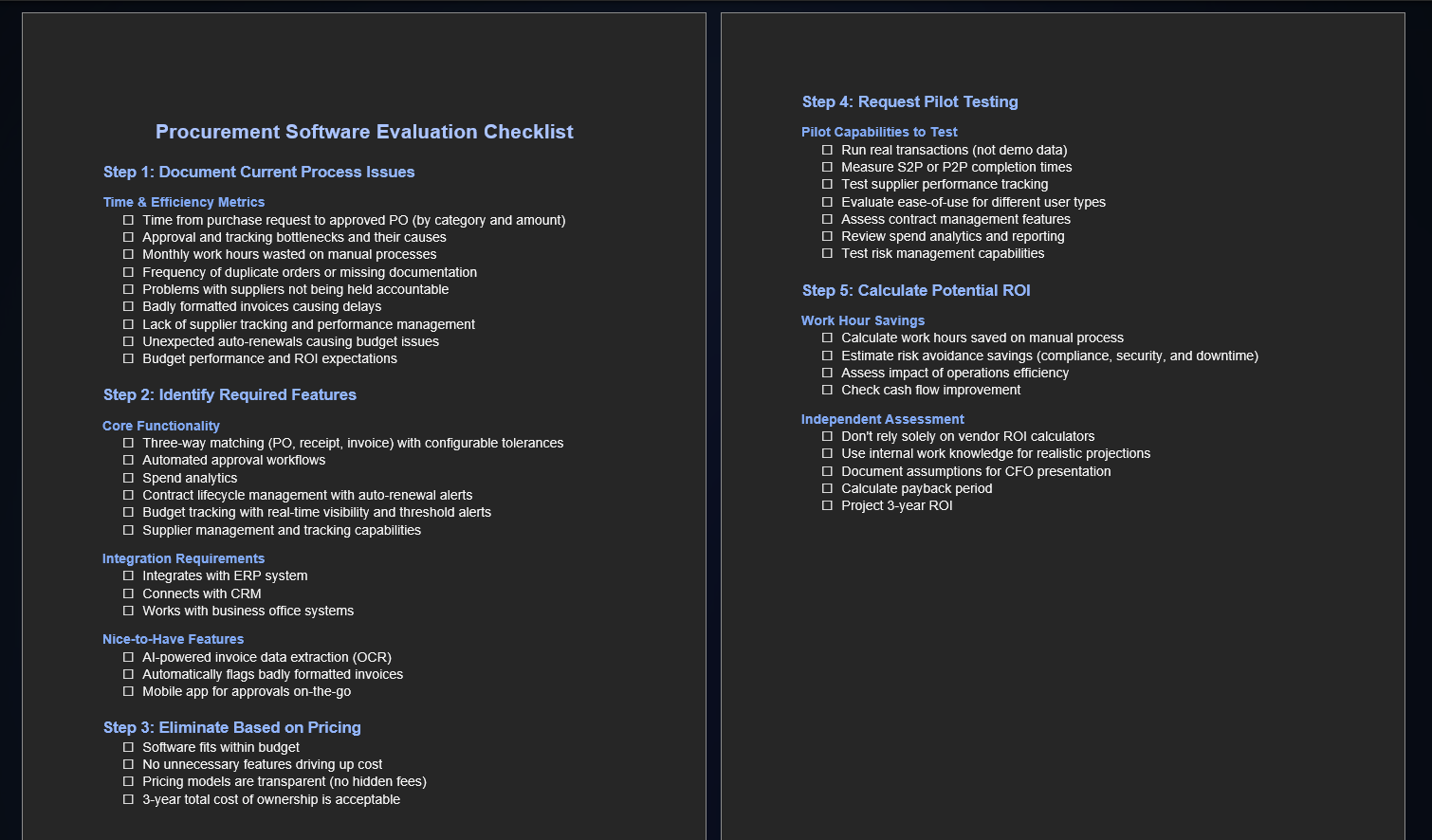
So, start by taking stock of the things you want to smooth out:
- Time from purchase request to approved PO (by category and amount)
- Number of approval bottlenecks and why they happen
- Issues with suppliers and vendors
- Auto-renewals
- Monthly work hours spent on invoice matching, approvals, and other manual processes
- Frequency of duplicate orders or missing documentation
Identify the Specific Features You Need
While most procurement software platforms offer similar S2P, P2P, invoicing, and automation features, you can use the problems you outlined earlier to find niche options that match your business model and solve your specific problems.
For example, if you've struggled to keep your supplier honest, you can use a software program that automatically flags badly formatted invoices and provides supplier tracking/management.
Things to consider include:
- Integration with your ERP, CRM, and business office systems
- Three-way matching (PO, receipt, invoice) with configurable tolerance levels
- Spend analytics by category, supplier, department, and project
- Contract lifecycle management with auto-renewal alerts
- Budget tracking with real-time visibility and threshold alerts
Eliminate Options Based on Pricing
Even if a tool offers everything you need, it may be too expensive because it has other features you won't use.
Eliminate more products from your list that do not fit your budget.
Request a Pilot
The pilot phase should allow you to run real transactions and measure S2P or P2P completion times, supplier performance, ease-of-use, contract management, spend analytics impact, and risk management features.
Calculate the Potential ROI for Using Each Tool
Before adopting a tool, calculate how much it makes you in work hour savings, risk avoidance, and operations efficiency.
While most platforms offer ROI calculators, I recommend independent assessments using internal work knowledge.
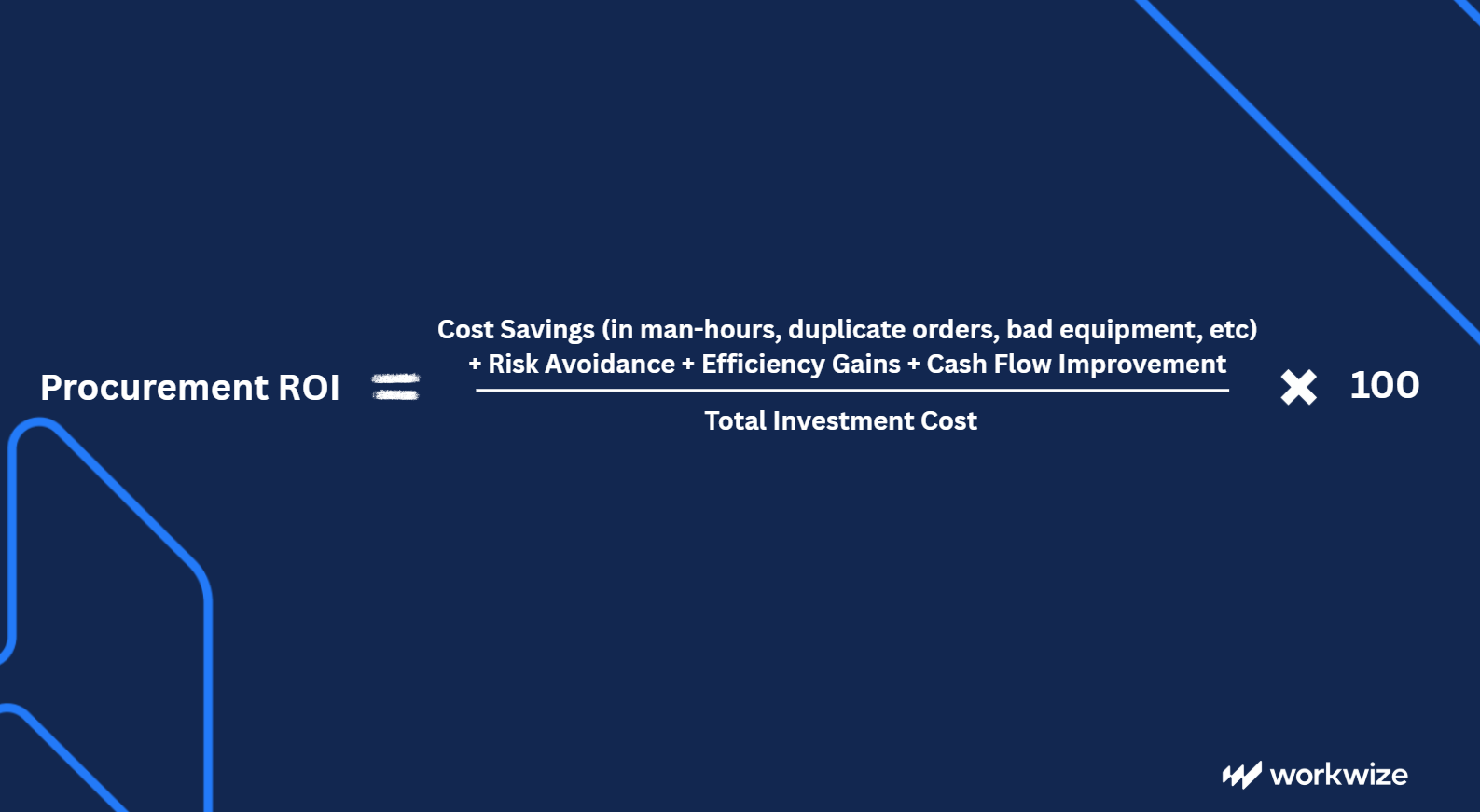
An ROI formula looks like this:
Procurement ROI = Cost Savings (in man-hours, duplicate orders, bad equipment, etc) + Risk Avoidance + Efficiency Gains + Cash Flow Improvement) - Total Investment Cost / Total Investment Cost × 100
Streamline Your IT Asset Procurement with Workwize
IT procurement services and software platforms deliver measurable efficiency and cost savings, but the best solutions ensure the trend continues throughout your assets' lifecycle.
If you focus on your procurement process alone, you may unknowingly create blind spots that hit you with deployment, tracking, retrieval, and disposal challenges after your assets arrive.
These issues can also consume significant internal resources that can erode the savings from your procurement optimizations.
Using Workwize gives you the best of both worlds: fix hardware procurement issues and gain asset visibility and control through comprehensive lifecycle management. Want to see how the magic happens? Request an IT procurement management demo now to transform your operations.

FAQs
How is IT procurement different from other types of procurement?
IT procurement is different from general procurement because it focuses on acquiring specialized technology that requires ongoing support, compatibility checks, security risk assessments, license renewals, and upgrade considerations rather than raw materials and office supplies.
What does an IT procurement do?
An IT procurement process identifies, acquires and manages an organization's hardware, software, cloud services, and IT infrastructure. It also ensures the company meets cost projections, compliance requirements, and security obligations throughout the buying process.
In some cases, procurement includes configuring and managing the lifecycle of acquired technology.
What is the IT system procurement process?
The IT system procurement process is a group of activities for purchasing and deploying a company's technology. It includes researching the company's needs, sourcing vendors, placing purchase orders, evaluating compliance and sustainability goals, and installing or configuring assets.
What are the 4 types of procurement?
The four types of procurement include direct, indirect, goods (or capital), and services procurement. For IT procurement specifically, the types of procurement are hardware, software, services, and cloud solutions.
What is an example of procurement in IT?
A company evaluates different vendor pricing and offerings to purchase 500 laptops for workers across 4 countries. It must run compliance checks, negotiate pricing, and finalize a contract (SLA) that specifies warranty, returns, and delivery terms.
The procurement team also has to handle installing the operating systems on these laptops, configuring work tools, such as MDM software, and the applications workers need to do their jobs.
What’s a typical pricing model for procurement software?
Most procurement software platforms use annual subscription-based pricing, but also offer custom prices for enterprises.
Subscriptions are often tier-based, which involves different features or functionality levels. Typical tiers are Free, Basic, Pro, and Enterprise, with Enterprise offering the most features.
Can procurement software handle both hardware and SaaS purchases?
Yes. Procurement platforms allow teams to document, automate, track, and create alerts for hardware and software (SaaS0 purchases. That means creating invoices, providing updates when hardware arrives, or software licenses are approved, tracking license expiration, and managing suppliers (including hardware and software resellers).
What are the benefits of outsourcing IT procurement?
Benefits include cost savings, smoother procurement operations, insulation from supply chain disruptions, and more focus on business operations, which yields better profit margins.
Use Workiwize's IT procurement solution today to start enjoying these benefits.